Gauss law for semi-infinite sheet of charge

Click For Summary

Homework Help Overview

The discussion revolves around applying Gauss's Law to determine the electric field due to a semi-infinite sheet of charge, contrasting it with the case of an infinite sheet of charge. Participants explore the implications of symmetry and edge effects in these scenarios.

Discussion Character

  • Conceptual clarification, Assumption checking, Mathematical reasoning

Approaches and Questions Raised

  • Participants discuss the application of Gauss's Law and the differences in reasoning between infinite and semi-infinite sheets of charge. Questions arise regarding the integration of electric fields and the nature of edge effects.

Discussion Status

Some participants have suggested breaking the problem into smaller components, such as treating the semi-infinite sheet as a series of infinitesimal strips. Others have raised questions about the convergence of integrals and the effects of symmetry on the electric field.

Contextual Notes

There is mention of edge effects impacting the uniformity of the electric field for the semi-infinite sheet, which is a point of contention in the discussion. Participants are also navigating the complexities of integrating over infinite domains.

fishingspree2
Messages
138
Reaction score
0
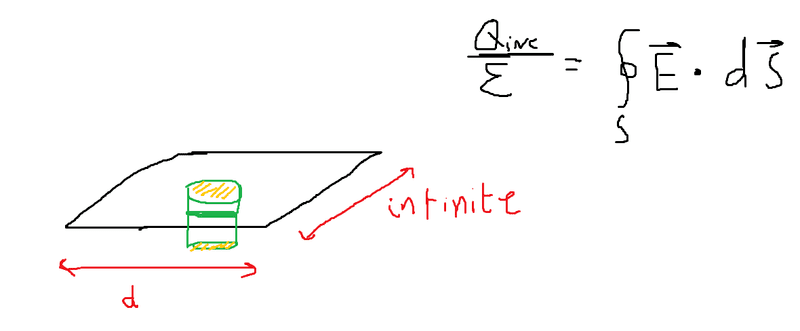
We know that for an infinite sheet of charge, E = λ / 2ε, where λ is the surface charge density. This can be easily found using gauss law and a cylinder perpendicular to the sheet as a gaussian surface. We will end up with something like Qinc/ε = 2E ∫dS, from which we find E = λ / 2ε.

Now say that I want to find the charge for a semi-infinite sheet of charge. A sheet that is infinite in only 1 dimension. If i try to apply Gauss's Law the same way as in the previous case, I end up with exactly the same procedure and answer, which is not correct.

But I fail to see what is different in the application of Gauss Law, between the 1st and the second case.
25sabl4.png
 
Physics news on Phys.org
fishingspree2 said:
But I fail to see what is different in the application of Gauss Law, between the 1st and the second case.
With an infinite sheet of charge, you can argue from symmetry that the field must be normal to the surface, which allows you to take advantage of Gauss's law to calculate the field. Not so with a semi-infinite sheet, since there would be edge effects. No reason to expect the field to be uniform.
 
Doc Al said:
With an infinite sheet of charge, you can argue from symmetry that the field must be normal to the surface, which allows you to take advantage of Gauss's law to calculate the field. Not so with a semi-infinite sheet, since there would be edge effects. No reason to expect the field to be uniform.
Alright, then what would be the way to compute the field at a point P above the centerline?
1zfklxz.png


integrating dE?

also, what are edge effects?
 
fishingspree2 said:
Alright, then what would be the way to compute the field at a point P above the centerline?
integrating dE?
Yes, you'll have to integrate.
also, what are edge effects?
As an example of what I mean by "edge effect", see this diagram of the field between two parallel plates. Note how the field curves at the edges of the plates (left diagram).
http://www.physics.sjsu.edu/becker/physics51/images/23_18Capacitor.JPGHere's a schematic of the field from a charged plate (top diagram). Note how the field points outward at the edges.
https://encrypted-tbn2.gstatic.com/images?q=tbn:ANd9GcTvN7Vjo4FoMiN9xIItgqOl6i7cYSrbPEQ9h5bc5_CztBh-tHdJ
 
Last edited by a moderator:
Here's what I tried:

Find V at the point, then E = -∇V

dV = \frac{dq}{4R\pi\epsilon}, where R is the distance between the charge element and the point, R = sqrt(x2 + y2 + h2)

dq = λ dA = λ dx dy

So,
V=\int_{-\frac{d}{2}}^{\frac{d}{2}}\int_{-\infty}^{\infty}\frac{\lambda dxdy}{4\pi\epsilon\sqrt{x^{2}+y^{2}+h^{2}}}

But this infinite integral does not converge.
 
Break the sheet into infinitely long infinitesimal strips of charge, which can be treated as infinite lines of charge. Add up the field contribution from each strip (set up the integral), taking advantage of symmetry.
 
Considering that the plane is infinite in the x direction, after setting up and some manipulations, I have

dE = [λ dy cos(θ)] / 2πrε in the k direction

where θ is the angle between the z axis and the distance vector between an infinite line and the point, r is the distance.

I know that cos(θ) = h/r, where h is the z coordinate of the point (the point lies on the z axis)
and r = sqrt(h2 + y2)

substituting,

dE = (λ h dy) / 2πr2ε in the k direction
= (λ h dy) / [ 2πε (h2 + y2) ]
which I integrate from -d/2 to d/2= λ/πε atan(d/2h) in the k direction
 
Last edited:

Similar threads

  • · Replies 26 ·
Replies
26
Views
3K
  • · Replies 5 ·
Replies
5
Views
2K
Replies
9
Views
1K
Replies
1
Views
1K
  • · Replies 22 ·
Replies
22
Views
3K
  • · Replies 1 ·
Replies
1
Views
3K
  • · Replies 10 ·
Replies
10
Views
2K
  • · Replies 1 ·
Replies
1
Views
2K
  • · Replies 3 ·
Replies
3
Views
2K