General Question about Vibrations

Click For Summary
SUMMARY

The discussion centers on the discrepancies between resonance frequency and natural frequency in a one degree of freedom (1 DOF) system involving a metal beam with an eccentric mass. The experimenter, Thomas, utilized the half power method and logarithmic decrement to calculate these frequencies. Key insights reveal that the resonance frequency is inherently higher than the natural frequency due to the system's dynamics, particularly influenced by the mass distribution and damping factors. The conversation emphasizes the importance of accurately accounting for all masses, including the motor, in frequency calculations.

PREREQUISITES
  • Understanding of one degree of freedom (1 DOF) systems
  • Familiarity with the half power method for damping ratio calculation
  • Knowledge of logarithmic decrement for free vibration analysis
  • Basic principles of resonance and natural frequency in mechanical systems
NEXT STEPS
  • Research the effects of mass distribution on natural frequency calculations
  • Learn about advanced damping techniques in mechanical systems
  • Explore the relationship between resonant frequency and natural frequency in complex systems
  • Investigate the impact of eccentric masses on vibration characteristics
USEFUL FOR

Mechanical engineers, vibration analysts, and students studying dynamics who are interested in understanding the principles of resonance and natural frequency in mechanical systems.

tomadevil
Messages
11
Reaction score
1
Hello Everyone,

I conducted an experiment with a metal beam which had a motor attached to it in with an eccentric mass on it. The two ends of the beams were fixed with a roller and a hinge(as I remember). This was a one degree of freedom experiment.
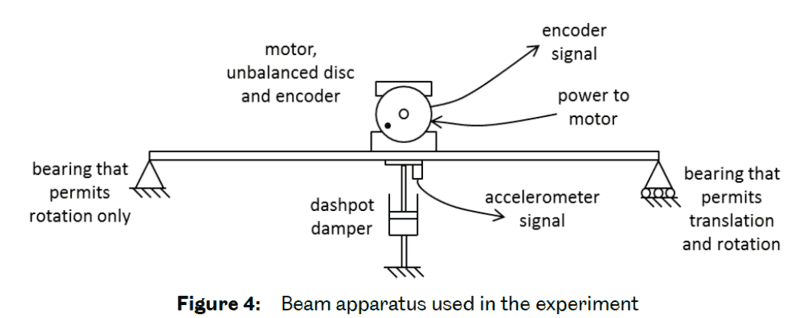
vib.png

I had to collect data during free/forced and damped/undamped vibrations. My data clearly shows that the resonance frequency is higher than the natural frequency but I don't really know why. I believe they should be the same.
I was thinking it might be related to the fact that this is a rotating system. Am I on the right track?
Can someone explain to me what causes this difference?

Thank you for the answer.
Thomas
 

Attachments

  • vib.png
    vib.png
    15.7 KB · Views: 1,529
Engineering news on Phys.org
That sounds like an interesting experiment.

Can you show us how you calculated the natural frequency?
 

Attachments

  • 133vib_tn.jpg
    133vib_tn.jpg
    3.1 KB · Views: 640
  • 733equ2_tn.jpg
    733equ2_tn.jpg
    1.2 KB · Views: 627
  • 619equ_tn.jpg
    619equ_tn.jpg
    961 bytes · Views: 657
What about the mass, shape and position of the motor, brackets and the mass? Did you include those in the natural frequency calculation?
 
anorlunda said:
What about the mass, shape and position of the motor, brackets and the mass? Did you include those in the natural frequency calculation?
No, I didn't. We have to assume that the motor is exactly in the middle of the beam and I think that would be beyond the scope of this exercise.
 
I asked that because the mass of the motor would probably change the natural frequency. Attach a large mass to a tuning fork and the pitch of the sound changes. The natural frequency of the shaft and the natural frequency of the system are not necessarily the same.

Your original question was why experiment does not agree with calculation. So you are seeking something wrong with your calculation.
 
  • Like
Likes   Reactions: waves and change
The test frequency being higher than the calculated would indicate that possibly either the mass of the system is lighter than that used in your calculation or that the actual damping factor is less than your calculated one.
 
If the actual system looks like your sketch above, then the motor is almost certainly the most significant mass in the system.

In truth, this is a system with infinitely many degrees of freedom. To say that it is 1 DOF involves a significant approximation, but it may be useful.

The expression you have relating the resonant frequency to the natural frequency must always give the resonant frequency higher than the natural frequency. You are calculating the resonance frequency by dividing the natural frequency by a number less than 1.0. I think you have some factors mis-arranged.
 

Similar threads

  • · Replies 10 ·
Replies
10
Views
7K
  • · Replies 9 ·
Replies
9
Views
8K
  • · Replies 3 ·
Replies
3
Views
3K
Replies
5
Views
2K
Replies
18
Views
2K
  • · Replies 0 ·
Replies
0
Views
3K
  • · Replies 1 ·
Replies
1
Views
5K
  • · Replies 6 ·
Replies
6
Views
3K
Replies
17
Views
4K
  • · Replies 17 ·
Replies
17
Views
3K