General Solution to a certain form of ODE

Click For Summary

Discussion Overview

The discussion revolves around finding a general solution to a specific form of ordinary differential equations (ODEs), particularly those of the type ##y' + y = ax^n##. Participants explore the derivation of solutions, potential naming conventions, and the classification of the equation.

Discussion Character

  • Exploratory
  • Technical explanation
  • Conceptual clarification

Main Points Raised

  • One participant presents a formula they discovered for solving ODEs of the form ##y' + y = ax^n## and inquires if it has an official name.
  • Another participant suggests using an integrating factor to find the general solution, providing a specific integral expression involving the incomplete gamma function.
  • A participant confirms their derivation aligns with the integrating factor method and reiterates their interest in whether the solution has a name.
  • Another participant clarifies that the equation is a first-order linear ODE and references its general form, noting that there does not seem to be a special name for this specific case.

Areas of Agreement / Disagreement

Participants generally agree on the form of the ODE and the method of solution, but there is no consensus on whether the solution has a specific name. The discussion remains unresolved regarding the naming of the solution.

Contextual Notes

Some limitations include the lack of discussion on the assumptions underlying the use of the integrating factor method and the specific conditions under which the proposed solutions apply.

CSteiner
Messages
31
Reaction score
0
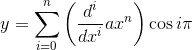
While fiddling around with some very simple linear ODEs, I "discovered" a formula that gives a solution to ODEs of the form: ##y'+y=ax^n ##.

here it is:
7D%5E%7Bn%7D%5Cleft%20%28%20%5Cfrac%7Bd%5Ei%7D%7Bdx%5Ei%7Dax%5En%20%5Cright%20%29%5Ccos%20i%5Cpi.gif


i'm sure that this was discovered before, but i was just wondering if it had any official name or something.
 
Physics news on Phys.org
You can find the general solution to this equation by using an integrating factor...

[itex]y= a e^{-x}\int{ e^x x^n dx}+ Ce^{-x}[/itex]

The integral can be expressed in terms of the incomplete gamma function.
For positive integer [itex]n[/itex] it simplifies to
[itex]\int{ e^x x^n dx}=e^x\left(x^n - n x^{n-1}+n\left(n-1\right)x^{n-2}\dots -1^n n! \right)[/itex]

This will reproduce your solution for the case [itex]C=0[/itex] .
 
yes, that's how I derived it. I was just wondering if it had a name.
 
CSteiner said:
yes, that's how I derived it. I was just wondering if it had a name.

The equation in the OP is a first order linear ordinary differential equation of the general form y' + p(x) y = q(x), with p(x) = 1, q(x) = axn.
http://tutorial.math.lamar.edu/Classes/DE/Linear.aspx

http://mathworld.wolfram.com/First-OrderOrdinaryDifferentialEquation.html

There does not appear to be a special name for that particular form. Perhaps there was way back when.

Some named first and second order ordinary differential equations found here:
http://mathworld.wolfram.com/OrdinaryDifferentialEquation.html
 
Last edited:

Similar threads

  • · Replies 3 ·
Replies
3
Views
2K
  • · Replies 2 ·
Replies
2
Views
3K
  • · Replies 14 ·
Replies
14
Views
3K
  • · Replies 5 ·
Replies
5
Views
2K
  • · Replies 1 ·
Replies
1
Views
2K
  • · Replies 4 ·
Replies
4
Views
6K
  • · Replies 2 ·
Replies
2
Views
5K
  • · Replies 3 ·
Replies
3
Views
2K
  • · Replies 2 ·
Replies
2
Views
2K
  • · Replies 4 ·
Replies
4
Views
3K