Geodesic Eq: Deriving 2nd Term on RHS

Click For Summary
SUMMARY

The discussion focuses on deriving the second term on the right-hand side of the geodesic equation when expressed in terms of the time coordinate parameter \( t \). The participant struggles to derive the term \( \frac{1}{2} \frac{d}{dt} \left[ \ln \gamma_{\alpha\beta} \left( \frac{dx^\alpha}{dt} \frac{dx^\beta}{dt} \right) \right] \). It is advised to avoid working directly with the metric and instead utilize variable substitution to parameterize the curve with \( t \) rather than \( s \). The transformation of the geodesic equation under this change is crucial for obtaining the desired term.

PREREQUISITES
  • Understanding of geodesic equations in differential geometry
  • Familiarity with the Christoffel symbols, specifically \( \Gamma^0_{\alpha\beta} \)
  • Knowledge of parameterization techniques in calculus
  • Basic concepts of tensor calculus and metric tensors
NEXT STEPS
  • Study the derivation of geodesic equations in general relativity
  • Learn about variable substitution techniques in differential equations
  • Explore the role of Christoffel symbols in geodesic motion
  • Investigate the transformation properties of tensors under coordinate changes
USEFUL FOR

Students and researchers in theoretical physics, particularly those focusing on general relativity and differential geometry, will benefit from this discussion.

peterpang1994
Messages
36
Reaction score
0
As the geodesic equation in a form of
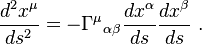
ed2e808ce2b6aa1859eb947f21f23ec0.png

is quite familiar for me. But I still cannot derive it in terms of time coordinate parameter;

a82eae864b04bc27b468fc0becfabe9d.png

I can't get the second term on the right hand side
what I can get is
½{d[lngαβ(dxα/dt)(dxβ/dt)]/dt}dxμ/dt

How can I obtain that term?
 
Physics news on Phys.org
I suggest you do not work in terms of the metric. The equation follows directly from the variable substitution to parameterise the curve with ##t## instead of ##s## and looking at how the geodesic equation transforms under this change. Keep in mind that
$$
\frac{d^2 t}{ds^2} = - \Gamma^0_{\alpha\beta} \dot x^\alpha \dot x^\beta .
$$
 
  • Like
Likes   Reactions: PAllen

Similar threads

  • · Replies 4 ·
Replies
4
Views
2K
  • · Replies 10 ·
Replies
10
Views
3K
  • · Replies 25 ·
Replies
25
Views
3K
  • · Replies 5 ·
Replies
5
Views
2K
  • · Replies 11 ·
Replies
11
Views
2K
  • · Replies 0 ·
Replies
0
Views
1K
  • · Replies 6 ·
Replies
6
Views
2K
  • · Replies 1 ·
Replies
1
Views
1K
  • · Replies 29 ·
Replies
29
Views
9K
  • · Replies 4 ·
Replies
4
Views
1K