member 428835
Hi PF!
I'm given a circle with parametric representation ##x=r\sin\theta,y=h+r\cos\theta##. There is also a line, which has the parametric equation ##x=x,y=\cot (\beta) x##. Note the line makes angle ##\beta## with the y-axis. When the circle intersects the line, it makes an angle, call this angle ##\alpha##. The 2D area of the enclosed y-axis,circular arc, and line, together form an area, call this ##A##. Given ##\beta,\alpha,A##, I want to determine ##h,r,\theta_e## where ##\theta_e## is the ##\theta## value that intersects with the line. See the image below for clarity.
I've come up with three equations to specify the system: can you confirm these are correct? I use subscribts ##c## and ##l## to denote circle and line respectively.
1) area equation
$$
\int_0^{\theta_e} y_c \, dx - \int_0^{x_c(\theta_e)} y_l \, dx = A \implies\\
\int_0^{\theta_e} y_c x_c'(\theta) \, d\theta - \int_0^{x_c(\theta_e)} y_l \, dx = A \implies\\
\boxed{\frac{1}{2} r (\sin (\theta_e ) (2 h+r \csc (\beta ) \sin (\beta -\theta_e))+\theta_e r) = A}.
$$
2) circle intersecting line equation
$$
x_c = x_l,\,\,\,y_c=y_l\implies\\
\boxed{h+r\cos\theta_e = r\sin\theta_e\cot\beta}.
$$
3) dot product of unit-tangent vectors for circle and line intersection must equal ##\cos\alpha##
$$
\left.\frac{\langle x_c'(\theta),y_c'(\theta)\rangle}{|| \langle x_c'(\theta),y_c'(\theta)\rangle||} \cdot \frac{\langle x_l,y_l'(x)\rangle}{|| \langle x_l,y_l'(x)\rangle||}\right|_{\theta=\theta_e} = \cos\alpha\implies\\
\boxed{-\sin(\theta_e-\beta)=\cos\alpha}.
$$
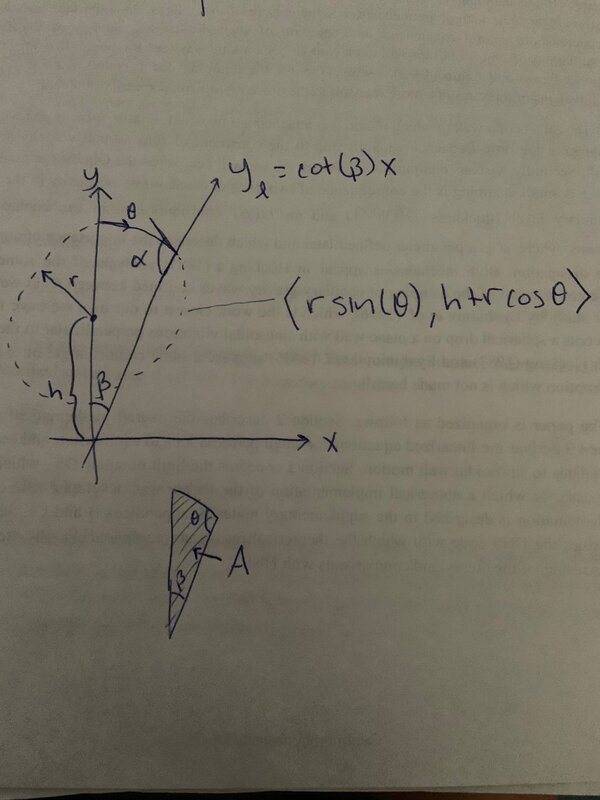
How do these equations look? (OOPS, the bottom figure labels the upper-right angle ##\theta##, but it should read ##\alpha##. My fault!)
I'm given a circle with parametric representation ##x=r\sin\theta,y=h+r\cos\theta##. There is also a line, which has the parametric equation ##x=x,y=\cot (\beta) x##. Note the line makes angle ##\beta## with the y-axis. When the circle intersects the line, it makes an angle, call this angle ##\alpha##. The 2D area of the enclosed y-axis,circular arc, and line, together form an area, call this ##A##. Given ##\beta,\alpha,A##, I want to determine ##h,r,\theta_e## where ##\theta_e## is the ##\theta## value that intersects with the line. See the image below for clarity.
I've come up with three equations to specify the system: can you confirm these are correct? I use subscribts ##c## and ##l## to denote circle and line respectively.
1) area equation
$$
\int_0^{\theta_e} y_c \, dx - \int_0^{x_c(\theta_e)} y_l \, dx = A \implies\\
\int_0^{\theta_e} y_c x_c'(\theta) \, d\theta - \int_0^{x_c(\theta_e)} y_l \, dx = A \implies\\
\boxed{\frac{1}{2} r (\sin (\theta_e ) (2 h+r \csc (\beta ) \sin (\beta -\theta_e))+\theta_e r) = A}.
$$
2) circle intersecting line equation
$$
x_c = x_l,\,\,\,y_c=y_l\implies\\
\boxed{h+r\cos\theta_e = r\sin\theta_e\cot\beta}.
$$
3) dot product of unit-tangent vectors for circle and line intersection must equal ##\cos\alpha##
$$
\left.\frac{\langle x_c'(\theta),y_c'(\theta)\rangle}{|| \langle x_c'(\theta),y_c'(\theta)\rangle||} \cdot \frac{\langle x_l,y_l'(x)\rangle}{|| \langle x_l,y_l'(x)\rangle||}\right|_{\theta=\theta_e} = \cos\alpha\implies\\
\boxed{-\sin(\theta_e-\beta)=\cos\alpha}.
$$
How do these equations look? (OOPS, the bottom figure labels the upper-right angle ##\theta##, but it should read ##\alpha##. My fault!)
Last edited by a moderator: