Geometry & Trigonometry - Two solutions

Click For Summary

Homework Help Overview

The problem involves finding the length of segment AD in a geometric figure and understanding why there are two possible solutions for this length. The context includes the application of the cosine formula in triangles and the implications of the figure's scale.

Discussion Character

  • Exploratory, Assumption checking, Problem interpretation

Approaches and Questions Raised

  • Participants discuss the use of the cosine formula to derive equations for segment AC and explore the resulting polynomial with two roots. There are questions about the angles related to each solution and the accuracy of the figure's scale. Some participants suggest calculating all possible angles in the figure.

Discussion Status

The discussion is ongoing, with participants sharing various attempts and calculations. Some have provided guidance on checking angles and the implications of drawing a circle centered at point C. There is recognition of multiple interpretations regarding the solutions, particularly in relation to the figure's scale and the angles involved.

Contextual Notes

Participants note that the drawing may not be to scale, which complicates the interpretation of the solutions. There is also a discussion about the fixed nature of points A, B, and C in triangle ABC, while allowing angle ADC to vary, which influences the understanding of the two solutions.

Rectifier
Gold Member
Messages
313
Reaction score
4
The problem
a) find the length of AD in the figure
b) Why are there two solutions in a) and what solution fits the figure?
Figure
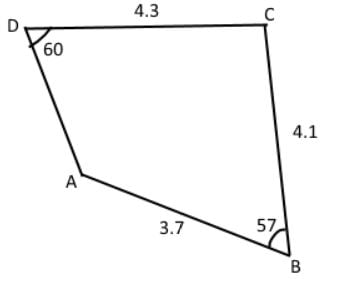
fgp6wFk.jpg


The attempt

I started with drawing a "help line" in the figure.
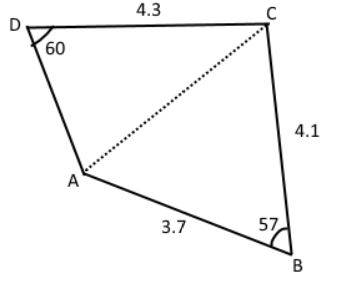
GAeYy1i.jpg


The cosine formula for AC with respect to triangles ADC and CBA gives us two equations:

## AC^2 = 4.1^2 + 3.7^2 - 2 \cdot 3.7 \cdot 4.1 \cdot cos(57) ##
and
## AC^2 = 4.3^2 + x^2 - 2 \cdot 4.3 \cdot x \cdot cos(60) ##

Setting these two equal to each other gives a polynomial of the 2nd degree that has two roots ## x_1=2.47886 ## and ## x_2=1.82114 ##. (These solutions are correct)

I am stuck at b). I have no idea how to continue.
 
Last edited:
Physics news on Phys.org
Rectifier said:
The problem
a) find the length of AD in the figure
b) Why are there two solutions in a) and what solution fits the figure?
Figure
fgp6wFk.jpg


The attempt

I started with drawing a "help line" in the figure.
GAeYy1i.jpg


The cosine formula for AC with respect to triangles ADC and CBA gives us two equations:

## AC^2 = 4.1^2 + 3.7^2 - 2 \cdot 3.7 \cdot 4.1 \cdot cos(57) ##
and
## AC^2 = 4.3^2 + x^2 - 2 \cdot 4.3 \cdot x \cdot cos(60) ##

Setting these two equal to each other gives a polynomial of the 2nd degree that has two roots ## x_1=2.47886 ## and ## x_2=1.82114 ##. (These solutions are correct)

I am stuck at b). I have no idea how to continue.
What are all the angles that result from each solution?

Is the given drawing close to being drawn to scale?
 
  • Like
Likes   Reactions: Rectifier
SammyS said:
What are all the angles that result from each solution?

Is the given drawing close to being drawn to scale?
No, the drawing is not drawn to scale. Should I calculate the all the possible angles in the figure?
 
Rectifier said:
... Should I calculate the all the possible angles in the figure?
That could help, especially for the portion above the "help line".
 
  • Like
Likes   Reactions: Rectifier
Skip to the next comment. It seems like this one is comepletely wrong.

Here comes my failed attempt:

Attempt:
I declare two angles above the "help line"
##∠A_1## and ##∠C_1##

##\frac{sin(60)}{AC}= \frac{sine(A_1)}{4.3} = \frac{sin(C_1)}{x}##

## AC^2=13.9757 \\ AC = 3.73841 ##

I know that ## A_1, C_1 < 120 ## ## \ \ \ \ (180-60)## since ## ∠D = 60##
##∠A_1## is either ##15.4535 \ or \ 164.547##
##∠A_1=164## is outside of the interval
##∠C_1## was harder to get since there are two x:es

##x_1=2.47886 ##
##x_1\frac{sin(60)}{AC}=sin(C_1) \\ C_1a = 6.47961 \\ C_1aa = 173. 52##
## C_1aa## is outside the interval above

##x_2=1.82114##
##x_2\frac{sin(60)}{AC}=sin(C_1) \\ C_1b = 8.83598 \\ C_1bb = 171. 164##
## C_1bb## is outside the interval above

Both of these angels are wrong since both of them ## + 60 \neq 180 ##

Further attempt:
The main angles ##∠A## and ##∠C## are
##∠A + ∠C = 360 - 60 - 57 = 243##
 
Last edited:
It seemes like my calculations were wrong above.

Attempt 2:

##180 = A_1 + C_1 + 60 \\ 120 = A_1 + C_2 \ \ A_1, C_1 < 120##
##A_1 = sin ^{-1} 4.3 \frac{sin(60)}{AC}=84.9519 \\ and \\ A_1 = 180 - 84.9519 = 95.0481##

thus
##A_1 = 84.9519 \ or \ 95.0481##

##C_1 = 120 - A_1 ##

ONE:
##C_1 = 120 - 84.9519 = 35.0481##

TWO:
##C_1 = 120 - 95.0481 = 24.9512 ##
 
Rectifier said:
Here comes my failed attempt:

Attempt:
I declare two angles above the "help line"
##∠A_1## and ##∠C_1##

##\frac{sin(60)}{AC}= \frac{sine(A_1)}{4.3} = \frac{sin(C_1)}{x}##

## AC^2=13.9757 \\ AC = 3.73841 ##

I know that ## A_1, C_1 < 120 ## ## \ \ \ \ (180-60)## since ## ∠D = 60##
##∠A_1## is either ##15.4535 \ or \ 164.547##
##∠A_1=164## is outside of the interval
##∠C_1## was harder to get since there are two x:es
...
Somehow you've made a mistake in finding angle A1.

Did you use AC2 rather than AC by mistake?

You will find two reasonable values for angle A1. Each gives a values for C. Do those agree with the two x values?

You may want to find A2 and C2 (below the help line).

Added in Edit: I just saw your recent post.
 
  • Like
Likes   Reactions: Rectifier
Rectifier said:
Yes indeed that calculation was wrong. I posted another attempt below the failed one.
Just to check yourself. Do those agree with the two x values?
 
  • Like
Likes   Reactions: Rectifier
  • #10
SammyS said:
Just to check yourself. Do those agree with the two x values?

##180 = A_1 + C_1 + 60 \\ 120 = A_1 + C_2 \ \ A_1, C_1 < 120##
##A_1 = sin ^{-1} 4.3 \frac{sin(60)}{AC}=84.9519 \\ and \\ A_1 = 180 - 84.9519 = 95.0481##

thus
##A_1 = 84.9519 \ or \ 95.0481##

##C_1 = 120 - A_1 ##

ONE:
##C_1 = 120 - 84.9519 = 35.0481##

TWO:
##C_1 = 120 - 95.0481 = 24.9512 ##

Yah, I checked both of them and got the x:es that I got before.
 
  • #11
Rectifier said:
Yah, I checked both of them and got the x:es that I got before.
You may want to find A2 and C2 (below the help line). Then find the overall angles, A and C .

So far there doesn't seem to be any reason to eliminate either of the two values for x, at least, not that I can see.
 
  • Like
Likes   Reactions: Rectifier
  • #12
This may be obvious to you, but if you draw a circle centered at C with radius AC, the source of the two solutions and the answer to b) become clear.
 
  • Like
Likes   Reactions: Rectifier
  • #13
insightful said:
This may be obvious to you, but if you draw a circle centered at C with radius AC, the source of the two solutions and the answer to b) become clear.
What do you mean by "the source of two solutions"? I am bad at english :,(
 
Last edited:
  • #14
Rectifier said:
What do you mean by "the source of two solutions"? I am bad at english
I mean it graphically shows the reason why there are two solutions, and why one of them matches the original sketch and the other one doesn't.
 
  • Like
Likes   Reactions: Rectifier
  • #15
Is this drawing correct?
mEjliQr.jpg

Not sure how the corners D and B should be placed on the circle.

I am not sure how to see that there are two solutions now... :,(
 
  • #16
B is not relevant.

Yeah, the drawing is so out of scale, it makes it hard. If it were to scale (I suggest you redraw it), the circle will cross AD much closer to A and then moving A to this new point is the second answer. The first answer has angle DAC as an acute angle and matches the original sketch. The second answer has angle DAC as an obtuse angle and so does not match.
 
  • #17
Rectifier said:
The attempt
I started with drawing a "help line" in the figure.
GAeYy1i.jpg


I am stuck at b). I have no idea how to continue.
we can take the points A, B C to be fixed, as triangle ABC is fully specified.

Consider what happens to the angle ##\angle ADC## if we allow it to vary (rather than fixing it at 60 deg) as angle ##\angle ACD## varies from 0 to 180 degrees, keeping the length of CD fixed at 4.3. CD is longer than AC so at ##\angle ACD=0## D will be on the extension of AC at a point further from C than A. Call that point D0. So ##\angle ADC=0##.

When ##\angle ACD=## 180 degrees D will be on the extension of AC at a point further from A than C. Call that point D180. So ##\angle ADC=0## again.

##\angle ADC=0## will be at a maximum when triangle ADC is isosceles, which is when the projection of D onto AC is at the midpoint of AC. And that maximum will be more than 60 degrees. Call the place where D is in that case Disos.

So the angle must pass through 60 degrees twice, once as D rotates from D0 towards Disos, and once again as D rotates from Disos towards D180. Those two points are the two solutions.

From the diagram, which I haven't checked for scale, it looks like the solution drawn is the first of the two solutions. IN the other solution ##\angle ACD## will be of the order of 140 degrees.
 
  • #18
For better or worse, here are my two solutions, drawn to scale. You can faintly see an arc of the circle through A I referred to above.
 

Attachments

  • Polygons.jpg
    Polygons.jpg
    22.6 KB · Views: 449
  • #19
Well you could: draw a line from D to B and use Pythagorean theorem to find length DB. Then use law of cosines to solve for length DA...( assuming that's a right angle there)
 
  • #20
DeldotB said:
Well you could: draw a line from D to B and use Pythagorean theorem to find length DB. Then use law of cosines to solve for length DA...( assuming that's a right angle there)
Where is there a right triangle here ?
 
  • #21
SammyS said:
Where is there a right triangle here ?
Ahh scratch that. At quick glance I assumed angle DCB was right. Whoops!
 

Similar threads

Replies
12
Views
5K
Replies
24
Views
3K
  • · Replies 5 ·
Replies
5
Views
2K
  • · Replies 25 ·
Replies
25
Views
4K
  • · Replies 3 ·
Replies
3
Views
2K
  • · Replies 4 ·
Replies
4
Views
2K
  • · Replies 3 ·
Replies
3
Views
3K
Replies
2
Views
2K
  • · Replies 3 ·
Replies
3
Views
5K
Replies
3
Views
2K