Graphyne Better Than Graphene?

  • Context: Graduate 
  • Thread starter Thread starter sanman
  • Start date Start date
  • Tags Tags
    graphene
Click For Summary
SUMMARY

Graphyne, a carbon allotrope featuring Carbon-Carbon triple bonds, exhibits distinct mechanical and electronic properties compared to graphene. While it may not possess superior mechanical strength due to its polar character affecting SP2-hybridization, it offers potential advantages in electron mobility and bandgap properties. The synthesis of graphyne is more complex than that of graphene, and its mechanical behavior is directionally dependent, with fracture strain ranging from 48.2 to 107.5 GPa. Research indicates that graphyne could have unique applications in lightweight materials and electronic devices due to its nonlinear stress-strain behavior and the presence of Dirac cones in its band structure.

PREREQUISITES
  • Understanding of carbon allotropes, specifically graphene and graphyne
  • Familiarity with mechanical properties of materials, including stress and strain
  • Knowledge of electronic properties related to band structure and Dirac cones
  • Experience with molecular dynamics simulations, particularly ReaxFF
NEXT STEPS
  • Research the synthesis methods for graphyne, focusing on dehydrobenzoannulene precursors
  • Explore the mechanical properties of graphyne using ReaxFF molecular dynamics simulations
  • Investigate the electronic properties of graphyne, particularly its Dirac cones and bandgap characteristics
  • Examine potential applications of graphyne in lightweight materials and flexible electronics
USEFUL FOR

Materials scientists, nanotechnology researchers, and engineers interested in advanced carbon materials and their applications in electronics and structural components.

sanman
Messages
737
Reaction score
24
Graphyne is a variant of graphene which has Carbon-Carbon triple-bonds:

http://physics.aps.org/articles/v5/24

Image:
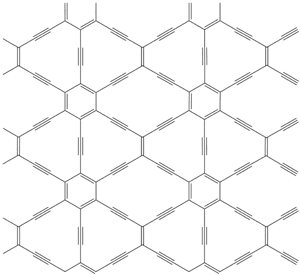
graphyne.png


I'm thinking that it wouldn't have superior mechanical properties, since the presence of the triple bond would give a polar character that weakens the SP2-hybridization. However that same polar character might have useful benefits for electron mobility and bandgap properties.

Opinions?
 
Last edited:
Physics news on Phys.org
Interesting! These probably would be very similar to graphene, but definitely lighter. I'm also betting that since they don't have as symmetrical a shape as graphene, they have some sort of directional dependence on their ability to resist stress/strain, so they might not be as good as graphene for applications like super-strong cables or flexible circuits/processors. They might be tensionally stronger by mass than graphene, but probably similar if not weaker by volume, so perhaps they'd be better for super light cables [space elevator?]. I'm also betting that they're even harder than graphene to synthesize.

I agree that their electron transport and energy band properties would probably be quite different from graphene. They might even have a directional dependence on their electron transport properties and band gap properties, which could have any number of interesting applications.
 
I guess this is how it behaves under strain:

https://www.youtube.com/watch?v=WOhjpb4_goE
 
http://www.sciencedirect.com/science/article/pii/S0008622311003861

Carbon nanotubes and graphene have paved the way for the next step in the evolution of carbon materials. Among the novel forms of carbon allotropes is graphyne – a two-dimensional lattice of sp–sp2-hybridized carbon atoms similar to graphene for which recent progress has been made in synthesizing dehydrobenzoannulene precursors that form subunits of graphyne. Here, we characterize the mechanical properties of single-atomic-layer graphyne sheets by full atomistic first-principles-based ReaxFF molecular dynamics. Atomistic modeling is carried out to determine its mechanical properties for both in-plane and bending deformation including material failure, as well as intersheet adhesion. Unlike graphene, the fracture strain and stress of graphyne depends strongly on the direction of the applied strain and the alignment with carbon triple-bond linkages, ranging from 48.2 to 107.5 GPa with ultimate strains of 8.2–13.2%. The intersheet adhesion and out-of-plane bending stiffnesses are comparable to graphene, despite the density of graphyne being only one-half of that of graphene. Unlike graphene, the sparser carbon arrangement in graphyne combined with the directional dependence on the acetylenic groups results in internal stiffening dependent on the direction of applied loading, leading to a nonlinear stress–strain behavior.

http://prl.aps.org/abstract/PRL/v108/i8/e086804

The existence of Dirac cones in the band structure of two-dimensional materials accompanied by unprecedented electronic properties is considered to be a unique feature of graphene related to its hexagonal symmetry. Here, we present other two-dimensional carbon materials, graphynes, that also possesses Dirac cones according to first-principles electronic structure calculations. One of these materials, 6,6,12-graphyne, does not have hexagonal symmetry and features two self-doped nonequivalent distorted Dirac cones suggesting electronic properties even more amazing than that of graphene.
 
Last edited:
I would like to ask what is the way of making graphyne ?
 
http://pubs.acs.org/doi/abs/10.1021/ol7014253

that's all I could find
 

Similar threads

Replies
1
Views
6K
  • · Replies 4 ·
Replies
4
Views
3K
  • · Replies 1 ·
Replies
1
Views
3K
  • · Replies 10 ·
Replies
10
Views
3K
  • · Replies 15 ·
Replies
15
Views
6K