Zman
- 96
- 0
(Apologies I posted this initially as a conversation. Not familiar with the format)
I used the ‘gravitational time dilation’ equation to see how the clock rate varies with distance from the center of an object. I got the opposite result to what I was expecting.From Wikipedia;
Gravitational time dilation outside a non-rotating sphere
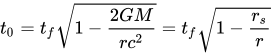 t0 is the proper time between events A and B for a slow-ticking observer within the gravitational field,
tf is the coordinate time between events A and B for a fast-ticking observer at an arbitrarily large distance from the massive object (this assumes the fast-ticking observer is using Schwarzschild coordinates, a coordinate system where a clock at infinite distance from the massive sphere would tick at one second per second of coordinate time, while closer clocks would tick at less than that rate),
r is the radial coordinate of the observer (which is analogous to the classical distance from the center of the object, but is actually a Schwarzschild coordinate),
rs is the Schwarzschild radius.I was interested to find out how the radius r varies with the time ratio t0/ tf for a given mass.
I plugged in t0/ tf = 1/10
This is effectively asking what is r when the fast clock is running 10 times faster than the slow clock.
The answer is r = rs X 100/99Then I asked what is r when the fast clock is running 2 times faster than the slow clock.
I plugged in t0/ tf = ½ expecting a smaller radius
I got the answer r = rs X 4/3 which is a bigger radius than the previous case.Clocks tick more slowly at the center than higher up. The higher up (the greater the radius) the faster a clock ticks relative to the center clock.Looking to clear up my confusion
I used the ‘gravitational time dilation’ equation to see how the clock rate varies with distance from the center of an object. I got the opposite result to what I was expecting.From Wikipedia;
Gravitational time dilation outside a non-rotating sphere
tf is the coordinate time between events A and B for a fast-ticking observer at an arbitrarily large distance from the massive object (this assumes the fast-ticking observer is using Schwarzschild coordinates, a coordinate system where a clock at infinite distance from the massive sphere would tick at one second per second of coordinate time, while closer clocks would tick at less than that rate),
r is the radial coordinate of the observer (which is analogous to the classical distance from the center of the object, but is actually a Schwarzschild coordinate),
rs is the Schwarzschild radius.I was interested to find out how the radius r varies with the time ratio t0/ tf for a given mass.
I plugged in t0/ tf = 1/10
This is effectively asking what is r when the fast clock is running 10 times faster than the slow clock.
The answer is r = rs X 100/99Then I asked what is r when the fast clock is running 2 times faster than the slow clock.
I plugged in t0/ tf = ½ expecting a smaller radius
I got the answer r = rs X 4/3 which is a bigger radius than the previous case.Clocks tick more slowly at the center than higher up. The higher up (the greater the radius) the faster a clock ticks relative to the center clock.Looking to clear up my confusion