Solving a Celestial Mechanics Task with Velocity Vector Scattering

Click For Summary
SUMMARY

The discussion revolves around solving a celestial mechanics task involving velocity vector scattering in the reference frame of the sun. The user initially misapplies the velocity equations, specifically $$\vec{v}_{sf}=-s\vec{v}_p \cos(\theta)$$, leading to incorrect kinetic energy calculations. The correct approach involves expressing the change in kinetic energy relative to the planet, utilizing the relationship between initial and final velocities as outlined in part (b) of the task. Ultimately, the user successfully resolves the task with guidance from another participant.

PREREQUISITES
  • Understanding of celestial mechanics principles
  • Familiarity with kinetic energy equations
  • Knowledge of vector mathematics
  • Experience with reference frames in physics
NEXT STEPS
  • Study the concept of velocity vector transformations in celestial mechanics
  • Learn about kinetic energy calculations in different reference frames
  • Explore the implications of scattering angles on velocity vectors
  • Investigate the relationship between initial and final velocities in orbital mechanics
USEFUL FOR

Students and professionals in physics, particularly those focusing on celestial mechanics, as well as anyone involved in solving complex vector problems in astrophysics.

Lambda96
Messages
233
Reaction score
77
Homework Statement
Find the difference in kinetic energy when the velocities of the object and planet are antiparallel
Relevant Equations
none
Hi,

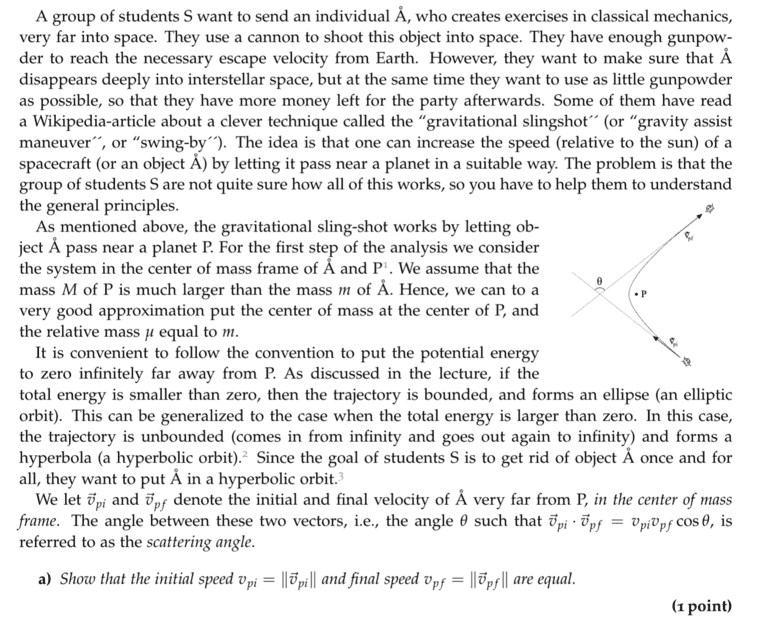
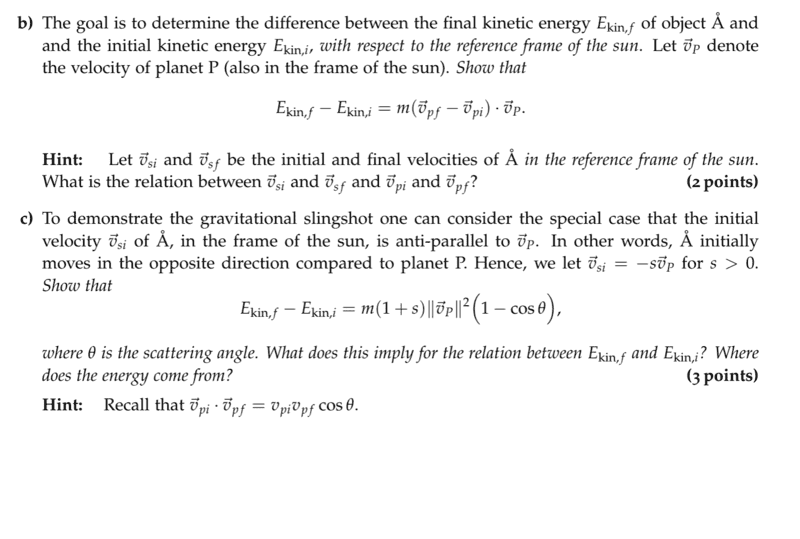
the task is as follows

Bildschirmfoto 2022-11-15 um 20.19.02.png

Bildschirmfoto 2022-11-15 um 20.19.25.png
Unfortunately, I am not getting anywhere at all with task c. I have now proceeded as follows:

I assume that the calculation takes place in the reference system of the sun. In the task the following is valid, $$\vec{v}_{si}=-s\vec{v}_p$$ I have now simply assumed that the planet is scattered the velocity vector by the angle $$\theta$$ so the following is valid for the final velocity

$$\vec{v}_{sf}=-s\vec{v}_p*cos(\theta)$$

After that I simply made the difference in the kinetic energy, i.e.$$E_{kin,f}-E_{kin,i}=\frac{1}{2}m\vec{v}_{sf}^2 - \frac{1}{2}m\vec{v}_{si}^2$$If I now insert $$\vec{v}_{sf}=-s\vec{v}_p*cos(\theta)$$ and $$\vec{v}_{si}=-s\vec{v}_p$$, I immediately see that I do not get the required equation, since I have terms like $$s^2$$ and $$cos(\theta)^2$$. But I also don't understand how to get this equation where $$s$$ and $$cos(\theta)$$ occur, you have to square the velocity for the kinetic energy.
 
Physics news on Phys.org
Lambda96 said:
I assume that the calculation takes place in the reference system of the sun.
Part (b) is setting you up for part (c). Thus, you can express the change in KE of ##\mathrm{\mathring{A}}## relative to the sun in terms of the initial and final velocities of ##\mathrm{\mathring{A}}## relative to the planet P! This makes things easier because the initial and final velocities relative to P have a simple relationship (as shown in part (a)).

Lambda96 said:
In the task the following is valid, $$\vec{v}_{si}=-s\vec{v}_p$$
OK. Can you use this to find an expression for ##\vec{v}_{pi}## in terms of ##s## and ##\vec{v}_P##?

Lambda96 said:
I have now simply assumed that the planet is scattered the velocity vector by the angle $$\theta$$ so the following is valid for the final velocity

$$\vec{v}_{sf}=-s\vec{v}_p*cos(\theta)$$
This equation can't be right. The right-hand side represents a vector quantity that has a direction either parallel or antiparallel to ##\vec{v}_P## (depending on the sign of ##\cos \theta##). But that's certainly not the right direction for ##\vec{v}_{sf}##. However, if you use the expression for the change in KE as given in part (b), you don't need ##\vec{v}_{sf}##. Instead, you need ##\vec{v}_{pf}##. Or, more specifically, you need ##\vec{v}_{pf} \cdot \vec{v}_P##.

Note that ##\mathrm{\mathring{A}}## is scattered by the angle ##\theta## in the frame of reference of the planet, not in the frame of reference of the sun.
 
Last edited:
  • Like
Likes jim mcnamara
Thanks for your help TSny 👍, with your help I was able to solve the task of 🙂
 

Similar threads

Replies
8
Views
2K
  • · Replies 11 ·
Replies
11
Views
3K
  • · Replies 1 ·
Replies
1
Views
2K
Replies
26
Views
4K
  • · Replies 3 ·
Replies
3
Views
2K
  • · Replies 9 ·
Replies
9
Views
2K
Replies
7
Views
3K
  • · Replies 6 ·
Replies
6
Views
2K
  • · Replies 16 ·
Replies
16
Views
4K
  • · Replies 4 ·
Replies
4
Views
3K