Gravity: Compounded Space (Time) Signal?

Click For Summary

Discussion Overview

The discussion revolves around the nature of gravity, particularly in the context of General Relativity and its relationship to mass and spacetime curvature. Participants explore whether gravity can exist without multiple masses, the implications of mass and energy perception, and the conceptualization of gravity as a compound signal of space curvatures.

Discussion Character

  • Exploratory
  • Debate/contested
  • Conceptual clarification

Main Points Raised

  • One participant questions if gravity can exist without multiple masses, suggesting it may be an effect from interacting disturbances.
  • Another participant asserts that General Relativity allows for solutions with a single gravitating mass, challenging the initial premise.
  • Concerns are raised about the validity of visual diagrams in representing relativity, emphasizing the importance of time and coordinate choices.
  • A participant proposes a relationship between the tension of a "space plain" and the gravitational constant (G), which is met with skepticism regarding its relevance in relativity.
  • There is a discussion about the perception of mass and energy, questioning if mass only exists at zero distance and if interactions occur at midpoints between masses.
  • One participant suggests that the conceptual question may be better framed within Newtonian gravitational potential rather than General Relativity.
  • A reference to a famous quote by Wheeler is made, indicating a relationship between matter and spacetime curvature, although its equivalence to the initial ideas is questioned.

Areas of Agreement / Disagreement

Participants express differing views on the nature of gravity, the validity of visual representations, and the relationship between mass and energy. No consensus is reached on the conceptual frameworks being discussed.

Contextual Notes

Some participants note limitations in the initial claims, particularly regarding the definitions of mass and energy, and the appropriateness of using visual diagrams in the context of General Relativity.

CuriousGiles
Messages
2
Reaction score
0
TL;DR
If the curvature of space (time) in the presence of mass induces attraction between masses then can gravity be described as a compound signal of multiple space curvatures?
Disclaimer - I am not an expert by any means so this might be as much about confirming my understanding as an inquiry from the general public... as such, it might be fairly conversational as I attempt to clearly communicate my thoughts and understanding. Please excuse this.

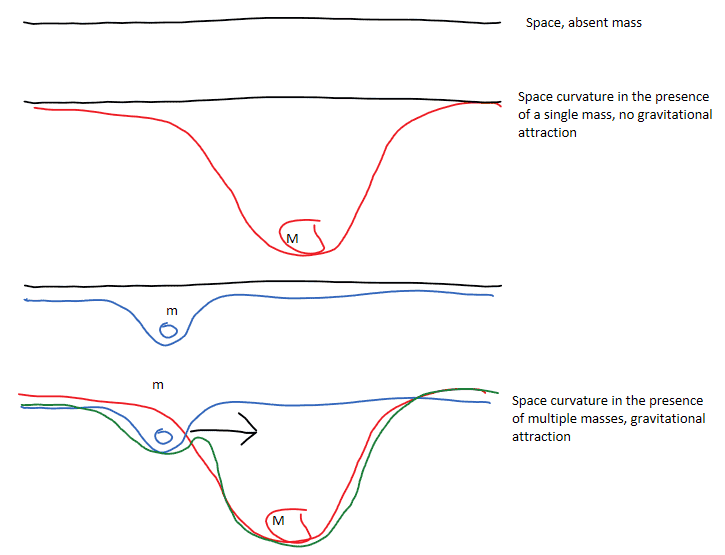
If gravity is the attraction between masses (Fg = G⋅M1⋅M2/r) then is it true that with an absence of multiple masses gravity cannot exist? This is a curious consideration for me as it implies gravity is an effect arising from interacting disturbances like a convolution. Visually:
1609029334881.png

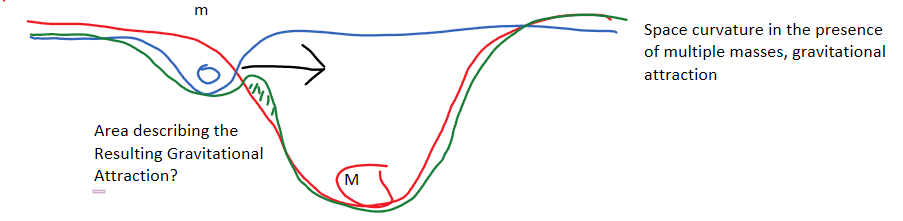
Observing the green space plain in the fourth image, there is a minimum point under m producing a slight increase in the space curve slope on the right side of m prior to rejoining the red space curvature caused by M. Is this the theoretical development of the gravitational attraction?
1609029673592.png

If the above is accurate, then is there an relationship between the tension of the space plain and the gravitational constant (G)? I intend to read up on the Einstein Tensor to explore this further but if anyone has a good reference to share that is appreciated.
 
Physics news on Phys.org
'
CuriousGiles said:
If gravity is the attraction between masses

You are in the relativity forum, so no, it isn't. Gravity is not a force in relativity. It is spacetime curvature.

CuriousGiles said:
is it true that with an absence of multiple masses gravity cannot exist?

No. There are perfectly good solutions in General Relativity that contain only one gravitating mass.

CuriousGiles said:
Visually

Diagrams like these are a very bad way to try to reason about what relativity says. First, they only show space, not time, and second, they depend on a particular choice of coordinates, but coordinates in relativity have no physical meaning.

CuriousGiles said:
the tension of the space plain

This concept appears nowhere in relativity. There are speculations along these lines in some work on quantum gravity, but discussion of those belongs in the Beyond the Standard Model forum, not this one.
 
@PeterDonis, was not expecting such a prompt response - thank you.
Before I move to the Beyond the Standard Model forum, while E=M⋅c^2 and given that in the human capacity to observe at a distance >0 only through sense (sight, hearing) detecting energy. Is it fair to conclude that mass, as perceived by me, only exists when at 0 distance and that the rest of the perceived universe is represented only in the synonymic energy state?

If this is the case, now thinking about a mass at a distance to any other mass, is there only an interaction between those bodies energies at any midpoint between them?
 
CuriousGiles said:
while E=M⋅c^2 and given that in the human capacity to observe at a distance >0 only through sense (sight, hearing) detecting energy. Is it fair to conclude that mass, as perceived by me, only exists when at 0 distance and that the rest of the perceived universe is represented only in the synonymic energy state?

If this is the case, now thinking about a mass at a distance to any other mass, is there only an interaction between those bodies energies at any midpoint between them?

I don't know what any of this means. It doesn't sound like any physics I am aware of.

You might want to review the PF rules on personal speculations.
 
  • Like
Likes   Reactions: CuriousGiles
CuriousGiles said:
Summary:: If the curvature of space (time) in the presence of mass induces attraction between masses then can gravity be described as a compound signal of multiple space curvatures?

Disclaimer - I am not an expert by any means so this might be as much about confirming my understanding as an inquiry from the general public... as such, it might be fairly conversational as I attempt to clearly communicate my thoughts and understanding. Please excuse this.

If gravity is the attraction between masses (Fg = G⋅M1⋅M2/r) then is it true that with an absence of multiple masses gravity cannot exist? This is a curious consideration for me as it implies gravity is an effect arising from interacting disturbances like a convolution. Visually:
View attachment 275199
Observing the green space plain in the fourth image, there is a minimum point under m producing a slight increase in the space curve slope on the right side of m prior to rejoining the red space curvature caused by M. Is this the theoretical development of the gravitational attraction?
View attachment 275200
If the above is accurate, then is there an relationship between the tension of the space plain and the gravitational constant (G)? I intend to read up on the Einstein Tensor to explore this further but if anyone has a good reference to share that is appreciated.

I think the conceptual question you have in mind here has nothing to do with General Relativity. You can pose it in terms of the Newtonian gravitational potential, where your pictures are much more relevant to the attraction:

https://en.wikipedia.org/wiki/Gravitational_potential

The question is: Why do two bodies come together, if each is in its own self-generated potential minimum?

The answer is. With a second massive body present, the individual potential wells are not perfectly centered symmetrically around each body, but are distorted with a bias towards the other body. This accelerates each body towards the other one.
 
Last edited:
  • Like
Likes   Reactions: CuriousGiles
CuriousGiles said:
Summary:: If the curvature of space (time) in the presence of mass induces attraction between masses then can gravity be described as a compound signal of multiple space curvatures?

A better model is given by Wheeler. The remark is quite famous:

wheeler said:
“Spacetime tells matter how to move; matter tells spacetime how to curve.”

I'm not quite sure if your idea is equivalent, though I suspect it is not. One can detect the curvature of space-time by the behavior of test masses and/or clocks.
 
  • Like
Likes   Reactions: CuriousGiles

Similar threads

  • · Replies 2 ·
Replies
2
Views
1K
  • · Replies 26 ·
Replies
26
Views
3K
  • · Replies 20 ·
Replies
20
Views
2K
  • · Replies 4 ·
Replies
4
Views
2K
  • · Replies 35 ·
2
Replies
35
Views
5K
  • · Replies 6 ·
Replies
6
Views
2K
  • · Replies 20 ·
Replies
20
Views
1K
  • · Replies 9 ·
Replies
9
Views
3K
  • · Replies 7 ·
Replies
7
Views
2K
  • · Replies 2 ·
Replies
2
Views
2K