Griffiths Quantum Mechanics 2nd edition Chapter 8 equation is confusing

2 replies · 3K views · last reply
edfink1
Messages
3
Reaction score
5
Homework Statement
Griffiths Quantum Mechanics 2nd edition
Relevant Equations
Griffiths second edition equations 8.24 and 8.25
In Griffiths Quantum Mechanics 2nd edition, in Chapter 8 he calculates the following integral on page 323

Equation: gamma = (1/hbar) times the integral from r1 to r2 of the square root of 2m(1/(4 pi epsilon0) times 2Ze^2/r - E) dr, equals (square root of 2mE/hbar) times the integral from r1 to r2 of the square root of (r2/r - 1) dr.

and he gets
Equation gamma = (sqrt(2mE)/hbar) [ r2 (pi/2 - arcsin(sqrt(r1/r2))) - sqrt(r1(r2 - r1)) ], with sin^-1 written as the inverse sine.

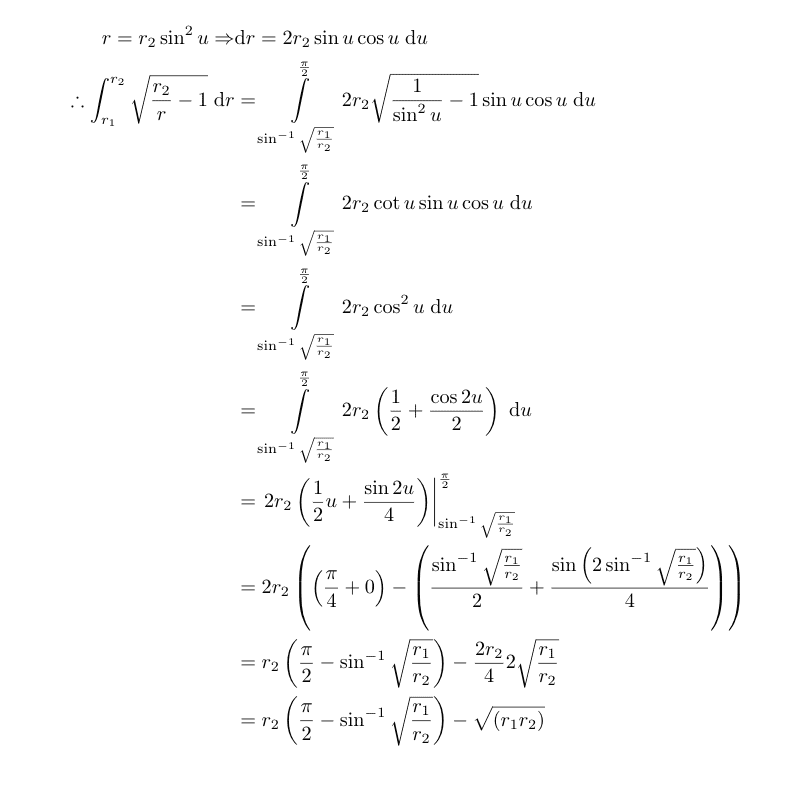
I disagree with this result, I think the integral should be
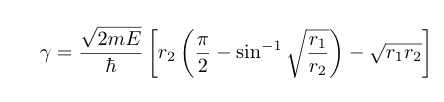
Equation gamma = (sqrt(2mE)/hbar) [r2 (pi/2 - arcsin(sqrt(r1/r2))) - sqrt(r1 r2)]

since

Handwritten-style LaTeX derivation of the integral of sqrt(r2/r - 1) dr from r1 to r2, substituting r = r2 sin^2 u, ending with r2(pi/2 - sin^-1 sqrt(r1/r2)) - sqrt(r1 r2).

Maybe somebody can explain why I am wrong? Also, from equation 8.24 to 8.25, he makes the assumption that sinϵ ≅ ϵ, but how does that imply sin^(-1)ϵ ≅ ϵ, which seems to be what he assumes to get from 8.24 to 8.25. Any insight is greatly appreciated!
 
Attachments
  • Equation phi(x) = (1/hbar) times the integral from 0 to x of p(x') dx', with the integration variable x' inside.
    Screen Shot 2020-10-10 at 3.19.14 PM.png
    6.1 KB · Views: 233
  • Equation gamma = (sqrt(2mE)/hbar) times [r2 (pi/2 - arcsin(sqrt(r1/r2))) - sqrt(r1 r2)].
    Screen Shot 2020-10-10 at 7.55.18 PM.png
    2.7 KB · Views: 238
  • Like
Likes   Reactions: Delta2
edfink1 said:
I disagree with this result, I think the integral should be
View attachment 270765
Note that the integral must go to zero as ##r_2## approaches ##r_1##. But your result doesn't satisfy this condition.

Check the following:
Two-line handwritten-style derivation: first line 2r2((pi/4 + 0) - (sin^-1 sqrt(r1/r2)/2 + sin(2 sin^-1 sqrt(r1/r2))/4)), second line r2(pi/2 - sin^-1 sqrt(r1/r2)) - 2r2/4 times 2 sqrt(r1/r2); an orange box highlights the sin(2 sin^-1 sqrt(r1/r2)) term with an orange question mark arrow pointing to the second line's term.
Also, from equation 8.24 to 8.25, he makes the assumption that sinϵ ≅ ϵ, but how does that imply sin^(-1)ϵ ≅ ϵ, which seems to be what he assumes to get from 8.24 to 8.25. Any insight is greatly appreciated!
Take the inverse sine of both sides of sinϵ ≅ ϵ. Or, do a Taylor series of ##\sin^{-1} x## about ##x=0## .
 
  • Like
Likes   Reactions: Delta2
Thank you, I get it now!
 
  • Like
Likes   Reactions: berkeman, Delta2 and TSny