Gyroscopic precession of a bicycle wheel

Click For Summary
SUMMARY

The discussion centers on the phenomenon of gyroscopic precession in a bicycle wheel. When a spinning wheel is subjected to an external torque, it experiences precession, causing it to rotate around the attachment point of a rope rather than simply swinging down due to gravity. This occurs because the applied force acts 90 degrees from its direction, affecting the angular momentum vector. The conversation clarifies that precession can occur even when the wheel is upright, as the torque is applied instantaneously, leading to the rotation of the spin axis.

PREREQUISITES
  • Understanding of gyroscopic motion
  • Familiarity with torque and angular momentum concepts
  • Basic knowledge of rotational dynamics
  • Experience with physics principles related to forces and motion
NEXT STEPS
  • Study the principles of angular momentum in detail
  • Explore the mathematical formulation of torque and its effects on rotating bodies
  • Investigate real-world applications of gyroscopic precession in engineering
  • Learn about the dynamics of rigid body motion and stability
USEFUL FOR

Physics students, mechanical engineers, and anyone interested in understanding the principles of rotational dynamics and gyroscopic effects.

Cibek
Messages
13
Reaction score
0
Hello!

I have recently been looking into the phenomenon of gyroscopic precession in my free time, and there is a scenario which I am not sure I have fully understood. Here it is:

Imagine a bicycle wheel with a shaft running through it's center. The shaft is attached to a rope at one of it's sides, and is held upright before it is spun up. If the wheel was not spinning, the force of gravity would simply cause the wheel to start swinging around the attachment point of the rope. However, when the wheel is spinning gyroscopic precession will cause the wheel to stay upright and instead start rotating around the rope, in the horizontal direction. This is supposedly because a force applied to a spinning object acts 90 degrees from the direction it was applied, which in this case causes the wheel to start rotating around the rope.

My questions are:
Is the precession occurring because the wheel is starting to change alignment when it starts swinging, and therefore the gravitational force is applied at an angle? In that case, am I right in assuming that the rotation would not start while the wheel is completely verticly upright? Or can a completely upright wheel still precess and rotate?
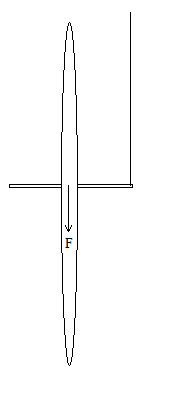
rOBQG1f.png
mRhxyzl.png
 
Physics news on Phys.org
Cibek said:
Is the precession occurring because the wheel is starting to change alignment when it starts swinging, and therefore the gravitational force is applied at an angle?
No, the precession occurs because, and at the same instant that, the torque is applied. There does not have to be (and in the idealised case there is not) any rotation in the direction you indicate.
Cibek said:
Or can a completely upright wheel still precess and rotate?
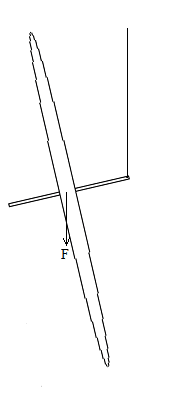
Yes.
 
Cibek said:
This is supposedly because a force applied to a spinning object acts 90 degrees from the direction it was applied,
The effect of an external torque on the spin axis is: Rotation of the spin axis around an axis that is perpendicular to both: the current spin axis and the external torque.

320px-Gyroscope_wheel-text.png


Cibek said:
Is the precession occurring because the wheel is starting to change alignment when it starts swinging, and therefore the gravitational force is applied at an angle?
No, its occurring because an external torque is applied, which changes the angular momentum vector:
http://hyperphysics.phy-astr.gsu.edu/hbase/rotv2.html
 
Last edited:
Thanks a lot for the answers, they made it a lot clearer.
 
There's a simple way to get a handle on why precession occurs.

Take a wagon wheel because it has rigid spokes, and cut the wheel between each spoke so that it's free from it's neighbors. You can focus attention at the sections that are above, below, and horizontally displaced from the hub at time zero.

If you refer to your drawing, as a section of rim passes over the top, it's being pushed, or accelerated to the left. This means that as the wheel section reaches a position horizontal with the hub it will tend to be displaced to the left. The section of wheel at the bottom is pushed to the right.

The forces on the horizontally displaced sections, for the most part, only twist the section about the axis of the spoke.

All this adds up to overall precession.
 

Similar threads

  • · Replies 10 ·
Replies
10
Views
903
  • · Replies 6 ·
Replies
6
Views
2K
  • · Replies 39 ·
2
Replies
39
Views
3K
  • · Replies 49 ·
2
Replies
49
Views
4K
  • · Replies 10 ·
Replies
10
Views
4K
  • · Replies 19 ·
Replies
19
Views
2K
  • · Replies 0 ·
Replies
0
Views
1K
  • · Replies 3 ·
Replies
3
Views
2K
  • · Replies 1 ·
Replies
1
Views
1K
  • · Replies 10 ·
Replies
10
Views
3K