Having trouble calculating Radial and Tangential aspects of a cars acceleration

Click For Summary

Homework Help Overview

The discussion revolves around calculating the radial and tangential components of a car's acceleration, as well as determining the radius of curvature based on these components. The original poster expresses difficulty with specific parts of the problem, particularly in understanding how to approach the calculations.

Discussion Character

  • Exploratory, Conceptual clarification, Mathematical reasoning

Approaches and Questions Raised

  • Participants suggest using vector projections to separate the tangential and normal components of acceleration. There are mentions of using scalar products and trigonometric methods to find components of acceleration relative to velocity. The original poster questions how to proceed with these methods, indicating ongoing uncertainty.

Discussion Status

Some participants have offered guidance on potential methods for calculating the components of acceleration, but the original poster continues to express confusion about the application of these methods. Multiple approaches are being discussed, indicating a collaborative exploration of the problem.

Contextual Notes

The original poster has provided an image of the question, which may contain additional details that are not explicitly stated in the text. There is also a mention of a sketch that is not being considered for the current discussion.

nukeman
Messages
651
Reaction score
0
Having trouble calculating Radial and Tangential aspects of a cars acceleration...!

Homework Statement


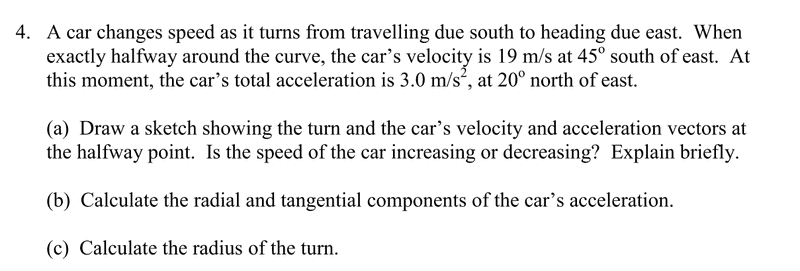
Here, I will just post the question as an image. Never mind the one where I have to sketch, but b and c I am having trouble with.
wilrfd.png


How do you calculate the radial and tangential aspects of the cars acceleration? and from that info, how do I calculate the radius?


Homework Equations

 
Physics news on Phys.org


You have the tangential direction since you are given the velocity. Figure out the vector projection of the acceleration along the tangential direction and subtract that from the acceleration to get the normal component. From that you should be able to calculate the curvature and radius of curvature with standard formulas.
 
I'm still having trouble with b

??


LCKurtz said:
You have the tangential direction since you are given the velocity. Figure out the vector projection of the acceleration along the tangential direction and subtract that from the acceleration to get the normal component. From that you should be able to calculate the curvature and radius of curvature with standard formulas.


Method 1:
Write the car's acceleration and its velocity in component form.
Then find the scalar (dot) product [itex]\vec{a}\cdot\vec{v}[/itex] from the components.
Remember that this scalar product gives you the component of a that's in the direction of v times the magnitude of v.
Can you take it from here?​


Method 2:
From the given information, find the angle between the direction of the acceleration and the direction of the velocity.
Use basic trig. to find the component of a parallel to v and the component of a perpendicular to v.​
 

Similar threads

  • · Replies 6 ·
Replies
6
Views
1K
Replies
7
Views
4K
  • · Replies 1 ·
Replies
1
Views
2K
  • · Replies 11 ·
Replies
11
Views
2K
Replies
2
Views
2K
  • · Replies 24 ·
Replies
24
Views
8K
  • · Replies 2 ·
Replies
2
Views
1K
  • · Replies 9 ·
Replies
9
Views
8K
Replies
1
Views
2K
  • · Replies 1 ·
Replies
1
Views
3K