Heat transfer/cooling problem (multilayers)

  • Thread starter Thread starter spudsquad
  • Start date Start date
  • Tags Tags
    Heat
Click For Summary

Discussion Overview

The discussion revolves around a heat transfer problem involving multilayer materials, specifically focusing on the cooling of a sample material transitioning from a high temperature of 450°F to a lower temperature of 300°F in a tank at 65°F. The participants explore methods for solving the problem, including Newton's law of cooling and the complexities introduced by phase changes in materials.

Discussion Character

  • Exploratory
  • Technical explanation
  • Debate/contested
  • Mathematical reasoning

Main Points Raised

  • One participant describes the problem of cooling a fiberglass sample and expresses uncertainty about the adequacy of the information provided to solve it.
  • Another participant suggests using Newton's law of cooling, noting that it requires solving a differential equation, and recommends consulting additional resources on differential equations.
  • A participant with knowledge of differential equations points out the complexity of the problem due to the interaction between the acrylic and PVC materials, which affects temperature changes.
  • One participant mentions that the PVC may be molten at 450°F and solidified at 300°F, indicating that the problem could be more complicated than initially thought.
  • Another participant speculates that the PVC is likely solid or nearly solid due to the presence of a void, but acknowledges that phase changes complicate the analysis.
  • One participant references melting points of acrylic and PVC, suggesting potential inconsistencies in the problem setup.
  • A final participant expresses frustration with the problem's complexity and suggests that it may have been an unrealistic expectation for a sophomore student.

Areas of Agreement / Disagreement

Participants express differing views on the feasibility of solving the problem as presented, with some suggesting that it is overly complex for the given context. There is no consensus on a clear method to approach the problem due to the various factors involved.

Contextual Notes

Participants note limitations related to the assumptions about material properties, the need for boundary conditions, and the potential for phase changes, which remain unresolved in the discussion.

spudsquad
Messages
3
Reaction score
0
i am a sophomore and just started my first co-op and the boss left me with this problem to solve that seems to be slightly beyond my knowledge so far. The whole problem is too long but here is the part i am stuck on.

I have a sample material that is being made and fed out of a machine, so it is infinitely long. The sample looks like this:
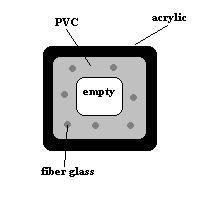
sample.jpg


it comes out at a temperature of 450F, and into a tank that is 65 degrees F.
What i need to find is how long before the fiberglass is 300F.

I have looked up specific heats, thermal conductivities, and all the dimensions.

I am having trouble even just finding the when the PVC will be 300F, i have read for hours online for ways to do this and can't seem to find a similar problem. This is my first post on the forum and would really appreciate any tips on the method to solve this, or if i even have enough information.
thanks.

attempts:
- i tried Newtons law of cooling and the conduction equation. the main problem i keep having is that all the formulas are dependent on difference in temperature and the temperature for both the acrylic and pvc are constantly changing.
 
Engineering news on Phys.org
Newtons law cooling should be the way to go, but it is a differential equation, and needs to be solved accordingly.

Have you had a course in differential equations?

If not, then you should approach your boss or one of the engineers, and ask about borrowing a intro Differential equation text, such as Boyce and DiPrima. They may be willing to get you started.


A common example problem is that of controlling temperature in a house with multilayed insulation. This should be of interest to you.
 
thanks for the reply.
i had a differential equations class and know how to solve a simple two body Newton cooling problem. But the problem that i have run into is that the cooling between air and the acrylic depend on difference in temperature, but the temperature of the acrylic is losing energy to the air but in turn will then gain energy from the pvc which is still at a higher temperature. Also i do not have another time and temperature to solve for k.
 
That is why I referred you to an example of a wall with multilayers of insulation, you need to set up a statement of the heat equation in each region with approbriate boundary condtions at the layer interfaces. Use Newtons Law of cooling as the heat loss boundary condition with the water.
 
A quick search on Google suggests the PVC would be molten at 450F and solidified at 300F.

If that's true, your problem is WAY more complicated than solving the diffusion equation for heat conduction in a solid. I think the only practical way to go would be use a computer model.
 
Since apparently there is a void in the center I think it is safe to assume that the PVC is solid or very nearly, or it would not hold the shape. Naturally any phase changes will complicate things a lot.
 
Integral said:
Since apparently there is a void in the center I think it is safe to assume that the PVC is solid or very nearly, or it would not hold the shape. Naturally any phase changes will complicate things a lot.

http://www.matweb.com/reference/deflection-temperature.asp says the MP of acrylic is 130C (266F)

http://www.dynalabcorp.com/technical_info_pvc.asp the MP of PVC is 80C (176F).

Something must be wrong somewhere.
 
Last edited by a moderator:
i've dropped the problem, but i appreciate the advice.
Clearly he didn't think the problem through before he gave me the numbers, or severely over estimated the abilities of a second year student.
 

Similar threads

  • · Replies 5 ·
Replies
5
Views
2K
  • · Replies 13 ·
Replies
13
Views
2K
Replies
7
Views
3K
  • · Replies 10 ·
Replies
10
Views
3K
Replies
10
Views
3K
  • · Replies 2 ·
Replies
2
Views
3K
Replies
18
Views
3K
  • · Replies 34 ·
2
Replies
34
Views
6K
  • · Replies 3 ·
Replies
3
Views
3K
Replies
15
Views
3K