Heat Transfer -- Newton's law of cooling

Click For Summary

Discussion Overview

The discussion revolves around the application of Newton's law of cooling to a heat transfer problem involving a body at a higher temperature and two bodies at a lower, constant temperature. Participants explore the setup, assumptions, and calculations related to temperature distribution over time.

Discussion Character

  • Technical explanation
  • Debate/contested
  • Mathematical reasoning

Main Points Raised

  • One participant, Mikael, presents a scenario involving a body A at 115°C and bodies B and C at 15°C, questioning the accuracy of their temperature function over time.
  • Another participant asks for clarification on whether the model assumes uniform temperature distribution and questions the validity of neglecting heat conduction within bodies B and C.
  • Some participants propose that if bodies B and C maintain constant temperatures, they can be treated as boundary conditions for body A's temperature distribution.
  • There is a discussion about the heat conduction occurring in the system and whether it should be included in the calculations.
  • One participant mentions the transient heat conduction equation, suggesting it may be relevant to the problem if heat conduction is considered.
  • Participants express uncertainty regarding the assumptions made about the boundaries and the nature of temperature changes in the system.

Areas of Agreement / Disagreement

Participants do not reach a consensus on the assumptions regarding heat conduction and boundary conditions. There are multiple viewpoints on how to model the system, and the discussion remains unresolved.

Contextual Notes

Participants highlight potential issues with unit consistency and the need for clarity on the assumptions regarding temperature distribution and heat transfer mechanisms.

Fritiofmikael
Messages
4
Reaction score
0
Hi,

I have been trying to set up a funtcion of the temperature over time and I am doubting my results.

In the system i have:
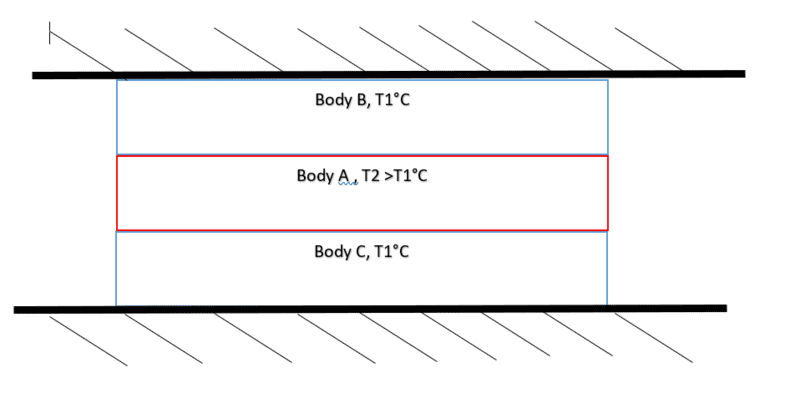
upload_2018-9-28_9-44-3.png

Fig 1.

The system is at rest. For simplicty I've considerd the ambient temperature to be same as T1.

By knowing:
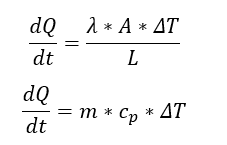
upload_2018-9-28_9-55-36.png

Fig 2.

yeilds:

upload_2018-9-28_9-57-23.png

Fig 3.

In my case B&C is at a constant Temperature of 15°C and Body A 115°C.

The specific heat cond and heat transfer coeff for A is:
0,19 W/m
1700 J/kg

For A:
Length = 2.41m
Width = 2.071m
Depth = 0.01m
Density = 950 kg/m3For Fig3. i end up with L=0.01m A=0.0207m2 and m = 47.4 kg.

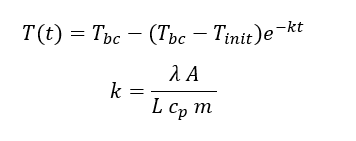
By using the function above and plotting over 60 sec i get.
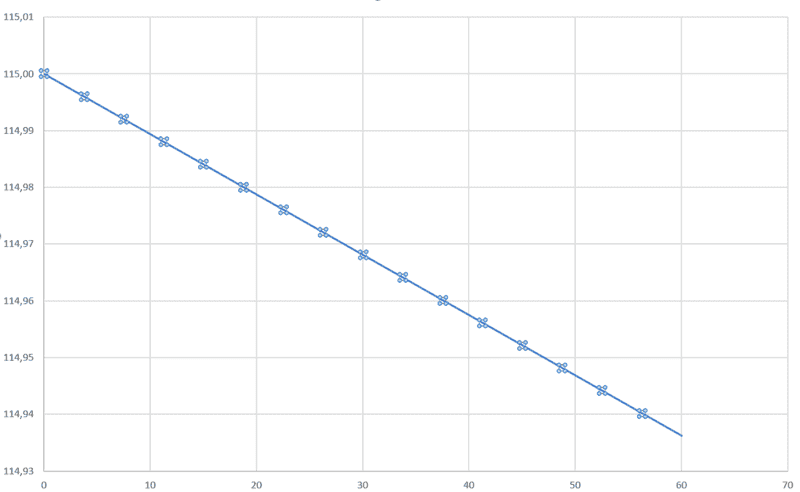
upload_2018-9-28_10-9-41.png

Fig 4

I'm not satisfied with my end result and wondering if anyone can see if there are any obvious errors?

Best Regards

Mikael
 

Attachments

  • upload_2018-9-28_9-44-3.png
    upload_2018-9-28_9-44-3.png
    7.9 KB · Views: 980
  • upload_2018-9-28_9-55-36.png
    upload_2018-9-28_9-55-36.png
    1.5 KB · Views: 705
  • upload_2018-9-28_9-57-23.png
    upload_2018-9-28_9-57-23.png
    1.5 KB · Views: 686
  • upload_2018-9-28_10-9-41.png
    upload_2018-9-28_10-9-41.png
    6.1 KB · Views: 622
Last edited:
Science news on Phys.org
Fritiofmikael said:
In my case B&C is at a constant Temperature of 15°C and Body A 115°C.

I'm not quite sure, how your model looks like. Are you trying to find the temperature distribution of your setup or just the transferred heat, i.e. do you assume that all the bodies (A, B, C) have a uniform tempeature at each time? Then what's your length ##L##? Do the bodies B and C are the boundaries (and therefore have the same temperature during your entire calculation)?

Also there are some issues with your units, the conductivity is in ##W/mK## and the heat transfer coefficient in ##W/m^2K##.

One last question: Is this kind of a homework or how did you come up with this scenario?
 
Thank you for your reply.

Yes I assume that the system has a uniform temperature distrubtion.

I want to find the temperature distribution of body A with an initial temp is 115 C. My length is 0.01m. B & C have a constant temp at 15 which can be considered as the boundaries.
 
Are the temperatures of bodies B and C changing with time? Do you think it is valid to neglect heat conduction within the bodies, and to only use a heat transfer coefficient at their boundaries...or would it be more accurate to assume that heat conduction is occurring and that there is no resistance to heat transfer at the boundaries?
 
@Chestermiller

Thank you for the reply,

There is a heat conduction in the system.

No more heat is generated into body A

Bodies B & C are actively cooling body A with a set point of 15 degrees Celsius. There will be heat conducted to B & C but one can consider that change to negligible.
 
Fritiofmikael said:
@Chestermiller

Thank you for the reply,

There is a heat conduction in the system.

No more heat is generated into body A

Bodies B & C are actively cooling body A with a set point of 15 degrees Celsius. There will be heat conducted to B & C but one can consider that change to negligible.

Are the boundaries and the temperature distribution of the Body A you want to assume like in the atttached schematic (for a specific time)?
 

Attachments

  • Model_HT_01.jpg
    Model_HT_01.jpg
    21.1 KB · Views: 459
@stockzahn

Thank you for your reply,

There are no boundaries of body A, yes that is my assumption.
 
Fritiofmikael said:
@Chestermiller

Thank you for the reply,

There is a heat conduction in the system.

No more heat is generated into body A

Bodies B & C are actively cooling body A with a set point of 15 degrees Celsius. There will be heat conducted to B & C but one can consider that change to negligible.
So, if you are including heat conduction, then are you solving the transient heat conduction equation within body A:
$$\rho C\frac{\partial T}{\partial t}=k\frac{\partial ^2 T}{\partial y^2}$$
where ##\rho## is the density of body A, C is its heat capacity, k is its thermal conductivity, and y is vertical position?
 
Fritiofmikael said:
@stockzahn

Thank you for your reply,

There are no boundaries of body A, yes that is my assumption.

If the temperature of the bodies B and C is constant you can assume them to be a boundary with ##T= const.## (a so-called Dirichlet boundary condition). You don't need to model them. So to be sure the only temperature changing (only in time) is the temperature of body A?
 

Similar threads

  • · Replies 15 ·
Replies
15
Views
3K
  • · Replies 3 ·
Replies
3
Views
2K
  • · Replies 4 ·
Replies
4
Views
5K
  • · Replies 11 ·
Replies
11
Views
3K
  • · Replies 5 ·
Replies
5
Views
4K
  • · Replies 6 ·
Replies
6
Views
2K
  • · Replies 3 ·
Replies
3
Views
2K
  • · Replies 4 ·
Replies
4
Views
3K
  • · Replies 4 ·
Replies
4
Views
2K
  • · Replies 3 ·
Replies
3
Views
1K