Heat transfer through AL shield by radiation & convection

Click For Summary
SUMMARY

This discussion focuses on calculating surface temperature on an object influenced by heat transfer through radiation, conduction, and convection. The thermal-resistive circuit method is identified as the analytical approach to solve the problem, requiring the calculation of thermal resistances for conduction (fiberglass and aluminum) and convection (air). Key equations include thermal resistance for conduction, convection, and radiation, with emphasis on the need to consider view factors for accurate radiation transfer coefficients. The discussion highlights the importance of understanding the thermal properties of the surfaces involved and the configuration of the heat source.

PREREQUISITES
  • Understanding of thermal-resistive circuit method
  • Knowledge of heat transfer principles: conduction, convection, and radiation
  • Familiarity with calculating thermal resistance for different materials
  • Ability to determine convective heat transfer coefficients
NEXT STEPS
  • Research the calculation of convective heat transfer coefficients for airflow at 25 mph
  • Study the application of view factors in radiation heat transfer calculations
  • Explore advanced thermal-resistive circuit analysis techniques
  • Learn about the thermal properties of various materials, particularly fiberglass and aluminum
USEFUL FOR

Engineers, thermal analysts, and students in heat transfer who are working on projects involving multi-mode heat transfer analysis and require a solid understanding of thermal resistance calculations.

RekhaP87
Messages
2
Reaction score
0
Hi all,

I am new here, and want to thank you for help in advance! I am working on a project and need some help - I need to figure out surface temp on an object at some distance from the heat source:
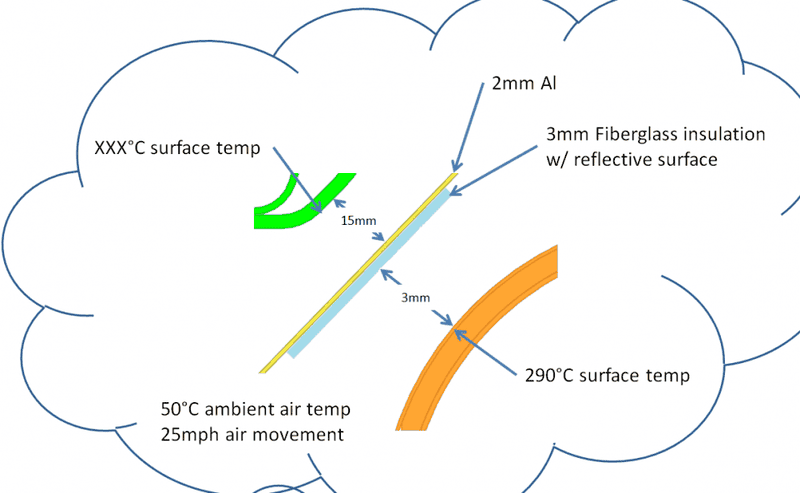
upload_2016-4-18_18-36-16.png


I need some help getting started.

Is it going to be: Heat transfer (radiation) + Heat transfer (conduction fiberglass) + Heat transfer conduction (Al + Heat transfer (radiation)

How do take into account convection to find surface temp at reflective surface and surface temp at green surface?

I am assuming I know the following: h(convection) air, k (fiberglass), k (Al).

Thanks,
Rp
 
Engineering news on Phys.org
This is a relatively complicated problem to solve, have you taken a course in Heat Transfer? What have you done so far to try and solve the problem?

This would be solved analytically using the thermal-resistive circuit method, calculating the "thermal resistance" for each part of the problem and then solving for temperature drops across each resistor. Are you familiar with this method?
 
Mech_Engineer said:
This is a relatively complicated problem to solve, have you taken a course in Heat Transfer? What have you done so far to try and solve the problem?

This would be solved analytically using the thermal-resistive circuit method, calculating the "thermal resistance" for each part of the problem and then solving for temperature drops across each resistor. Are you familiar with this method?

Hi, thank you for your response! I have taken few heat transfer classes, and am familiar with the thermal-resistive circuit method. I know basic radiation, conduction, and convection equations has well.

25mph air is throwing me off in how to add the convection contribution + radiation from the heat source to the reflective material.
 
To calculate the contribution of of multiple heat transfer methods, you only need to calculate each method's thermal resistance and then add them as if they were parallel resistors. See attached diagram. When calculating the thermal resistance for convection, you need to calculate the convective coefficient h, which uses the speed of the flow as an input.

The equations you'll need to use are:
  • Thermal Resistance, Conduction: R = \frac{L}{k A}
  • Thermal Resistance, Convection: R = \frac{1}{h A}
  • Thermal Resistance, Radiation: R = \frac{1}{h_r A}
Make sure and take view factors into account when you're calculating your radiation transfer coefficients.
 

Attachments

  • Resistor Network.JPG
    Resistor Network.JPG
    27.8 KB · Views: 585
I think you will need to know more about the thermal properties of the surface who's temperature you are trying to calculate. For example the thermal resistance between it an some point that you consider to be at a fixed temperature.
 
There is not enough information in the initial description of the problem to allow of any meaningful calculations .

Post a sketch showing the actual configuration in 3D and tell us more about that heat source .
 

Similar threads

Replies
10
Views
3K
  • · Replies 5 ·
Replies
5
Views
2K
  • · Replies 34 ·
2
Replies
34
Views
6K
Replies
9
Views
2K
  • · Replies 5 ·
Replies
5
Views
2K
  • · Replies 10 ·
Replies
10
Views
3K
  • · Replies 6 ·
Replies
6
Views
2K
  • · Replies 2 ·
Replies
2
Views
2K
Replies
1
Views
1K
  • · Replies 10 ·
Replies
10
Views
5K