Heisenberg algebra Isomorphic to Galilean algebra

Click For Summary

Homework Help Overview

The discussion revolves around the isomorphism between the Lie algebra of one-dimensional Galilean symmetry, represented by the generators K, P, and H, and the Heisenberg algebra characterized by specific commutation relations. Participants explore the implications of these algebraic structures and their definitions.

Discussion Character

  • Conceptual clarification, Assumption checking, Mixed

Approaches and Questions Raised

  • Participants discuss the definitions and properties of Galilean and Heisenberg algebras, questioning the nature of their isomorphism. Some express uncertainty about the implications of commutation relations and the role of central extensions.

Discussion Status

The conversation is ongoing, with participants sharing insights and clarifications about the algebraic structures. Some suggest that the algebras may be isomorphic under certain conditions, particularly in one-dimensional cases, while others seek further definitions and examples.

Contextual Notes

There is a noted lack of clarity regarding the term "Galilean group" and its representation, as well as the dimensionality of the algebras in question. Participants are encouraged to define terms and explore the implications of their assumptions.
Azure Ace

Homework Statement


Given for one-dimensional Galilean symmetry the generators ##K, P,## and ##H##, with the following commutation relations: $$[K, H] = iP$$ $$[H,P] = 0$$ $$[P,K] = 0$$

Homework Equations


Show that the Lie algebra for the generators ##K, P,## and ##H## is isomorphic to the Heisenberg algebra $$[X, P] = i \hbar I$$.

The Attempt at a Solution


The Heisenberg algebra is a non-trivial central extension of the Galilean algebra. I don't know how to prove how they are isomorphic.
 
Last edited by a moderator:
Physics news on Phys.org
What is a Galilean algebra? The multiplication rules you gave under section 1. is directly how the three dimensional Heisenberg algebra is defined. If you switch the names, then what is the Heisenberg algebra to you?
 
  • Like
Likes   Reactions: Azure Ace
fresh_42 said:
What is a Galilean algebra? The multiplication rules you gave under section 1. is directly how the three dimensional Heisenberg algebra is defined. If you switch the names, then what is the Heisenberg algebra to you?
I think by isomorphic, the commutation relations I have for my so-called "Galilean" algebra really are for the Heisenberg algebra. By Galilean algebra, I mean the Lie algebra for the Galilean group, which is the set of all Galilean transformations. I think Heisenberg algebra is the same as Bargmann Lie algebra, which as I understood it, is a non-trivial central extension of the Galilean algebra.
 
Azure Ace said:
I think by isomorphic, the commutation relations I have for my so-called "Galilean" algebra really are for the Heisenberg algebra. By Galilean algebra, I mean the Lie algebra for the Galilean group, which is the set of all Galilean transformations. I think Heisenberg algebra is the same as Bargmann Lie algebra, which as I understood it, is a non-trivial central extension of the Galilean algebra.
Can you write down the multiplications within a given vector space basis of the Galilean algebra?

One possible representation of the three dimensional Heisenberg algebra by matrices is the algebra of matrices of the form ##\begin{bmatrix}0&*&*\\0&0&*\\0&0&0\end{bmatrix}## with Lie multiplication ##[X,Y]=XY-YX##. It is nilpotent with a one-dimensional center. Can you do similar for the Galilean algebra, whatever this is? I don't know the term Galilean group either. Of course I can make some guesses what I think you mean, but it's probably better if you define it.
 
  • Like
Likes   Reactions: Azure Ace
fresh_42 said:
Can you write down the multiplications within a given vector space basis of the Galilean algebra?

One possible representation of the three dimensional Heisenberg algebra by matrices is the algebra of matrices of the form ##\begin{bmatrix}0&*&*\\0&0&*\\0&0&0\end{bmatrix}## with Lie multiplication ##[X,Y]=XY-YX##. It is nilpotent with a one-dimensional center. Can you do similar for the Galilean algebra, whatever this is? I don't know the term Galilean group either. Of course I can make some guesses what I think you mean, but it's probably better if you define it.

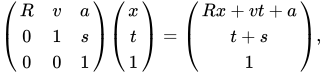
The Galilean group, as what was discussed to us, is the set of Galilean transformations given in matrix form as:
a3e57643c70bb66bcf57936968f4435d1a8c3ba1

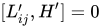
where R is for rotations, v is for Galilean boosts, a is spatial translations and s is for time translations. The commutation relations are the following.
62b718a50d9bbc524206f938d4094000fdd5f02a

98fc7c4a468ce7fa72d4ce1a447632324337ff52

01b7aa61bc2856d4e3cfc6ce5f3d72564535f1f5

ade86ef409f8f767be149b605b2a76127684a3dc

285a4d16555cfca4c80d963f36f2925c64d7037d

7337d08fee8d9be08a2969bb16b578504d9182b1

61e8488de4717b3e616094f5b8b3d8ab464aa502

ca5972e950d30691dba2fafc2e58977300b6ad69

2c57b7e93beefa09f215b05f16f8f2a309ba7775

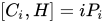
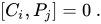
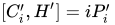
I just took these equations from wikipedia. For the Bargmann algebra,
c5de574832089c79e6f579c52ef4de1f1f950c13

8e56cbe7fc5ad8aaa4b5e99bd208e961edcbb242

334b98de717fad3a286c171163b52e65222e72a5

7c93f26d28dda58f1c60e3938f66753530cd0fec

627522438a338d0623fe653177fbf778892aa7d3

bc33032edd56c7309ae548c711c86071e157dc0b

8f774a5b5348649053a05ecb9349301f2f659c5e

eaa99e5eac46bb60b94276b49313baea2e8dabc3

235c0adc062f85c03c8d1263d159233b1c483f23

I think this one is the same as the Heisenberg algebra my professor is talking about with ##[C'_{i}, P'_{j}] = iM\delta_{ij}## equivalent to ##[X,P] = i\hbar I \delta_{ij}##. But I'm not really sure about this. A hint given to me is that I shouldn't really take the notations seriously and that ##P## in the Galilean algebra is the central generator. Does this mean that perhaps if I compare the two, maybe the isomorphism is ##K \to X, H \to P, P \to \hbar I##?

Thank you very much for your interest in helping me!
 
Yes, that's what Wikipedia says. But what dimension do we have here? Certainly a significantly higher number than three. So either we must consider generalized Heisenberg algebras (with increased dimension) or a low dimensional version of the Galilean group.

We have as Heisenberg algebra ##\mathcal{H} = \left\{ \begin{bmatrix} 0&K&P\\0&0&H\\0&0&0\end{bmatrix} \right\}##. The same as we get by ##\{C_1,H,P_1\}## with ##C_1 \leftrightarrow K## and only one index, no ##L## and eventually a scalar correction for ##P=p\cdot P_1##. This means: no rotation and one-dimensional boost and translations, i.e. a different algebra than the large algebra you just described.
 
  • Like
Likes   Reactions: Azure Ace
fresh_42 said:
Yes, that's what Wikipedia says. But what dimension do we have here? Certainly a significantly higher number than three. So either we must consider generalized Heisenberg algebras (with increased dimension) or a low dimensional version of the Galilean group.

We have as Heisenberg algebra ##\mathcal{H} = \left\{ \begin{bmatrix} 0&K&P\\0&0&H\\0&0&0\end{bmatrix} \right\}##. The same as we get by ##\{C_1,H,P_1\}## with ##C_1 \leftrightarrow K## and only one index, no ##L## and eventually a scalar correction for ##P=p\cdot P_1##. This means: no rotation and one-dimensional boost and translations, i.e. a different algebra than the large algebra you just described.

Yes, I would only like to consider a smaller Galilean group. For 1D Galilean symmetry we have no rotations, right? So does that mean for a 1D physical space the two algebras are isomorphic (which now I think they are)? How about for 2D space with SO(2) rotational symmetry? I'm sorry I'm a little bit of a beginner here. Also thank you very much for your reply! I really appreciate it and I actually learned something new. ^_^
 
Last edited by a moderator:
Azure Ace said:
Yes, I would only like to consider a smaller Galilean group. For 1D Galilean symmetry we have no rotations, right?
Yes.
So does that mean for a 1D physical space the two algebras are isomorphic (which now I think they are)?
Yes. You don't even need a complicated basis transformation. The basis vectors only have different letters (in the versions above) and maybe one has to deal with a factor ##\pm i## or so for the central vector ##P##. I haven't checked.
How about for 2D space? I'm sorry I'm a little bit of a beginner here. Also thank you very much for your reply! I really appreciate it and I actually learned something new. ^_^
I admit my notation ##\begin{bmatrix}0&K&P\\0&0&H\\0&0&0\end{bmatrix}## has been a bit sloppy (lazy). It should have been:
$$
K=\begin{bmatrix}0&1&0\\0&0&0\\0&0&0\end{bmatrix}\; , \; H=\begin{bmatrix}0&0&0\\0&0&1\\0&0&0\end{bmatrix}\; , \;P=\begin{bmatrix}0&0&-i\\0&0&0\\0&0&0\end{bmatrix}
$$
I haven't checked the two-dimensional case. You could do it as an exercise.
 
  • Like
Likes   Reactions: Azure Ace
fresh_42 said:
Yes.Yes. You don't even need a complicated basis transformation. The basis vectors only have different letters (in the versions above) and maybe one has to deal with a factor ##\pm i## or so for the central vector ##P##. I haven't checked.
I admit my notation ##\begin{bmatrix}0&K&P\\0&0&H\\0&0&0\end{bmatrix}## has been a bit sloppy (lazy). It should have been:
$$
K=\begin{bmatrix}0&1&0\\0&0&0\\0&0&0\end{bmatrix}\; , \; H=\begin{bmatrix}0&0&0\\0&0&1\\0&0&0\end{bmatrix}\; , \;P=\begin{bmatrix}0&0&-i\\0&0&0\\0&0&0\end{bmatrix}
$$
I haven't checked the two-dimensional case. You could do it as an exercise.
Wow! Thank you very much! I learned a lot of new things from your replies. Thank you again! ^_^
 

Similar threads

  • · Replies 6 ·
Replies
6
Views
2K
  • · Replies 5 ·
Replies
5
Views
2K
  • · Replies 19 ·
Replies
19
Views
3K
Replies
5
Views
2K
  • · Replies 11 ·
Replies
11
Views
4K
Replies
9
Views
2K
  • · Replies 6 ·
Replies
6
Views
2K
  • · Replies 5 ·
Replies
5
Views
7K
  • · Replies 45 ·
2
Replies
45
Views
6K
  • · Replies 4 ·
Replies
4
Views
2K