{ help } Calculating the B-field at the center of a solenoid

Click For Summary
SUMMARY

The discussion centers on calculating the magnetic field (B-field) at the center of a finite solenoid, specifically one that is 40 cm long, 3.0 cm in diameter, and wound with 500 turns, carrying a current of 4.0 A. The magnetic field at the center, 10.0 cm from one end, and 5.0 cm from one end is derived using the formula involving the sine of angles, where the term (sinΘ2 - sinΘ1) is crucial for finite solenoids. The negative sign for Θ1 arises from the geometry of the solenoid's finite length, which affects the calculation of the magnetic field.

PREREQUISITES
  • Understanding of electromagnetic theory, specifically solenoid behavior.
  • Familiarity with the Biot-Savart Law and its application to finite solenoids.
  • Knowledge of trigonometric functions, particularly sine, in relation to angles in physics.
  • Ability to manipulate and derive equations involving magnetic fields.
NEXT STEPS
  • Study the derivation of the magnetic field for finite solenoids using the Biot-Savart Law.
  • Learn how to apply trigonometric identities in electromagnetic calculations.
  • Explore the differences between finite and infinite solenoids in magnetic field calculations.
  • Investigate practical applications of solenoids in electromagnetic devices.
USEFUL FOR

Students and professionals in physics, electrical engineering, and anyone interested in understanding the principles of magnetism in solenoids.

Special One
Messages
32
Reaction score
1
Homework Statement
Explain how did we get the formula used in the question answer.
Relevant Equations
Magnetic field
Problem 52:
A solenoid is 40 cm long, has a diameter of 3.0 cm, and is wound with 500 turns. If the current through the windings is 4.0 A, what is the magnetic field at a point on the axis of the solenoid that is (a) at the center of the solenoid, (b) 10.0 cm from one end of the solenoid, and (c) 5.0 cm from one end of the solenoid? (d) Compare these answers with the infinite-solenoid case.
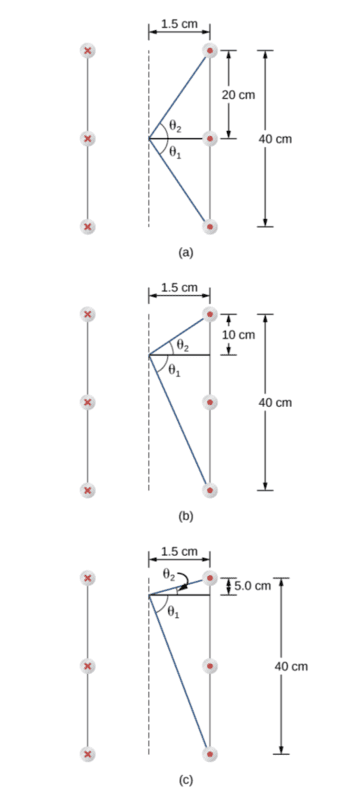
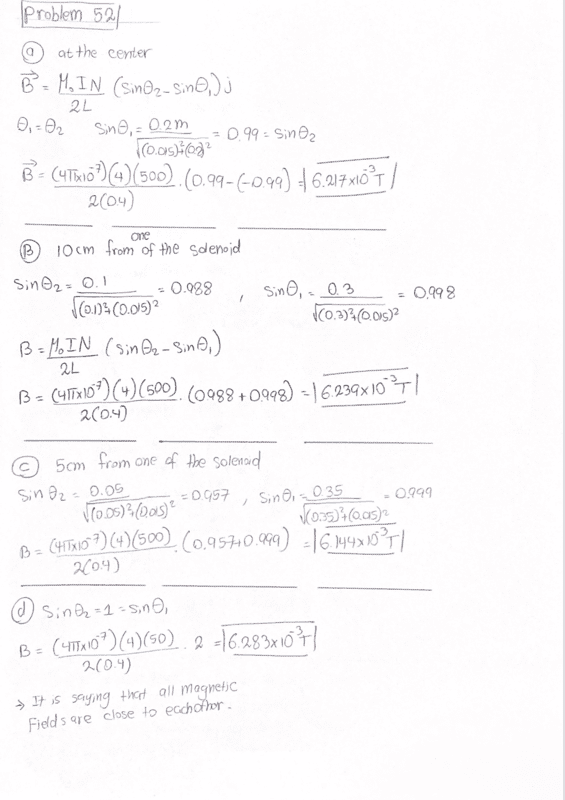
Screenshot 2020-05-14 at 19.48.35.png
Screenshot 2020-05-14 at 19.49.10.png

I didn't get the second half of the formula, which is ( sinΘ2-sinΘ1 ) ?
And why when we substitute we consider the Θ1 as negative??
 
Physics news on Phys.org
Is the posted work under Problem 52 your attempt at a solution? If yes, then you should know where the ##(\sin\theta_2-\sin\theta_1)## term came from; it has to do with the fact that the solenoid is finite. If that's someone else's solution, please post your attempt and we'll take it from there. Once you have correctly derived (with perhaps some help) your own equation, then you will know why ##\theta_1## is taken negative.
 

Similar threads

  • · Replies 15 ·
Replies
15
Views
1K
Replies
5
Views
2K
  • · Replies 5 ·
Replies
5
Views
2K
  • · Replies 7 ·
Replies
7
Views
10K
  • · Replies 3 ·
Replies
3
Views
4K
Replies
3
Views
2K
  • · Replies 21 ·
Replies
21
Views
6K
Replies
11
Views
3K
Replies
4
Views
6K
Replies
5
Views
4K