Help finding coefficient of friction

Click For Summary
SUMMARY

The discussion revolves around calculating the minimum coefficient of static friction required for a 1600kg car negotiating a 16-degree ramp. The user calculated a coefficient of friction (u) of 0.395, while the reference book states the correct value is 0.365. The user provided equations of motion, including force balance equations and moment equations, but encountered discrepancies in their calculations, particularly in the application of the static friction formula.

PREREQUISITES
  • Understanding of static friction and its role in mechanics
  • Familiarity with free body diagrams (FBD) and their application in statics
  • Knowledge of Newton's laws of motion
  • Basic trigonometry for resolving forces on inclined planes
NEXT STEPS
  • Review the principles of static friction and its calculation methods
  • Study free body diagram techniques for analyzing forces on inclined planes
  • Learn about the application of Newton's laws in static equilibrium problems
  • Explore the effects of angle and weight on frictional forces in mechanics
USEFUL FOR

Students and professionals in engineering, particularly those studying statics, mechanics, or physics, will benefit from this discussion. It is also relevant for anyone involved in automotive engineering or dynamics analysis.

Soshamim
Messages
6
Reaction score
0
Hey, I was wondering if someone could help me with this statics problem.

The question is: "The 1600kg car is just beginning to negotiate the 16* ramp. If the car has rear-wheel drive, determine the minimum coefficient fo static friction required at B.

My FBD:
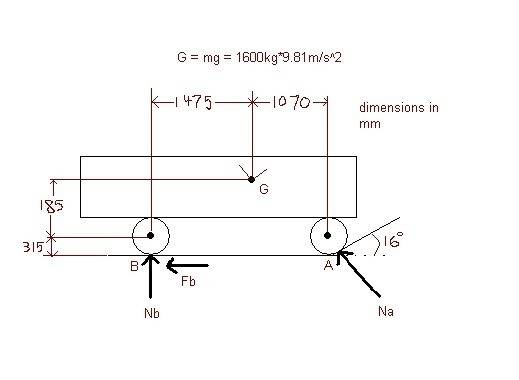
attachment.php?attachmentid=8335&stc=1&d=1163575175.jpg


The answer I keep getting is 0.395, but the book says Us = 0.365.

I'm about to type up my work in a second
 

Attachments

  • 6-27 fbd-jpg file.jpg
    6-27 fbd-jpg file.jpg
    11.5 KB · Views: 1,250
Physics news on Phys.org
[tex]\Sigma \vec{F}_{x} = \vec{f}_{B} - \vec{A} sin(16) = 0[/tex]
[tex]\Sigma \vec{F}_{y} = \vec{B} + \vec{A} cos(16) - G = 0[/tex]
[tex]\Sigma \vec{M}_{B} = -1.475*G + 2.545*\vec{A} cos(16)[/tex]

...From moment equation, A = 9463N
...From Fy equation, B = 6599N
...From Fx equation, Fb = 2608N

Using Fb = u*B, I get u = 0.395, which is not the correct answer. I'm not really sure what I'm doing wrong here.
 

Similar threads

Replies
18
Views
3K
  • · Replies 7 ·
Replies
7
Views
2K
  • · Replies 13 ·
Replies
13
Views
2K
Replies
48
Views
8K
  • · Replies 3 ·
Replies
3
Views
22K
  • · Replies 4 ·
Replies
4
Views
2K
  • · Replies 28 ·
Replies
28
Views
6K
  • · Replies 1 ·
Replies
1
Views
1K
  • · Replies 1 ·
Replies
1
Views
2K
  • · Replies 5 ·
Replies
5
Views
3K