Help finding deflection of beam

  • Thread starter Thread starter Dell
  • Start date Start date
  • Tags Tags
    Beam Deflection
Click For Summary

Discussion Overview

The discussion revolves around calculating the deflection of a beam at a specific point (point B) under various loading conditions. Participants explore the contributions to the deflection, including axial extensions and moments, while addressing the complexities of the problem through mathematical expressions and physical principles.

Discussion Character

  • Technical explanation
  • Mathematical reasoning
  • Debate/contested

Main Points Raised

  • One participant presents a free body diagram and derives expressions for moments and deflections, but notes the need for additional conditions to solve for constants.
  • Another participant challenges the correctness of the moment expressions, emphasizing the need to consider the definition of moments and suggesting a verification method.
  • Multiple participants identify three contributions to the deflection at point B: the deflection of segment DC, the distributed load, and the axial force in segment AB, but express uncertainty about how to calculate these contributions without certain parameters.
  • A suggestion is made to visualize the deflection and consider the implications of axial extension on the position of point C.
  • Mohr's theorems for slope and deflection are mentioned as potentially applicable to the problem, but their relevance remains to be clarified.

Areas of Agreement / Disagreement

Participants generally agree on the existence of multiple contributions to the deflection at point B, but there is disagreement regarding the correctness of the moment expressions and the methods to calculate the deflections. The discussion remains unresolved with various perspectives on how to approach the problem.

Contextual Notes

Participants express limitations in their calculations due to missing parameters, such as the area of segment AB and the specific properties of the beam, which may affect the accuracy of their analyses.

Dell
Messages
555
Reaction score
0
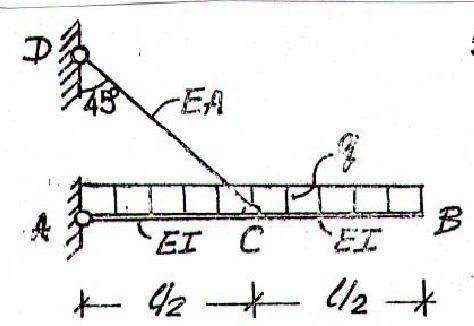
find the deflection of the beam at point B
Capture.JPG


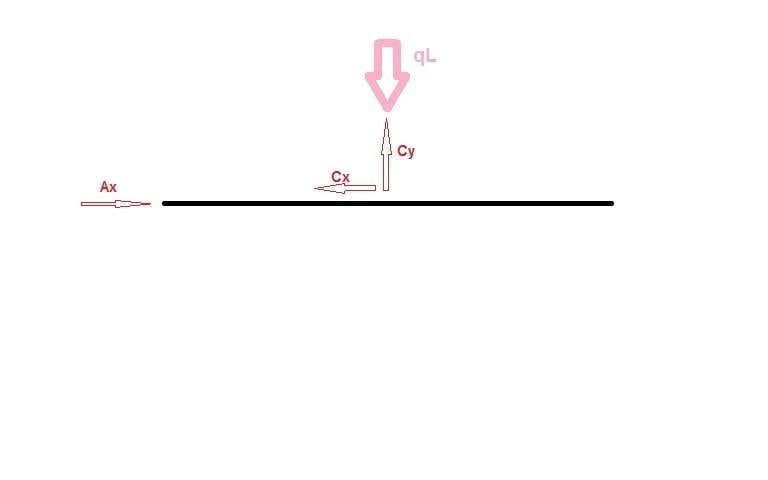
i drew the free body diagram of the beam and found that
Ay=0
Ax=qL
Cy=qL
Cx=qL
Untitled.jpg


M(x)= (qL)*x - (qx)*x/2 +(qL)*<x-L/2>

M(x)=(qL)x -(q/2)x2 +(qL)<x-L/2>

EIΦ(x)=(qL/2)x2 -(q/6)x3 +(qL/2)<x-L/2>2 + C1

EIY(x)=(qL/6)x3 -(q/24)x4 +(qL/6)<x-L/2>3 + C1*x + C2

EIY(0)=0= 0+ C2
===>c2=0

but i need another condition to find C1, i think i need to use the deflection of the bar DC somehow, but I am not quite sure how, i tried using triangles and saying that the deflection of point C is the same as the deflection of the bar DC*sin(45) but that didnt work
 
Physics news on Phys.org
There are 3 contributions to the deflection at B. Can you identify them? One of them is the extension of CD, as you have realized. If you know the force in CD, you should be able to work out its axial extension. By the way I don't agree your expressions for M(x). In each case one of the terms is not right. The definition of a moment is force times PERPENDICULAR distance. Look at it again. The moment at a section is the algebraic sum of moments on one side of that section. So it can always be checked by looking at the other side of the section; you should then get the same result.
 
pongo38 said:
There are 3 contributions to the deflection at B. Can you identify them? .

1) the deflectin of DC,
2) the spread force q
3)the axial force and deflection of AB?

if this is so, how do i find it?? the area of AB is not given
 
Let's say that C moves to C' as a result of the axial extension of DC. Where is C' in relation to C? Try sketching the exaggerated shape of the deflection as accurately as you can. Your remark that you don't know the area A is also true of EI for the beam. So I assume you are just developing a formula as an answer. CB is a cantilever extension to a beam. What is the difference between that and a cantilever built into a wall rigidly? I think you will find Mohr's theorems for slope and deflection applicable to this problem. Does that help?
 

Similar threads

  • · Replies 8 ·
Replies
8
Views
2K
  • · Replies 8 ·
Replies
8
Views
3K
Replies
3
Views
2K
  • · Replies 12 ·
Replies
12
Views
2K
  • · Replies 5 ·
Replies
5
Views
3K
  • · Replies 18 ·
Replies
18
Views
4K
  • · Replies 6 ·
Replies
6
Views
9K
  • · Replies 24 ·
Replies
24
Views
4K
  • · Replies 1 ·
Replies
1
Views
1K
  • · Replies 10 ·
Replies
10
Views
4K