Help identifying a zero-force member

  • Thread starter Thread starter Saladsamurai
  • Start date Start date
  • Tags Tags
    Member
Click For Summary
SUMMARY

The discussion centers on identifying zero-force members in structural analysis, specifically at joint K involving members CK, CJ, and KB. The established rules for zero-force members state that if two members form a joint without external forces, they are zero-force members, and if three members are present with two collinear, the third is zero-force if no external forces act on the joint. The challenge arises when four members meet at a joint, complicating the application of these rules. The user seeks clarification on how to determine if member CK is a zero-force member in this scenario.

PREREQUISITES
  • Understanding of static equilibrium principles in structural analysis
  • Knowledge of zero-force member identification rules
  • Familiarity with joint force equilibrium equations
  • Basic concepts of truss structures and member interactions
NEXT STEPS
  • Study advanced examples of zero-force member identification in truss structures
  • Learn about the implications of external loads on joint equilibrium
  • Explore software tools for structural analysis, such as SAP2000 or ANSYS
  • Review case studies involving complex joint configurations in engineering design
USEFUL FOR

Structural engineers, civil engineering students, and professionals involved in truss design and analysis will benefit from this discussion.

Saladsamurai
Messages
3,009
Reaction score
7
So I know the that the general rule for identifying a zero force member is that if two members form a joint and no external loading or reaction forces are applied to the joint then the members must be zero force members.

And if three members form a joint for which two are collinear, then the 3rd is zero force provided there is no external/reaction forces at the joint.

BUT in the following case how would one know that the joint at member CK is zero force?
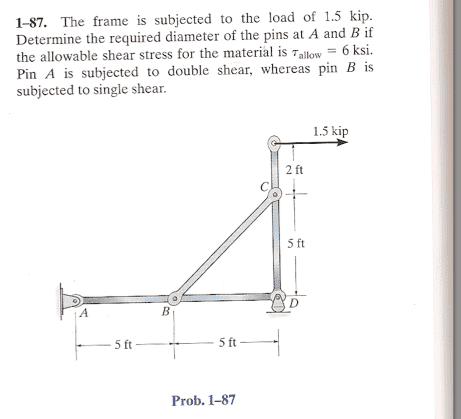
Picture1-1.png

There are four members at the joint, so neither general rule can be applied.

I mean, what would "tip me off"? And how would I prove it is zero force?
 
Physics news on Phys.org
Wow. This must be a tough one. Anyway. Looking at Joint K we would have [tex]\sum F_y=F_{kb}_y+f_{ck}=0[/tex] so this doesn't tell me anything. Looking at joint C we would have [tex]F_{ck}+4+F_{cj}_y=0[/tex]. . . great, now what?. . . hmmm let me think.

Any ideas?
 
god damnit
 

Similar threads

  • · Replies 4 ·
Replies
4
Views
6K
  • · Replies 8 ·
Replies
8
Views
2K
  • · Replies 22 ·
Replies
22
Views
5K
  • · Replies 3 ·
Replies
3
Views
2K
Replies
21
Views
2K
  • · Replies 21 ·
Replies
21
Views
4K
  • · Replies 3 ·
Replies
3
Views
2K
  • · Replies 3 ·
Replies
3
Views
2K
Replies
8
Views
3K
Replies
20
Views
5K