Help in noise calculation of BJT.

Click For Summary
SUMMARY

The discussion focuses on calculating the equivalent input noise voltage in a BJT circuit, specifically using the MPSA18 transistor. The user, Alan, simplifies the circuit by excluding frequency-dependent components and models the input resistance as βR_E, where β is the current gain. Alan expresses confusion regarding the modeling of input resistance and the discrepancies between textbook noise calculations and the MPSA18 datasheet. He concludes that with a low source resistance (R_s) and a high emitter resistor (R_E), the voltage noise dominates, impacting the signal-to-noise ratio.

PREREQUISITES
  • Understanding of BJT noise models, specifically the MPSA18 transistor.
  • Familiarity with thermal noise calculations in resistors.
  • Knowledge of equivalent circuit modeling for BJTs.
  • Basic concepts of signal-to-noise ratio in electronic circuits.
NEXT STEPS
  • Study the Van der Ziel model for noise in transistors.
  • Learn about thermal noise calculations using the formula v_b^2=4kT r_b Δf.
  • Research the impact of emitter resistors on signal-to-noise ratios in BJT circuits.
  • Examine the Integrated Circuit design principles outlined in Paul Grey's book.
USEFUL FOR

Electrical engineers, circuit designers, and students focusing on analog electronics and noise analysis in BJT circuits will benefit from this discussion.

yungman
Messages
5,741
Reaction score
291
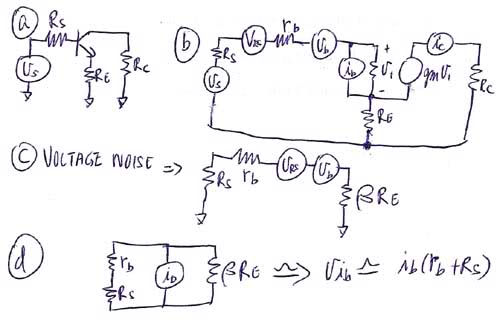
All the models I see is mostly common emitter, I have a circuit with AC equivalent shown in Fig a. Where v_s \; is the signal voltage and the source resistance R_s. I want to calculate the equivalent input noise voltage. Here is what I attempt to do it:

147190[/ATTACH]"]
jpftci.jpg


I show the equivalent model in Fig b. I simplify by leaving the frequency depend components out for simplicity. You can see the emitter resistor and collector resistor. r_b\; is the base resistance of the transistor. I left out output resistance to further simplify the circuit. v_{RS} is the thermal noise of R_s and v_b \; is the noise voltage or the base resistance. I also left out the noise refer from the collector current back to the input by assuming gm is very high so just to look at the effect of the input components where my question is.

Fig c. show the model for calculation the equiv. input noise voltage. I assume the input resistance of the transistor is \beta R_E\; where \beta\; is the current gain of the transistor. As you can see \beta R_E\; is much larger than r_b+R_s\; therefore the input see the full v_b+v_{RS}.

Fig d is where my confusion. how do I model the input resistance. I attempt to use Fig d. but I am not sure this is correct. Can anyone verify Fig c and Fig d?

So the total noise voltage:

v_{n_{in}}=\sqrt{ v_{RS}^2 + v_b^2+v_{ib}^2}

Thanks

Alan
 

Attachments

  • jpftci.jpg
    jpftci.jpg
    18.6 KB · Views: 888
Last edited:
Engineering news on Phys.org
Also I am confused with the data sheet of the MPSA18:

http://pdf1.alldatasheet.com/datasheet-pdf/view/5139/MOTOROLA/MPSA18.html

You can see in Fig 1, the equivalent noise voltage and current is switch from what I am using which I got from textbooks. I understand it is the total equivalent noise voltage, but I still think it should be switch and voltage always has to be in series with the source and input resistance and current is parallel. You can verify by looking at any of the BJT models.

Also, it seems that Fig.2 to Fig.7 are only true for ground emitter only, if you have an emitter resistor that is over 5K, nothing apply anymore! I think the only way to use the data sheet is to find r_b\; from the data sheet using Fig.2 where the source resistance is zero to get rid of the i_b\; term and e_n=v_b\; and use the formula

v_b^2=4kT\;r_b \Delta f

to find the base resistance and use my formulas to calculate the voltage equivalent noise( I include flicker noise into the model and just assume base resistance increase at low frequency!...Lazy!). and use \beta\; to calculate equivalent noise current i_b\; using the collector current by

i_b^2=2q\frac {I_c }{\beta} \Delta f

Help!
 
Last edited:
Anyone?

If I am correct in my assumption in Fig. c and Fig. d, this mean with the emitter resistor R_E\; of a few kohms, and keep the R_s\; very low, you eliminate the current noise. As for the voltage noise, \beta R_E\; is so high that you always see the full noise voltage at the input regardless of any R_s\; if the value is under 50K or so.
 
An emitter resistor reduces the gain for both the source signal and noise, but it introduces another noise source in parallel with the original, thus degrading the signal to noise ratio.
 
Studiot said:
An emitter resistor reduces the gain for both the source signal and noise, but it introduces another noise source in parallel with the original, thus degrading the signal to noise ratio.

Thanks for the reply. Do you have any link on this, how to model this?
 
Noise in Transistor Circuits

Wireless World

Article 1 November 1968 (5 pages)
Article 2 December 1968 (6 pages) This is really the important one from your point of view.

I have a rather poor photocopy of these available.
 
Thanks, I have not been able to find the articles, I just order the Integrated Circuit design by Paul Grey( for less than $10! on ebay). I used to use this book when I was designing bipolar ICs, I since lost it and I remember it has a lot of models for transistors. But I read some where that there are new models like Van der Ziel model which I know nothing. The one I posted was the Grey and Meyer model.
 
Van Der Ziel wrote the original articles in the 1950s and one book

'Fluctuation Phenomena in Semiconductors'

Butterworths 1959

I forgot to mention the author of my previous reference - Peter Baxandell of tone control and other audio innovations fame. A PM with an email address capable of receiving jpgs gets you a scan.

go well
 

Similar threads

Replies
16
Views
10K
Replies
10
Views
2K
  • · Replies 3 ·
Replies
3
Views
2K
  • · Replies 19 ·
Replies
19
Views
2K
  • · Replies 7 ·
Replies
7
Views
2K
  • · Replies 5 ·
Replies
5
Views
3K
  • · Replies 13 ·
Replies
13
Views
5K
  • · Replies 1 ·
Replies
1
Views
2K
  • · Replies 5 ·
Replies
5
Views
3K
  • · Replies 7 ·
Replies
7
Views
6K