Help me understand why this summation index is not j

  • Thread starter Thread starter docnet
  • Start date Start date
  • Tags Tags
    Dot product
Click For Summary
SUMMARY

This discussion centers on the confusion surrounding the summation index in the expression for the inner product involving Markov Chains. The participants clarify that the term ##g(i)## should be replaced with ##g(j)## in the first equation, as the summation should indeed be over ##j## rather than ##i##. They also highlight that the switching of indices in the second equation is incorrect, leading to a misinterpretation of the expressions. The conversation emphasizes the importance of the balance condition for the self-adjoint property of the transition matrix ##P##.

PREREQUISITES
  • Understanding of Markov Chains and their properties
  • Familiarity with matrix-vector operations
  • Knowledge of inner product definitions in probability theory
  • Ability to interpret mathematical notation and equations
NEXT STEPS
  • Study the balance condition in Markov Chains and its implications for self-adjoint matrices
  • Learn about the properties of transition matrices in Markov processes
  • Explore the concept of inner products in the context of probability distributions
  • Review matrix-vector multiplication and its applications in Markov Chain theory
USEFUL FOR

Mathematicians, statisticians, and data scientists working with Markov Chains, as well as students seeking to deepen their understanding of probability theory and linear algebra.

docnet
Messages
796
Reaction score
486
Homework Statement
.
Relevant Equations
.
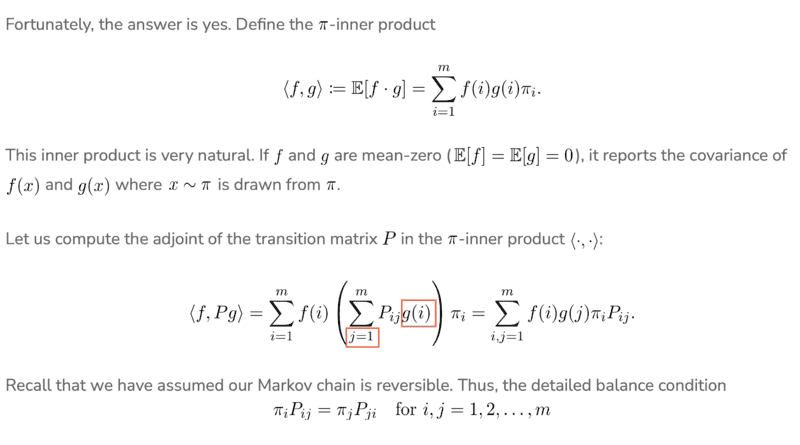
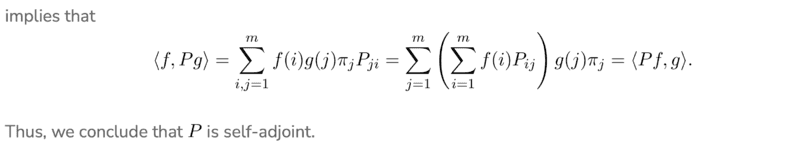
The below image is an excerpt from a website about Markov Chains.

In the red boxed which I put in the image, I don't understand why the term ##g(i)## isn't being summed over ##j## instead of ##i##, since the outer sum is over the ##i##th element of the vector ##Pg##, which is the dot product between the ##i##th row of ##P## and ##g##.

I expected ##\langle f,Pg \rangle## to expand as $$\sum_i f(i)(Pg)_i \pi_i = \sum_i f(i)\Big(\sum_jP_{ij}g(j)\Big)\pi_i .$$

But, the website shows $$\langle f,Pg \rangle= \sum_i f(i)\Big(\sum_jP_{ij}g(i)\Big)\pi_i .$$ What am I misunderstanding?

Screenshot 2024-02-12 at 9.58.44 PM.png

Screenshot 2024-02-12 at 9.58.50 PM.png
 
Physics news on Phys.org
In the theory of Markov chains, don't they do the matrix-vector operation back-to-front? Just to be different.
 
  • Like
Likes   Reactions: docnet
PeroK said:
In the theory of Markov chains, don't they do the matrix-vector operation back-to-front? Just to be different.
Yes, if you mean left side multiplication, I think for probability distributions. Right side multiplication is done for expected values. The special inner product is defined using ##Pg## so I thought it was the usual right side multiplication... I am also not understanding how in the last line, ##P_{ji}## is switched with ##P_{ij}## as soon as the summation order changed.. 😭 :bow::headbang:
 
Obvious misprint.
 
  • Like
Likes   Reactions: FactChecker and docnet
PeroK said:
In the theory of Markov chains, don't they do the matrix-vector operation back-to-front? Just to be different.
Even if that is the case (I have not checked), the quoted expressions have typos. Exactly what they should be depends on this definition so I am not going to get into details regarding that.
 
  • Like
Likes   Reactions: FactChecker and docnet
Having browsed the page: The first equation in the quote should have ##g(j)##, not ##g(i)##. This is also clear from the second step where they do write ##g(j)##.

For the second equation they should not have switched the indices and their target expression should not have switched indices.

I’d say a case of bad proof reading in general.
 
  • Like
  • Informative
Likes   Reactions: FactChecker and docnet
Thank you ! you saved me from an existential crisis for now. :eek::oldsurprised:
 
docnet said:
Thank you ! you saved me from an existential crisis for now. :eek::oldsurprised:
It all hinges on the "balance condition". ##P## is ##\pi##-self-adjoint iff that condition holds.
 
  • Informative
Likes   Reactions: docnet
PeroK said:
It all hinges on the "balance condition". ##P## is ##\pi##-self-adjoint iff that condition holds.
Yes, but that was used already when writing the first expression in that equation down. The step where they just switch the indices on P is actually wrong and results in a wrong expression that they then interpret as if it were the correct one.
 
  • Informative
Likes   Reactions: docnet
  • #10
Orodruin said:
Yes, but that was used already when writing the first expression in that equation down. The step where they just switch the indices on P is actually wrong and results in a wrong expression that they then interpret as if it were the correct one.
It is a mess. At this level, I would expect to highlight that the balance condition is precisely the condition that makes ##P## self-adjoint. It's not just useful for the proof, it's the whole basis of the proof.
 
  • Informative
Likes   Reactions: docnet
  • #11
The way I would do this is simply.
$$\langle f,Pg \rangle = \sum_i f(i)\Big(\sum_jP_{ij}g(j)\Big)\pi_i = \sum_{i,j} f(i)g(j)\pi_iP_{ij}$$$$= \sum_{i,j} f(i)g(j)\pi_jP_{ji} =\sum_{i,j} P_{ji} f(i)g(j)\pi_j = \langle Pf, g \rangle$$
 
  • Informative
Likes   Reactions: docnet
  • #12
PeroK said:
The way I would do this is simply.
$$\langle f,Pg \rangle = \sum_i f(i)\Big(\sum_jP_{ij}g(j)\Big)\pi_i = \sum_{i,j} f(i)g(j)\pi_iP_{ij}$$$$= \sum_{i,j} f(i)g(j)\pi_jP_{ji} =\sum_{i,j} P_{ji} f(i)g(j)\pi_j = \langle Pf, g \rangle$$
That's sort of what I did as well! I thought about adding an extra step

$$\sum_{i,j} P_{ji} f(i)g(j)\pi_j=
\sum_j g(j)\Big(\sum_iP_{ji}f(i)\Big)\pi_j=
\langle Pf, g \rangle$$

where the change of the order of the summation is allowed because the double sum would converge absolutely, conditional on ##g(j)## and ##f(i)## being bounded in ##\mathbb{R}^n##. (And because ##P_{ij}\leq 1## for all ##i,j,## and ##\sum_j\pi_j=1##.)
 
  • Like
Likes   Reactions: PeroK

Similar threads

  • · Replies 8 ·
Replies
8
Views
4K
  • · Replies 0 ·
Replies
0
Views
2K
  • · Replies 1 ·
Replies
1
Views
2K
  • · Replies 4 ·
Replies
4
Views
1K
  • · Replies 6 ·
Replies
6
Views
2K
Replies
1
Views
1K
  • · Replies 11 ·
Replies
11
Views
3K
  • · Replies 2 ·
Replies
2
Views
4K
  • · Replies 4 ·
Replies
4
Views
2K
  • · Replies 2 ·
Replies
2
Views
2K