Help Solve Optimization Problem

  • Thread starter Thread starter JenniferBlanco
  • Start date Start date
  • Tags Tags
    Optimization
Click For Summary

Homework Help Overview

The discussion revolves around an optimization problem involving the area of a triangle and a parabolic segment defined by the equation y=x^2. Participants are exploring how to calculate the area of the triangle QPR, which is stated to be 3/4 of the area of the parabolic segment enclosed between points QR and the parabola.

Discussion Character

  • Exploratory, Conceptual clarification, Mathematical reasoning, Problem interpretation

Approaches and Questions Raised

  • Participants discuss calculating the area of the parabolic segment and the triangle, questioning how to find the area between two functions and the specific coordinates involved. There is also exploration of the distance from a point to a line and its implications for the triangle's area.

Discussion Status

The discussion has progressed through various attempts to calculate areas and clarify concepts related to definite integrals and geometric interpretations. Some participants have provided guidance on how to approach the calculations, while others are still seeking clarification on specific steps and concepts.

Contextual Notes

Participants note that they have just begun learning about integration, which may limit their confidence in applying these concepts. There is also mention of the need to calculate the area of the triangle independently, as well as the importance of understanding the coordinates of the vertices involved.

JenniferBlanco
Messages
47
Reaction score
0
I'm having a tough time solving this question.:frown: I'd appreciate it if someone can please help me out
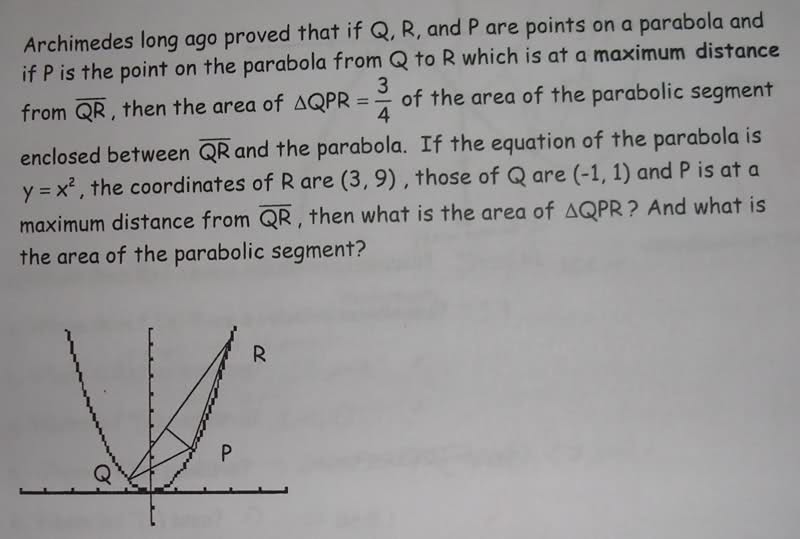
Homework Statement


29askxw.jpg


Homework Equations


y=x^2

Triangle QPR =3/4 of the area of the parabolic segment enclosed between QR and the parabola

The Attempt at a Solution


I don't know where to start :(
 
Physics news on Phys.org
Well, the area of the segment should be pretty easy to work out. Why don't you start there? It might give you some ideas on how to calculate the area of the triangle.
 
NateTG said:
Well, the area of the segment should be pretty easy to work out. Why don't you start there? It might give you some ideas on how to calculate the area of the triangle.

How do I calculate the area of the segment?
 
Do you know how to calculate the area between two functions f(x),g(x) for x \in (a,b)?
 
Rainbow Child said:
Do you know how to calculate the area between two functions f(x),g(x) for x \in (a,b)?

Nope, we haven't been taught that. We actually just started with integration today. Anyways, I think I kind of got the first step though -y=x^2

and then the equation of the line b/w Q and R can be found out
m = 9-1/ 3-(-1) = 8/4= 2
y-1=2(x+1)
y=2x+3

elminating y and we get:
x^2 - 2x -3

now what shall I do?
 
The area between two functions f(x),g(x) for x \in (a,b) is

\int_a^b|f(x)-g(x)|\,d\,x

In your case f(x)=2x+3,\,g(x)=x^2.

Now can you caclulate the area of the segment?
 
Rainbow Child said:
The area between two functions f(x),g(x) for x \in (a,b) is

\int_a^b|f(x)-g(x)|\,d\,x

In your case f(x)=2x+3,\,g(x)=x^2.

Now can you caclulate the area of the segment?

We just started integrating today, So I am not that confident about it :( I'll give it a shot though

2x+3-x^2
[(2x^2)/2] +3x- [(x^3)/3]
[x^2]+3x-[(x^3)/3]

I don't know what to do now
 
Correct! But it is a definite integral, so

I=\int_a^b|f(x)-g(x)|\,d\,x=(x^2+3x-\frac{x^3}{3})\Big|_{-1}^{3}
 
:cool:

now how shall I proceed?
 
  • #10
Did you find I?
 
  • #11
I don't know how to do that. Do I have to plug -1 and 3 into x?
 
  • #12
Ok!
(x^2+3x-\frac{x^3}{3})\Big|_{-1}^{3} means

(x^2+3x-\frac{x^3}{3})\Big|_{x=3}-(x^2+3x-\frac{x^3}{3})\Big|_{x=-1}
 
  • #13
So that just becomes

9 -(2 - (-1/3))
9 -(2.33)
6.67 units^2

?
 
  • #14
I think its better \frac{32}{3} :smile:
 
  • #15
Rainbow Child said:
I think its better \frac{32}{3} :smile:

Ooops! let me recheck
we first plug in 3 and get

[9+9 - (27/3)]
=9

and for the other side we get

-[1-3 - [-1/3] ]
-[-2 + [1/3]]
-[-1.67]
1.67

9+1.67 = 10.67 or 32/3 :)

aah so the area of the parabolic segment = 32/3 units^2
while the area of the Triangle = (3/4)*(32/3) = 96/12 = 8 units^2
 
  • #16
Yes! But I think you have to calulate the area of the triangle independently.
 
  • #17
Thank you! :smile:

But doesn't it say that "Triangle QPR =3/4 of the area of the parabolic segment enclosed between QR and the parabola"

so that makes the triangle areas 3/4 of 32/3units^2 which is equal to 8..right?

also can you please explain how you got 3 and -1 for the numbers to be plugged in?Thanks
Jennie
 
  • #18
...also can you please explain how you got 3 and -1 for the numbers to be plugged in?

The geometric meaning of the definite integral

\int_a^b|f(x)| \,d\,x

is the area between the graph of f(x) the x-axis and the vertical lines x=a,x=b

When you have two curves and you want the area between them you should use

\int_a^b|f(x)-g(x)| \,d\,x

where now x=a and x=b are the points where the two urves intersect. In your case these are x=-1, \,x=3.

But doesn't it say that "Triangle QPR =3/4 of the area of the parabolic segment enclosed between QR and the parabola"

so that makes the triangle areas 3/4 of 32/3units^2 which is equal to 8..right?

From the statement of the problem I think that first you should calculate the area of the triangle too, in order to see that Arcimedes was correct! :smile:

But I don't I take an oath! :smile:
 
  • #19
Thanks for the explanation about the definite integral :smile:

Rainbow Child said:
From the statement of the problem I think that first you should calculate the area of the triangle too, in order to see that Arcimedes was correct! :smile:

But I don't I take an oath! :smile:

Now how do we go about calculating the area of the triangle?
 
  • #20
I don't understand what \overline{QR} stands for. Does it stands for the chord QR?
 
  • #21
yes it does
 
  • #22
Ok! How can you calculate an area of a triangle if you know the coordinates of the vertices?
 
  • #23
but do we don't know the coordinates of point P.

1/2 * 8.944 * height
 
  • #24
Yes, but we know the propety that P satisfies.
 
  • #25
Rainbow Child said:
Yes, but we know the propety that P satisfies.

hmm so how do we go about using the the maximum distance from QR statement?
 
  • #26
That's the easy part :smile:

We already now the equation of the line QR. Let the coordinates of P be (x_0,x_0^2). Now what's the distance of P from the line QR?
 
  • #27
The distance equation is Ax+By+C/ sqrt (a^2+b^2)

so the distance will be 2(x0) + 1(xo^2) +3 / sqrt(4+1)
 
  • #28
You need an absolute value, and I think that

d=\frac{|2x_0-x_0^2+3|}{\sqrt{5}}

Correct?
 
  • #29
yes, you're right
 
  • #30
Good! :smile:

Now what's the maximum value of d? For which x_0 you obtain that?
 

Similar threads

  • · Replies 3 ·
Replies
3
Views
2K
  • · Replies 1 ·
Replies
1
Views
1K
Replies
5
Views
2K
  • · Replies 1 ·
Replies
1
Views
2K
  • · Replies 10 ·
Replies
10
Views
4K
  • · Replies 5 ·
Replies
5
Views
2K
Replies
4
Views
2K
  • · Replies 3 ·
Replies
3
Views
8K
  • · Replies 2 ·
Replies
2
Views
2K
  • · Replies 24 ·
Replies
24
Views
4K