Help Understanding TMDS - Dom Needs Your Help!

  • Thread starter Thread starter Severence
  • Start date Start date
Click For Summary
Dom is seeking assistance with understanding the TMDS datasheet for a SIL150A transmitter/encoder, specifically regarding the pinout for connecting RGB signals and synchronization inputs. He initially misinterprets the serial connections for the RGB signals, but others clarify that the inputs are parallel and require all 8 bits for each color simultaneously. The discussion also addresses the output configuration for a DVI setup, noting that TMDS uses differential pairs for transmission. There is confusion about whether the transmitter outputs analog or digital signals, with clarification that the output is a digitally modulated signal. Overall, the community provides guidance to help Dom better understand the TMDS setup.
Severence
Messages
3
Reaction score
0
Hi my names Dom, just joined the forum and look forward too getting to know you other members.

Hopefully I've posted this in the right section.

I'm struggling to understand a TMDS datasheet and was hoping someone with a bit more know-how could help me out (draw it in crayons for me) :D

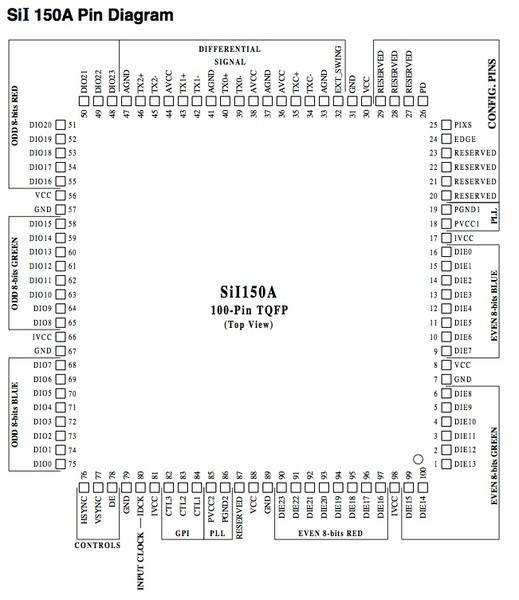
I have a source device that outputs three 8bit serial RGB lines as well as clock, Hsync and Vsync. I've read through the datasheet for a SIL150A TMDS transmitter/encoder and the pinout is confusing me.
Untitled.jpg


If i understand it correctly (unlikely) my serial 8 bit red signal would go to DIE23 Pin 90, green to DIE15 pin 99, and blue to DIE7 Pin 9 and this would give me 1-pixel clock input mode? input clock, HYSNC & VYSNC all seem pretty self explanatory to hook up (although I'm probably wrong about that too)

If the above is correct? what are the outputs to the corresponding inputs... for a DVI setup for example, is it TX1+ etc?

Thanks in advance to anyone who can help out.
 

Attachments

Last edited:
Engineering news on Phys.org
Edit: above, seems as though the transmitter above can only output analog (i think) and not digital, hdmi, dvi which is what I'm after, but the same principles apply to other TMDS transmitters such as analog devices ADV7513
 
Severence said:
I'm struggling to understand a TMDS datasheet and was hoping someone with a bit more know-how could help me out (draw it in crayons for me) :D

I looked at the datasheet and it's pretty self-explanatory. :rolleyes:


Severence said:
If i understand it correctly (unlikely) my serial 8 bit red signal would go to DIE23 Pin 90, green to DIE15 pin 99, and blue to DIE7 Pin 9

No, the inputs are parallel. You have to deliver the entire 8 bits for each colour at the same time (so for red you place a 8 bit value at DIE16-23. Check the Input Pin Description section in the datasheet PDF (p.4).

Severence said:
this would give me 1-pixel clock input mode?

No, PIXS held LOW sets 1-pixel mode.

Severence said:
what are the outputs to the corresponding inputs... for a DVI setup for example, is it TX1+ etc?

I don't know much about TDMS but it looks like it uses 4 differential pairs - TX0+/-, TX1+/-, TX2+/- and TXC+/- for transmission.
 
Severence said:
seems as though the transmitter above can only output analog (i think) and not digital, hdmi, dvi

The output is a digitally modulated signal, so the result is analog. That's Digital Communications 101.
 
Last edited:
Thanks for your resposne, youve been a great help.

I'll have a bash at it and report back :)

cheers.
 
I am trying to understand how transferring electric from the powerplant to my house is more effective using high voltage. The suggested explanation that the current is equal to the power supply divided by the voltage, and hence higher voltage leads to lower current and as a result to a lower power loss on the conductives is very confusing me. I know that the current is determined by the voltage and the resistance, and not by a power capability - which defines a limit to the allowable...

Similar threads

Replies
2
Views
2K
  • · Replies 2 ·
Replies
2
Views
1K
  • · Replies 10 ·
Replies
10
Views
4K
  • · Replies 12 ·
Replies
12
Views
2K
  • · Replies 7 ·
Replies
7
Views
3K
  • · Replies 3 ·
Replies
3
Views
3K
  • · Replies 1 ·
Replies
1
Views
8K
Replies
13
Views
2K
Replies
1
Views
3K
  • · Replies 2 ·
Replies
2
Views
5K