Help Urgently on Bijection, Injection, Subjection Functions

Click For Summary
The discussion focuses on understanding bijection, injection, and surjection functions, specifically through example problems involving finite sets A and B. The user seeks assistance with listing one-to-one, onto, and bijective functions between the sets, as well as proving properties of bijections involving function composition and inverses. There is confusion regarding the definitions and relationships between these types of functions, particularly in how one-to-one functions relate to being onto when the sets are of equal size. The user also expresses uncertainty about the notation and labeling of the problems presented. Clarification on these concepts is needed to resolve the user's queries effectively.
xZhongCheng
Messages
2
Reaction score
0
Hi, I would like to say this is a great forum I found. This is my very first post yay =)

I need help on these certain questions.

5. (10%) Given A = {1, 2, 3} and B = {a, b, c}
(a) list in two-line notation all one-to-one functions from A to B;
(b) list in two-line notation all onto functions from A to B;
(c) list in two-line notation all bijections from A to B.

6. (10%) Given two finite sets A and B such that |A| = |B|, prove or disprove that every one-to-one function from A to B is bijective.

7. (10%) Let f : A -> B and g : B -> C be bijections. Prove that
(a) g f is a bijection;
(b) (g o f)^-1 = f^-1 o g^-1

I will scan my page for 5. Numbers 6 and 7 I have no idea how to start it^-^^^^^?-
Number 5 i am having some troubles as well
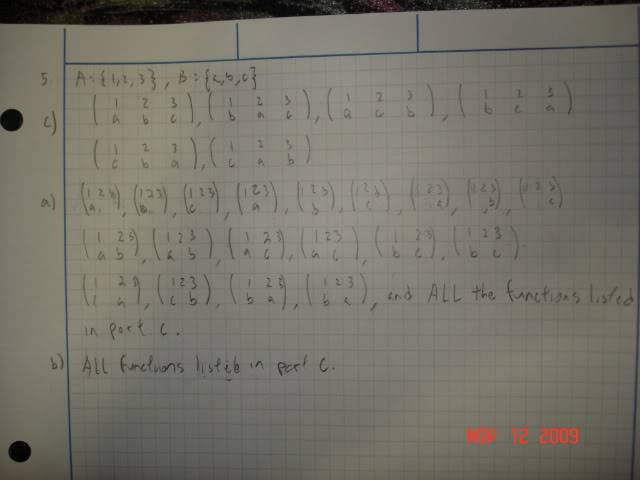
DSC03430.jpg
 
Physics news on Phys.org
if f:A-->B, where |A|=n, and |B|=m, then the total nr of functions from A to B is m^n. Now, if f is to be one to one with m=n, there will be n! functions(why?). But in this case every 1-1 function will be also an onto function (why?).
 
seems like you swapped question letters aorund?

if the function A-> B is onto, i think it should the image of A should be all of B, simlarly if the functions is 1:1 then f(a) = f(b) iff a=b, so eitehr way you look at it, i don;t agree with what you have labelled for a)
 
lanedance said:
seems like you swapped question letters aorund?

if the function A-> B is onto, i think it should the image of A should be all of B, simlarly if the functions is 1:1 then f(a) = f(b) iff a=b, so eitehr way you look at it, i don;t agree with what you have labelled for a)

I looked at the page for wiki where injection is just each argument is mapped to at most one value.

So It should be possible for some other values not mapped to any?
 
For 6. since f is one-to-one you want to show tha f is onto. i.e that for any b in B there is a in A such that f(a)=b.

let b=F^0(b),F(b),F^2(b)..., and these are all elements in a finite set,A, so cannot all be distinct. Let r,s, with say r>s, such that f^r(b)=f^s(b). Then we have:
=>F^(r-1)(b)=F^(s-1)(b)=...=F^(r-s)(b)=b=>F(a)=b, with a=F^(r-s-1)(b), where with F, i have denoted the inverse of f, it exists (why?)
 
Question: A clock's minute hand has length 4 and its hour hand has length 3. What is the distance between the tips at the moment when it is increasing most rapidly?(Putnam Exam Question) Answer: Making assumption that both the hands moves at constant angular velocities, the answer is ## \sqrt{7} .## But don't you think this assumption is somewhat doubtful and wrong?

Similar threads

Replies
1
Views
2K
  • · Replies 7 ·
Replies
7
Views
3K
  • · Replies 11 ·
Replies
11
Views
1K
Replies
5
Views
2K
Replies
12
Views
2K
Replies
4
Views
1K
  • · Replies 4 ·
Replies
4
Views
5K
  • · Replies 1 ·
Replies
1
Views
3K
  • · Replies 4 ·
Replies
4
Views
2K
  • · Replies 4 ·
Replies
4
Views
2K