Help with a statics problem finding free members and two force members

Join the discussion
Registration is free. Ask a follow-up in this thread, or start your own.
4 replies · 3K views
Zulliz
Messages
3
Reaction score
0
Homework Statement
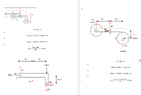
So ive gotten the problem i have to solve, and for some reason this 2-member forces and dividing the frame into members simply does not click with my brain, it should be so simple, yet i cannot get it right.

Ive attatched a picture of the problem as well as my intended equation for moment around point A, can you guys tell me if im on the right track?

And even better can you help me find the forces applied in A, B, C and D? Im completely stuck, for some reason my brain cannot comprehend this 2 force member stuff and i dont know why…
Relevant Equations
SUMof moments in clockwise direction around A = 0
Physics news on Phys.org
Welcome, @Zulliz !

Your first attempt seems to be correct, but representing the vector F at D would be better.

The horizontal 2F keeps pressure on point C, and the 2-member acts like one solid part.
 
Lnewqban said:
Welcome, @Zulliz !

Your first attempt seems to be correct, but representing the vector F at D would be better.

The horizontal 2F keeps pressure on point C, and the 2-member acts like one solid part.
But how would i go about it then? Can you elaborate? As I tried to explain my brain is simply shutting down on the two-force members and im having such a hard time understanding how to do them unfortunately.

Would i do sum of moments around B to find the force F pressing up at point C using the 2F x a - 2a x C?
 
Last edited:
Zulliz said:
But how would i go about it then? Can you elaborate? As I tried to explain my brain is simply shutting down on the two-force members and im having such a hard time understanding how to do them unfortunately.
If the problem requires you to analyze each part separately, do a free body diagram of each.
Represent the external given forces first.
Then, represent all the reactions (forces and torques) that the part would need to have acting on it in order to remain in static equilibrium (not moving).

Zulliz said:
Would i do sum of moments around B to find the force F pressing up at point C using the 2F x a - 2a x C?
You will need to calculate the magnitude of the force acting at D first, since that moment matters.
 
Reply
  • Like
Likes   Reactions: Zulliz
Lnewqban said:
If the problem requires you to analyze each part separately, do a free body diagram of each.
Represent the external given forces first.
Then, represent all the reactions (forces and torques) that the part would need to have acting on it in order to remain in static equilibrium (not moving).


You will need to calculate the magnitude of the force acting at D first, since that moment matters.
So something like this?
 

Attachments

  • statics.png
    statics.png
    18.2 KB · Views: 99
Last edited: