Help with Basic Circuits: i1, i2, i, V1, R, Power

  • Thread starter Thread starter Imposta
  • Start date Start date
  • Tags Tags
    Circuits
Click For Summary
The discussion revolves around a request for help with basic circuit analysis, specifically calculating currents (i1, i2, i), power from a voltage source, and resistance (R) based on given voltage and power values. Participants emphasize the importance of demonstrating understanding by showing work using Kirchhoff's Current Law (KCL) or Kirchhoff's Voltage Law (KVL) before seeking assistance. There is a clear expectation that users should utilize online resources for learning rather than relying solely on forum help. The complexity of the questions suggests a need for foundational knowledge in circuit theory, and participants encourage a step-by-step approach to problem-solving. Overall, the thread highlights the balance between seeking help and demonstrating effort in learning.
Imposta
Messages
3
Reaction score
0
My teacher has been absent most of the semester and the substiute hasn't been much help so I was wondering if you guys could help me out. Thanks

1. Find i1 and i2.
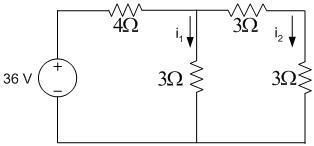
attachment.php?attachmentid=20979&stc=1&d=1254887607.jpg


2. (a) Determine the value of i.
(b) Find the power supplied by the dependent voltage source.
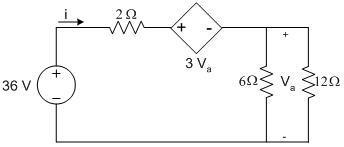
attachment.php?attachmentid=20980&stc=1&d=1254887607.jpg


3. (a) Find R if V1=30 V.
(b) Find R if power supplied by the current source is 1575 W.
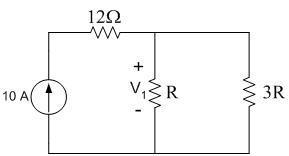
attachment.php?attachmentid=20981&stc=1&d=1254887607.jpg
 

Attachments

  • 1.JPG
    1.JPG
    5 KB · Views: 383
  • 2.JPG
    2.JPG
    4.8 KB · Views: 378
  • 3.JPG
    3.JPG
    4 KB · Views: 407
Physics news on Phys.org
Imposta said:
My teacher has been absent most of the semester and the substiute hasn't been much help so I was wondering if you guys could help me out. Thanks

1. Find i1 and i2.
attachment.php?attachmentid=20979&stc=1&d=1254887607.jpg


2. (a) Determine the value of i.
(b) Find the power supplied by the dependent voltage source.

attachment.php?attachmentid=20980&stc=1&d=1254887607.jpg


3. (a) Find R if V1=30 V.
(b) Find R if power supplied by the current source is 1575 W.

attachment.php?attachmentid=20981&stc=1&d=1254887607.jpg

It doesn't matter if your teacher is AWOL. You know how to use wikipedia and other learning resouces on the Internet. We do not do your homework for you here at the PF. Show us your KCL or KVL equations as an attempt at the solution. Then we can offer tutorial help if you have problems.
 
Did you read the bit above where it says not to put homework here?

The second and third question are at a much higher level than the first one, so I have to wonder if you really couldn't do even the first one?

Without doing it for you,
What is 3 ohms in series with 3 ohms?

What is the result of putting 3 ohms across this combination?

What is the result of putting 4 ohms in series with this combination?

Now put 36 volts across the whole set of resistors and what current flows?

How much voltage is there across the 4 ohm resistor?

How much voltage is across the combination of 3 ohm resistors?

So, how much current is flowing in the single 3 ohm resistor?

How much is flowing in the series 3 ohm resistors?
 
The book claims the answer is that all the magnitudes are the same because "the gravitational force on the penguin is the same". I'm having trouble understanding this. I thought the buoyant force was equal to the weight of the fluid displaced. Weight depends on mass which depends on density. Therefore, due to the differing densities the buoyant force will be different in each case? Is this incorrect?

Similar threads

  • · Replies 9 ·
Replies
9
Views
2K
  • · Replies 1 ·
Replies
1
Views
2K
  • · Replies 2 ·
Replies
2
Views
2K
Replies
2
Views
1K
  • · Replies 6 ·
Replies
6
Views
4K
Replies
8
Views
2K
Replies
1
Views
1K
  • · Replies 7 ·
Replies
7
Views
5K
  • · Replies 7 ·
Replies
7
Views
3K
  • · Replies 1 ·
Replies
1
Views
5K