Help with determining the direction of induced currents

Click For Summary
Induced currents in loops A, B, and C are discussed in relation to their proximity to a long straight wire carrying current. For loop A, no current is induced, while loop B experiences a counterclockwise induced current, and loop C has a clockwise induced current. The concept of induced current is clarified through Faraday's law, which relates changing magnetic flux to electromotive force (emf), and Lenz's law, which helps determine the direction of the induced current. Additionally, the direction of the current induced in a resistor when a switch is closed is also examined. Understanding these principles is crucial for analyzing electromagnetic induction scenarios.
riseofphoenix
Messages
294
Reaction score
2
2. Three loops of wire move near a long straight wire carrying a current as in the following figure.
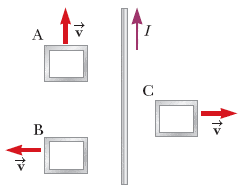
20-p-009.gif


(a) What is the direction of the induced current, if any, in loop A?

a. clockwise
b. counterclockwise
c. No current is induced. (ANSWER)

WHY IS "C" THE ANSWER? I don't understand the concept of determining the direction of an induced current. What does an induced current even mean?? Is it a current caused by something else (such as a long wire in this case)?

(b) What is the direction of the induced current, if any, in loop B?

a. clockwise
b. counterclockwise (ANSWER)
c. No current is induced.

:(:(!

(c) What is the direction of the induced current, if any, in loop C?

a. clockwise (ANSWER)
b. counterclockwise
c. No current is induced.


5. In the figure below what is the direction of the current induced in the resistor at the instant the switch is closed?
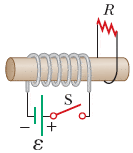
20-p-014.gif


a. The current out of the page.
b. No current is present.
c. The current is into the page.
 
Physics news on Phys.org
You need to study up on http://hyperphysics.phy-astr.gsu.edu/%E2%80%8Chbase/electric/farlaw.html#c1 and http://hyperphysics.phy-astr.gsu.edu/%E2%80%8Chbase/electric/farlaw.html#c2.
 
Ohh thanks!
 
riseofphoenix said:
2. Three loops of wire move near a long straight wire carrying a current as in the following figure.

20-p-009.gif


(a) What is the direction of the induced current, if any, in loop A?

a. clockwise
b. counterclockwise
c. No current is induced. (ANSWER)

WHY IS "C" THE ANSWER? I don't understand the concept of determining the direction of an induced current. What does an induced current even mean?? Is it a current caused by something else (such as a long wire in this case)?

Faraday: emf = -N d(phi)/dt. Is there a d(phi)/dt for coil A?
phi = B x area of coil.

The others are similarly solved. As Doc Al says, you need Lenz' law to determine direction if a current is induced. Applies to problem 5 also.


b) What is the direction of the induced current, if any, in loop B?[/B]

a. clockwise
b. counterclockwise (ANSWER)
c. No current is induced.

:(:(!

(c) What is the direction of the induced current, if any, in loop C?

a. clockwise (ANSWER)
b. counterclockwise
c. No current is induced.


5. In the figure below what is the direction of the current induced in the resistor at the instant the switch is closed?

20-p-014.gif


a. The current out of the page.
b. No current is present.
c. The current is into the page.
 
The book claims the answer is that all the magnitudes are the same because "the gravitational force on the penguin is the same". I'm having trouble understanding this. I thought the buoyant force was equal to the weight of the fluid displaced. Weight depends on mass which depends on density. Therefore, due to the differing densities the buoyant force will be different in each case? Is this incorrect?

Similar threads

Replies
4
Views
1K
  • · Replies 1 ·
Replies
1
Views
2K
  • · Replies 2 ·
Replies
2
Views
2K
Replies
8
Views
1K
Replies
1
Views
1K
Replies
3
Views
1K
  • · Replies 0 ·
Replies
0
Views
984
  • · Replies 1 ·
Replies
1
Views
2K
  • · Replies 3 ·
Replies
3
Views
3K
  • · Replies 10 ·
Replies
10
Views
2K