Help with Material Selection Process

Click For Summary
SUMMARY

The discussion focuses on the material selection process for a shaft in a hand winch design, specifically addressing the calculation of maximum stress using the formula σ_max = (M_max*y)/I, resulting in a stress value of 31.2 MPa. Participants emphasize the importance of comparing this maximum stress with the yield strength of potential materials and highlight the need to consider deflection and external compression forces due to the design of a hollow drum. The conversation concludes that external compression forces, particularly from the rope tension, are critical and can significantly impact the structural integrity of the winch.

PREREQUISITES
  • Understanding of mechanical stress calculations, specifically σ_max = (M_max*y)/I
  • Knowledge of yield strength and material properties
  • Familiarity with deflection analysis in structural design
  • Concept of hoop stress in hollow cylindrical structures
NEXT STEPS
  • Research material properties relevant to yield strength for shaft applications
  • Learn about deflection calculations in beams and shafts
  • Study the effects of hoop stress on hollow cylindrical structures
  • Explore design considerations for winch mechanisms, including load distribution
USEFUL FOR

Mechanical engineers, product designers, and anyone involved in the design and analysis of load-bearing structures, particularly in winch and pulley systems.

chessguy103
Messages
13
Reaction score
3
Hi all,

I'm working on designing a device, and I'm having trouble with material selection for a shaft, modeled below.
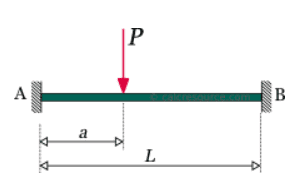
1618602281239.png

I have found the maximum stress due to bending on the shaft in question by using

σ_max = (M_max*y)/I

where σ is stress, M is bending moment, y is distance from the neutral axis (aka radius of shaft), and I is polar moment of interia.

I got σ = 31.2 MPa. This is where I'm stuck. Now that I have this stress, how do I choose a material? Do I just look at yield strength?

Any help is appreciated. Thanks :)
 
Engineering news on Phys.org
You should also check the deflection. But generally yes, compare the maximum stress with yield strength.
 
  • Like
Likes   Reactions: chessguy103
Thank you.

And once I find the deflection, what do I do with that value?
 
chessguy103 said:
And once I find the deflection, what do I do with that value?
Does the shaft rotate? At what RPM?
Is the shaft subject to axial forces?
 
In the scenario I'm looking at, no it doesn't rotate. I'm trying to model a hand winch with a force applied through the rope, but with the brake activated so that no parts are moving.
 
chessguy103 said:
I'm trying to model a hand winch with a force applied through the rope, but with the brake activated so that no parts are moving.
Warning. There is a hidden trap here.
To prevent damage to the (wire?) rope, the shaft = drum = spool must have a large radius. It will therefore be fabricated from a hollow tube. How thick must the tube wall be? The tension in the rope, multiplied by the maximum number of turns will provide an external hoop compressive force to the drum. That will cause the drum to fail through external compression, long before the shaft deflects.
 
  • Like
Likes   Reactions: chessguy103
I’m modeling my winch based on a winch that I bought and disassembled. It had a hollow drum, but inside the hollow drum was another hollow tube to allow for spinning. Inside the second hollow tube there was a bolt that went through the tube (and therefore the drum), and held everything together against the shell.

The compression force makes sense, and i should add that to the model. But would failure through external compression be that much of an issue in this case?
 
chessguy103 said:
But would failure through external compression be that much of an issue in this case?
It is n times more significant than the deflection; where n is the number of turns posible on the drum.
 
  • Like
Likes   Reactions: chessguy103
Also, let’s say tension on the rope is 1000 N. If the total number of turns on the drum is 20, then the compressive force is 20000 N? I assume that would be applied as a uniform distributed load across the surface area of the drum, in addition to the 1000 point load tension?
 
  • #10
20 turns at 1000 N tension will be 20 kN as a hoop stress around the outer surface of the drum. The drum section is under that hoop compression, as if an external pressure was being applied to the drum surface.

FYI: https://www.irjet.net/archives/V6/i4/IRJET-V6I4746.pdf
 
  • Like
Likes   Reactions: chessguy103

Similar threads

Replies
2
Views
3K
Replies
3
Views
2K
Replies
3
Views
2K
  • · Replies 16 ·
Replies
16
Views
3K
  • · Replies 4 ·
Replies
4
Views
2K
  • · Replies 2 ·
Replies
2
Views
2K
Replies
1
Views
2K
  • · Replies 3 ·
Replies
3
Views
2K
  • · Replies 2 ·
Replies
2
Views
2K