Help with negative charges in an electric field.

Click For Summary
SUMMARY

The discussion centers on the behavior of negative charges in an electric field, specifically how they can move towards higher electric potential while losing electric potential energy. It is established that for positive charges, movement from high to low potential results in a loss of potential energy, while negative charges experience the opposite force direction. The potential energy formula, U = qV, indicates that a negative charge moving towards a higher potential must do work against the electric force, resulting in a gain of potential energy and a loss of kinetic energy. The distinction between electric potential and potential energy is crucial in understanding these dynamics.

PREREQUISITES
  • Understanding of electric fields and forces
  • Familiarity with the concepts of electric potential and potential energy
  • Basic knowledge of electrostatics and charge behavior
  • Ability to interpret diagrams related to electric fields
NEXT STEPS
  • Study the relationship between electric potential and potential energy in electrostatics
  • Explore the mathematical formulation of electric fields and forces on different charges
  • Investigate the implications of charge movement in varying electric potentials
  • Review diagrams illustrating electric field lines and charge interactions
USEFUL FOR

Students of physics, educators teaching electrostatics, and anyone seeking to deepen their understanding of charge behavior in electric fields.

Sarah0001
Messages
31
Reaction score
1
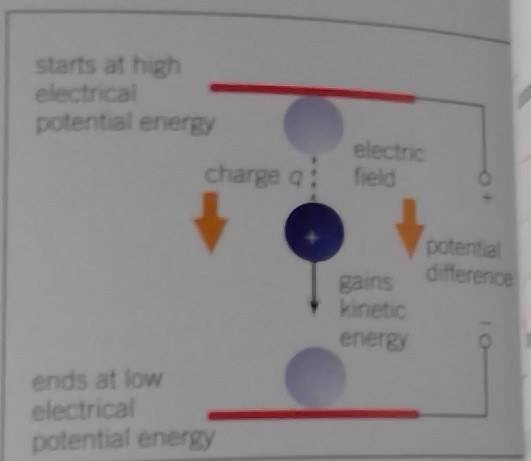
How can a negative charge move towards a position of a higher electric potential from lower potential but lose electric potential energy?
WIN_20190401_16_59_42_Pro.jpg
From my understanding, I understand that for a positive charge, it must lose potential energy from the electric field as work is done by the electric force in the direction of the E-field as seen in the diagram. This can be seen as it moves from high electrical potential energy to low potential energy. However, for a negative charge, it would do work up this electric field. I do not understand how it can do work and as the diagram suggests gain electrical potential energy as it moves up to a higher potential energy.
 
Physics news on Phys.org
Potential in Electrostatics is not the same thing as potential energy. Your argument essentially shows this.

The direction of the force on negative and positive charges is opposite. The formulation of potential energy in the two cases, therefore, must be different for the same electric field.
 
  • Like
Likes   Reactions: Ibix
The diagram is not correct for a negative charge. The field and potential difference are the same, those are caused by other charges external to ##q##. But the force it feels is toward the positive terminal, and the potential energy ##U = qV## is lower when ##V## is higher, at the positive terminal. In that diagram a negative charge moving downward is moving against the force. It would have to do work against the force to gain potential energy and thus lose kinetic energy.
 

Similar threads

  • · Replies 7 ·
Replies
7
Views
2K
  • · Replies 8 ·
Replies
8
Views
2K
  • · Replies 3 ·
Replies
3
Views
2K
  • · Replies 21 ·
Replies
21
Views
4K
  • · Replies 2 ·
Replies
2
Views
1K
  • · Replies 11 ·
Replies
11
Views
2K
  • · Replies 3 ·
Replies
3
Views
2K
  • · Replies 1 ·
Replies
1
Views
1K
  • · Replies 73 ·
3
Replies
73
Views
6K
  • · Replies 4 ·
Replies
4
Views
2K