Help with Ptolemy metric space

Click For Summary
SUMMARY

The discussion focuses on proving Ptolemy's inequality in the context of Euclidean space R^n, specifically addressing the relationship between distances defined by the Euclidean norm. The user seeks clarification on how to demonstrate that R^n satisfies Ptolemy's inequality using a suitable Möbius transformation, as referenced in a related paper. The paper suggests that by positioning point z as the midpoint of points y and w, one can derive the necessary conditions to establish the inequality. The inquiry highlights the need for a deeper understanding of Möbius transformations in this geometric context.

PREREQUISITES
  • Understanding of Ptolemy's inequality in metric spaces
  • Familiarity with Euclidean space R^n and its properties
  • Knowledge of Möbius transformations and their applications
  • Basic concepts of triangle inequalities in geometry
NEXT STEPS
  • Research the properties of Möbius transformations and their role in geometry
  • Study the proof of Ptolemy's inequality in various metric spaces
  • Explore the implications of triangle inequalities in Euclidean geometry
  • Examine related geometric configurations and their proofs in R^n
USEFUL FOR

Mathematicians, geometry enthusiasts, and students studying metric spaces and inequalities, particularly those interested in the applications of Ptolemy's inequality in Euclidean spaces.

ypatia
Messages
6
Reaction score
0
Ptolemy metric space. Help!

The problem is :
"Let x,y,z,t belongs to R^n where d(x,y)=||x-y||.
Show that(Ptolemy's inequality):
d(x,y)d(z,t)<=d(x,z)d(y,t)+d(x,t)d(y,z)"


I have found this related to the topic paper but I cannot show that the Euclidean space R^n is Ptolemy.
The paper in the second page "2.Preliminaries" says that "To show that the Euclidean space R^n is Ptolemy, consider again four points x,y,z,w. Applying a suitable Mobius transformation we can assume that z is a midpoint of y and w, i.e. |yz|=|zw|=1/2 |yw|. For this configuration...."
But how can we extract from the above paragraph that the Euclidean space R^n is Ptolemy and which is the "suitable Mobius transformation"??


Thanks anyone in advance.
 
Physics news on Phys.org
In a tendon quadrangle
\ square ABCD
look at the triangle
 \ triangle ABC
with the separate point D on its circumference with radius r and the associated base triangle
\ triangle LMN
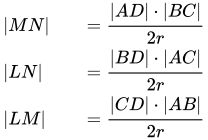
, The formula for calculating the side lengths of a base triangle then returns for
\ triangle LMN
:

{\ begin {aligned} & | MN | & = {\ frac {| AD | \ cdot | BC |} {2r}} \\ & | LN | & = {\ frac {| BD | \ cdot | AC |} {2r}} \\ & | LM | & = {\ frac {| CD | \ cdot | AB |} {2r}} \\\ end {aligned}}

220px-Ptolemy_inequality_proof.svg.png


But now that D is on the perimeter of
\ triangle ABC
is, is
\ triangle LMN
degenerate and its sides lie on the corresponding Simson line , so that the two sides LM and NM complement each other to the third side LN . It therefore applies:

| LM | + | NM | = | LN |

With the above equations, this provides:

| AB | \ cdot | CD | + | BC | \ cdot | AD | = | AC | \ cdot | BD |

If D is not on the circumference, then due to the triangle inequality for
\ triangle LMN
:

|> | | LM | + | NM LN |

The above equations then provide the inequality of Ptolemy:

| AB | \ cdot | CD | + | BC | \ cdot | AD |> | AC | \ cdot | BD |
Source: https://de.wikipedia.org/wiki/Satz_von_Ptolemäus
Translation: Google chrome
 

Similar threads

  • · Replies 0 ·
Replies
0
Views
2K
  • · Replies 17 ·
Replies
17
Views
2K
  • · Replies 2 ·
Replies
2
Views
3K
  • · Replies 16 ·
Replies
16
Views
3K
  • · Replies 7 ·
Replies
7
Views
4K
  • · Replies 2 ·
Replies
2
Views
2K
  • · Replies 5 ·
Replies
5
Views
2K
  • · Replies 9 ·
Replies
9
Views
3K
  • · Replies 11 ·
Replies
11
Views
4K
  • · Replies 19 ·
Replies
19
Views
3K