Help with this quantum circuit textbook problem about controlled gates

Click For Summary
The discussion centers around a user's difficulty with understanding controlled gates in quantum mechanics, particularly from the textbook "Quantum Mechanics: A General Introduction." The user identifies their background as a networking major with basic skills in quantum mechanics. A mentor advises that assistance can only be provided if the user attempts the problem first and suggests referencing similar problems from the textbook. Additionally, the mentor recommends using a quantum circuit simulator to aid in understanding and verifying work. The conversation emphasizes the importance of foundational knowledge and practical tools in grasping quantum concepts.
kellys
Messages
1
Reaction score
0
Summary:: My skills are very very basic and I'm more a networking major but i had to take a quantum mechanics class, i have trouble with this xcercise from textbook quantum mechanics a general introduction

[Mentor Note -- Thread moved from the Technical forums so no Homework Template is shown]

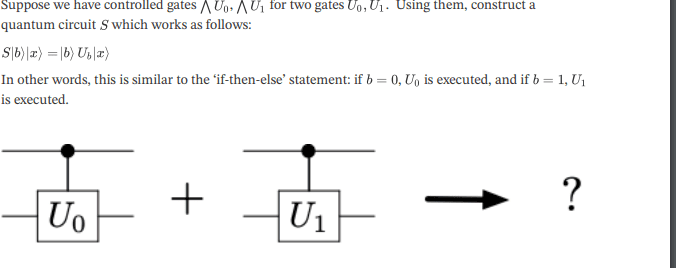
i am still struggling with the concept of controlled gates
1588757959937.png
 
Last edited by a moderator:
Physics news on Phys.org
kellys said:
Summary:: My skills are very very basic and I'm more a networking major but i had to take a quantum mechanics class, i have trouble with this xcercise from textbook quantum mechanics a general introduction

[Mentor Note -- Thread moved from the Technical forums so no Homework Template is shown]

i am still struggling with the concept of controlled gates
View attachment 262160
Welcome to the PF. :smile:

Per the PF Homework rules, we can only help you if you at least try to start working on the problem. Can you show us similar problems that your textbook explains?
 
Not sure what your actual question is, but regardless I recommend using a quantum circuit simulator since it can be very helpful for checking your work: https://algassert.com/quirk
 
The book claims the answer is that all the magnitudes are the same because "the gravitational force on the penguin is the same". I'm having trouble understanding this. I thought the buoyant force was equal to the weight of the fluid displaced. Weight depends on mass which depends on density. Therefore, due to the differing densities the buoyant force will be different in each case? Is this incorrect?

Similar threads

  • · Replies 9 ·
Replies
9
Views
2K
  • · Replies 6 ·
Replies
6
Views
3K
Replies
1
Views
3K
  • · Replies 25 ·
Replies
25
Views
5K
  • · Replies 2 ·
Replies
2
Views
3K
  • · Replies 6 ·
Replies
6
Views
3K
  • · Replies 19 ·
Replies
19
Views
2K
  • · Replies 11 ·
Replies
11
Views
5K
  • · Replies 4 ·
Replies
4
Views
3K
  • · Replies 4 ·
Replies
4
Views
4K