Herodotus Machine: Tilting & Force Calculation

  • Context: Undergrad 
  • Thread starter Thread starter adapterant
  • Start date Start date
  • Tags Tags
    Machine
Click For Summary

Discussion Overview

The discussion revolves around the mechanics of the "Herodotus Machine," specifically focusing on the calculations required to determine the force needed to tilt a block from a level position to its tipping point. Participants explore various approaches to modeling this machine, including considerations of mechanical advantage and the impact of block height on force calculations.

Discussion Character

  • Exploratory
  • Technical explanation
  • Debate/contested
  • Mathematical reasoning

Main Points Raised

  • One participant seeks to calculate the force needed to tilt a block using a cross beam and questions the relevance of the block's height in these calculations.
  • Another participant suggests using levers from the bottom of the block and proposes a work and energy approach instead of a force-based analysis.
  • A participant believes they have derived a solution involving mechanical advantage and presents a formula for calculating the length required to tilt the block.
  • There is a discussion about the stability of the block when using different methods of lifting, with a caution against upending the block for lifting purposes.
  • Some participants note the need for the beam to be positioned upright for better leverage when tilting the block.

Areas of Agreement / Disagreement

Participants express differing views on the best approach to analyze the mechanics of the Herodotus Machine, with no consensus reached on the most effective method or the implications of block height on force calculations.

Contextual Notes

There are unresolved assumptions regarding the definitions of mechanical advantage and the specific configurations of the machine being discussed. The calculations presented depend on various factors that have not been fully clarified.

adapterant
Messages
6
Reaction score
0
I started looking into the operation of a really simple machine called the "Herodotus Machine". A quick Google search gives some good info on it https://www.google.com/webhp?sourceid=chrome-instant&ion=1&espv=2&ie=UTF-8#q=Herodotus+Machine . I wanted to use a block that was taller than it was wide and determine first what force would be needed to tilt it from a level position to its tipping point. Here is my work on the counter clockwise rotation of the block.
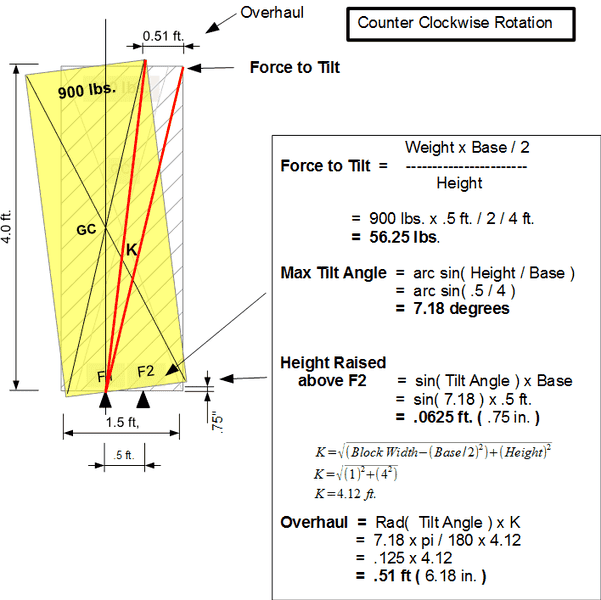
upload_2015-9-24_11-39-23.png


Tilting it back to a level position requires more force and below is what I believe is a correct for calculating that force, moving the block in a clockwise direction.
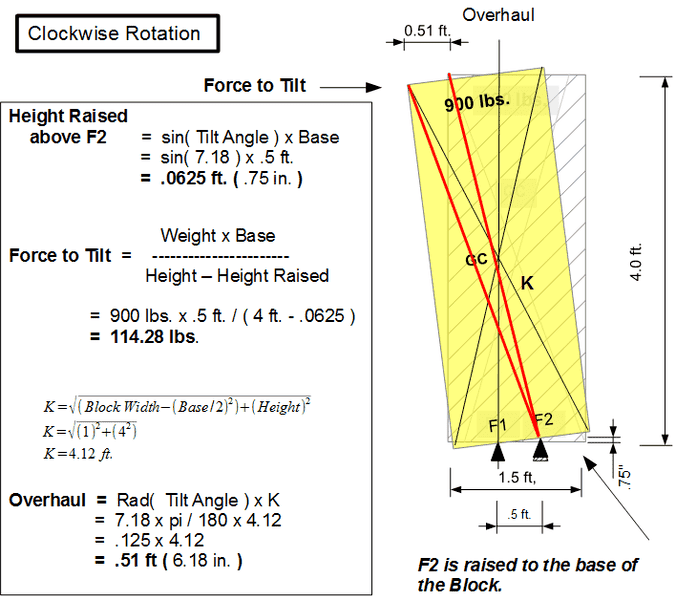
upload_2015-9-24_11-50-13.png
What has perplexed me is how to calculate this action when one uses a cross beam, across the top of the block, to tilt it back and forth. I would sure appreciate some help in solving the missing values in the next image. I set the Mechanical Advantage provided by the cross beam to 4. The missing values I'd like to come up with are in red. One point to consider, does the height of the block make any difference in the calculation. If it doesn't, then the force needed to tilt in the previous examples are irrelevant. If that is the case then what would be the force needed to tilt the block from a level position and from a tilted position with a beam that could provide a MA of 4.
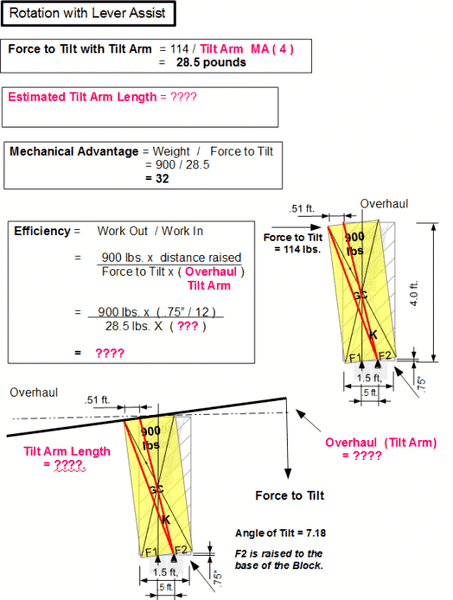
upload_2015-9-24_11-39-23.png
upload_2015-9-24_11-50-13.png
upload_2015-9-24_11-56-49.png
upload_2015-9-24_11-39-23.png
upload_2015-9-24_11-50-13.png
upload_2015-9-24_11-56-49.png


upload_2015-9-24_11-56-49.png
 
Physics news on Phys.org
You diagrams do not follow the designs in the links provided.
Rocking the block to raise it woul work better, and easier to model, if you use levers from the bottom.
Instead of a force-based analysis, try work and energy.
 
Simon, thanks for taking note. That link shows what has been considered to be the original design from way back. I didn't make that video. They did a pretty good job though.
I believe that I have come up with a solution to my problem. I thought that the Mechanical Advantage that the block exhibited when being pushed from its top, as shown in the 1st and 2nd drawings, added to the overall MA when the Tilt Lever was added. As it turns out the height of the block only serves to carry mass (weight). The following is correct I believe and gives the main items I was looking for:

Force to Tilt x Length x cos(Tilt Angle) = Weight x (F1 to F2)

Length = ( 900 pounds x .5 ) / 28.5 pounds x cos( 7.14 )

Length = 15.9 feet.

Total Length = 2 x 15.9 ft. + ( F1 to F2 )

= 32.3 feet

And you could have this top or bottom of the block. I guess it would depend on how you wanted to remove the block from the machine once it was to the height you wanted.
 
The link top of post #1 is to a google search page.
Most of the search results show a ramp and lever arrangememt, with holes in the ramp.
It looks like you are thinking of rocking the block while inserting chocks.

You would not really want to upend the block for lifting by this method... its less stable that way, even if tall blocks are usually easier to rock.
 
My bad, the link is a look at more than one version of what could be a Herodotus Machine. I was trying to examine the one where the block is tilted up and a short wood piece is slid under it. and it is really any ones guess that this is a more accurate version than any other. Herodotus didn't leave a lot to go on.
 
To get the benifit of adding a beam to your setup, you need it upright rather than across the top.
You appear to be doing thevanalysis by rule... try using physics instead.
 
Yes, placing the beam upright along the side does give one additional leverage when tilting.

upload_2015-9-26_10-0-0.png
 

Similar threads

  • · Replies 13 ·
Replies
13
Views
2K
  • · Replies 11 ·
Replies
11
Views
3K
  • · Replies 16 ·
Replies
16
Views
3K
  • · Replies 9 ·
Replies
9
Views
3K
Replies
16
Views
5K
Replies
4
Views
2K
  • · Replies 4 ·
Replies
4
Views
12K
  • · Replies 5 ·
Replies
5
Views
6K
  • · Replies 8 ·
Replies
8
Views
4K
  • · Replies 1 ·
Replies
1
Views
3K