High Voltage Discharges or Explosions from Powerlines -- why these colors?

Click For Summary
SUMMARY

This discussion centers on the phenomenon of high voltage discharges from power lines, specifically the color changes observed during electrical explosions captured on video in Cabo Rojo, Puerto Rico. The blue color is attributed to electrons exciting N2 + ions in the stratosphere, while the red color results from the excitation of neutral nitrogen molecules in the mesosphere. The conversation explores potential causes for the color transitions, including transformer failures and the ionization of air molecules, emphasizing the complexity of the event and the various factors influencing the observed colors.

PREREQUISITES
  • Understanding of electrical discharge phenomena
  • Familiarity with atmospheric chemistry and ionization processes
  • Knowledge of high voltage power transmission systems
  • Experience with video analysis and interpretation of transient luminous events
NEXT STEPS
  • Research the chemistry of electrical arcs and their color emissions
  • Explore the mechanics of high voltage transformer failures
  • Study Transient Luminous Events (TLEs) and their atmospheric conditions
  • Investigate the effects of power line proximity on radio frequency interference
USEFUL FOR

Electrical engineers, atmospheric scientists, and anyone interested in the effects of high voltage electricity on the environment and the phenomena of electrical discharges.

astroscout
Messages
62
Reaction score
4
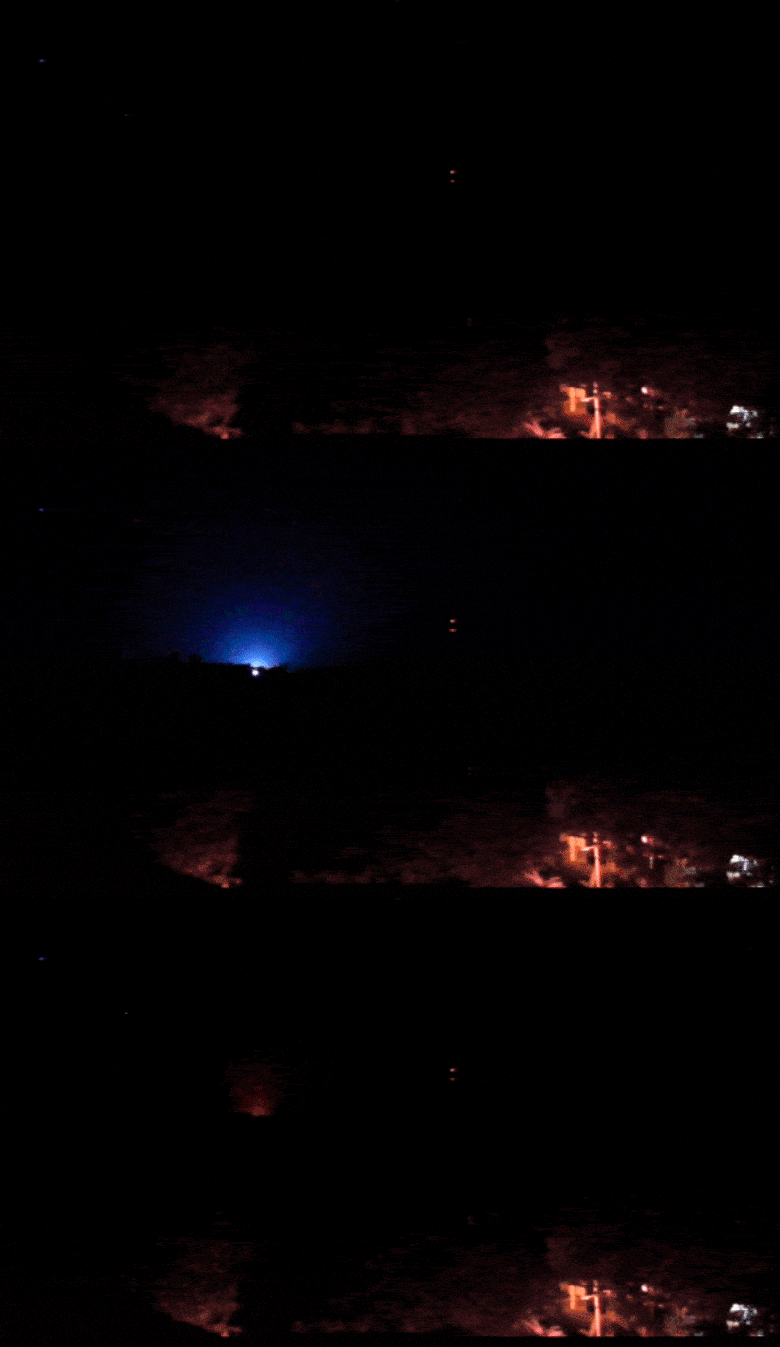
Hi...Here is a GIF of some electrical explosions that I recorded with my full spectrum camera. These power lines supply power to a neighboring county so it didn't affect my area. In the upper atmosphere we see something similar in Transient Luminous Events (TLEs). In the case of the blue in Blue Jets and Gigantic Jets, the blue would be caused by electrons exciting N2 + ion in the stratosphere and the red would be caused by the electrons exciting neutral nitrogen molecules located in the mesosphere.

My question is what could have made these Hi voltage explosions go from blue to red?
Hi_volt_gif.gif
 

Attachments

  • Hi_volt_gif.gif
    Hi_volt_gif.gif
    61.7 KB · Views: 1,741
Engineering news on Phys.org
That video raises lots of questions.

The animated GIF repeats. How long is it without repeats?

If this was lightning on power lines, it would not flash every 2 seconds so regularly.

Where was this taken?
Did you make the video yourself?
What was the weather?
How are you sure it is power lines?
 
These are actually 3 separate video captured frames combined to create this GIF to show that at one time the explosion was blue and then later it was red. After the red there was one more blue flash. You can view the video at:

These images were taken in Cabo Rojo, Puerto Rico about 2 years ago. Our power grid has been failing for years now and Hurricane Maria has dealt the final blow.
I did take the video myself and actually saw the explosions with my own eyes.
It was a clear night with no signs of any storms nearby, so we can rule out lightning.
I am sure these were high voltage transmission lines because I've seen them. There are no houses where these explosions occurred. These high voltage lines run over the main road and continue to the neighboring county. When you are in your car listening to the radio, you will hear static when you pass under these lines.

Here are the two separate video captures.
 

Attachments

  • Hi_voltage_blue.jpg
    Hi_voltage_blue.jpg
    9.3 KB · Views: 527
  • Hi_voltage_red.jpg
    Hi_voltage_red.jpg
    7.2 KB · Views: 535
astroscout said:
It was a clear night with no signs of any storms nearby, so we can rule out lightning.

then it could have been as simple as a failure in the power grid, transformer failures are reasonably common on their own
without outside help ... stray animals etc
 
Yes, but are the blue and red flashes caused by a chemical in the transformer, if it was a transformer, or is it the ionization of molecules in the air?

Here is a Gigantic Jet lightning event that I photographed back in 2011 that clearly shows the blue ionization and just barely shows the red ionization towards the top.
2011_GJ_800dpi.jpg
 

Attachments

  • 2011_GJ_800dpi.jpg
    2011_GJ_800dpi.jpg
    29.9 KB · Views: 793
Last edited:
My bet is that the red glow is thermal - something got hot during the arc and glows while cooling down.
 
  • Like
Likes   Reactions: Asymptotic and jim hardy
OK, so it is not blinking every 2 seconds. That really threw me off.

There could be many scenarios. A transformer starts a fire that spreads. A manual attempt to re-close the circuit breaker on a persistent short circuit. Arrival of emergency vehicle on the scene. The video gives far too little clues for informed speculation.

I would not compare it with red/blue sprites in the upper atmosphere like your photo in #5.
 
How much "later"? Could just be something caught on fire.
 
CWatters...It was around 3 minutes later.

anortunda...I was just curious to find out if the blue and the red was caused by ionization of molecules in the air due to the high voltage or if maybe it was a chemical reaction caused by the transformer. I saw a video once of a physicist from the Florida Institute of Technology, that used a Van de Graaff generator to demonstrate what we see in Blue Jets. Here is the video:

 
Last edited:
  • #10
I love your curiosity. Keep it. But in this case there are too many possibilities to give an answer.

https://en.wikipedia.org/wiki/Electrical_breakdown#Persistent_arcs said:
The color of an arc depends primarily upon the conducting gasses, some of which may have been solids before being vaporized and mixed into the hot plasma in the arc. The free ions in and around the arc recombine to create new chemical compounds, such as ozone, carbon monoxide, and nitrous oxide. Ozone is most easily noticed due to its distinct odour.

In other words, vaporized electrical components contribute to the gasses.

With blue/red sprites high in the atmosphere, we can safely assume normal mixes of gas at altitude, free of contaminants. That is a reason why they don't compare well with this incident.
 
  • #11
Thank You anorlunda...I love science and I love contributing what I can to the advancement of it.
 

Similar threads

  • · Replies 2 ·
Replies
2
Views
4K
  • · Replies 9 ·
Replies
9
Views
4K
  • · Replies 6 ·
Replies
6
Views
3K
  • · Replies 9 ·
Replies
9
Views
13K
  • · Replies 1 ·
Replies
1
Views
4K
  • · Replies 4 ·
Replies
4
Views
9K
  • · Replies 1 ·
Replies
1
Views
3K