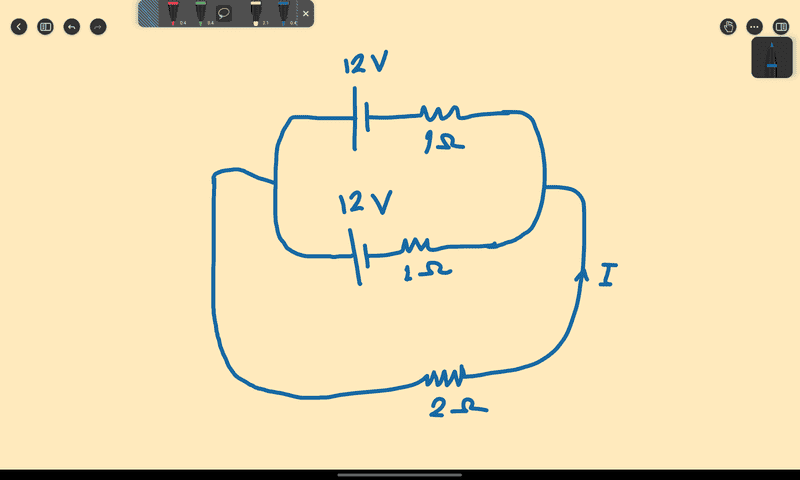
Homework help : The difference between these 2 circuits

Click For Summary

Homework Help Overview

The discussion revolves around understanding the differences between two electrical circuits involving batteries, specifically focusing on the implications of merging two batteries and the resulting voltage. The subject area is electrophysics, with an emphasis on circuit analysis and battery configurations.

Discussion Character

  • Exploratory, Assumption checking, Conceptual clarification

Approaches and Questions Raised

  • Participants explore the concept of merging two batteries and question why the resulting voltage is perceived as 12 volts instead of 24 volts. There are attempts to clarify the arrangement of the batteries and whether they are in series or parallel. Some participants suggest redrawing the circuits for better understanding.

Discussion Status

The discussion is active, with participants expressing differing views on the configuration of the batteries and the resulting voltage. Some have provided guidance on how to visualize the circuits, while others have raised concerns about potential misunderstandings regarding circuit theory. There is no explicit consensus on the interpretation of the circuits.

Contextual Notes

Participants note that there may be confusion regarding the definitions of series and parallel connections, and some express the need for further clarification on these concepts. Additionally, there is mention of the original poster's language background, which may influence their understanding of the technical terms used in the discussion.

Maghraby
Messages
8
Reaction score
1
Homework Statement
Electrophysics
Relevant Equations
the source voltage
I want to know the difference between the two circuits below , and Why don't I bundle both batteries into one 24V battery?
pls help me in this .
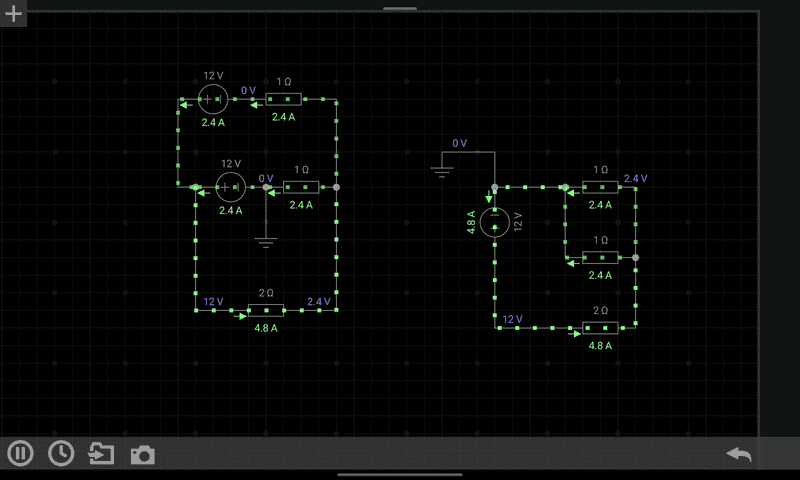
Screenshot_20231124-142953_EveryCircuit.png


This is the original circuit:

Screenshot_20231124-151612_Notein.png


And to merge the two batteries , What is the resulting value of a battery resulting from the merger?
I thought that the value would be 24 volts, but after experimenting on the application, I found that it must be 12 volts, how is that?
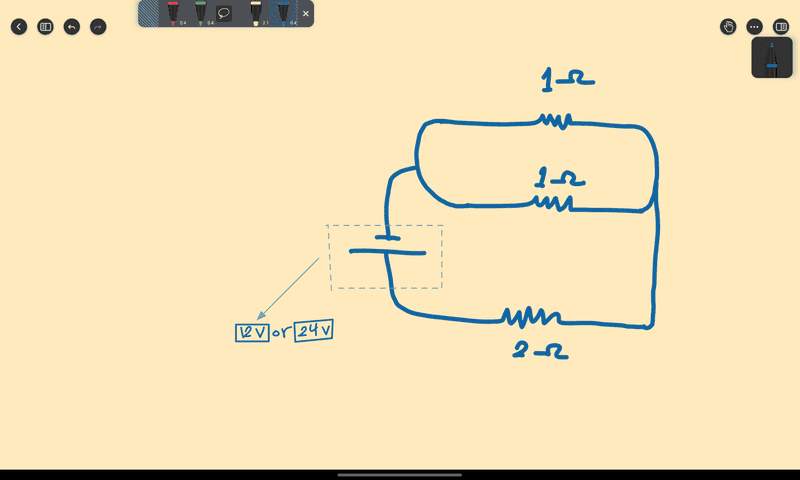
Screenshot_20231124-152037_Notein.png
 
Last edited:
Physics news on Phys.org
Maghraby said:
Homework Statement: Electrophysics
Relevant Equations: the source voltage

I want to know the difference between the two circuits below , and Why don't I bundle both batteries into one 24V battery?
pls help me in this ,,
View attachment 336082
Hello @Maghraby ,

:welcome:

Please read the PF guidelines : we need you to post your attempt at solution before we are allowed to help.

In the mean time you could redraw the circuits in such a way that it becomes clearer ...

##\ ##
 
BvU said:
Hello @Maghraby ,

:welcome:

Please read the PF guidelines : we need you to post your attempt at solution before we are allowed to help.

In the mean time you could redraw the circuits in such a way that it becomes clearer ...

##\ ##
done !
 
I agree with the 12 V.
So: is there a difference between the two circuits, or are they completely identical ?

##\ ##
 
BvU said:
I agree with the 12 V.
So: is there a difference between the two circuits, or are they completely identical ?

##\ ##
OK , there isn't difference ,but I want to know why 12 V and not 24 V ?
 
Maghraby said:
OK , there isn't difference ,but I want to know why 12 V and not 24 V ?
So, they are different (12 vs 24) but they are not different? Seriously?
 
phinds said:
So, they are different (12 vs 24) but they are not different? Seriously?
You misunderstood. I mean the difference between the two circuits in the first picture.When I merge the 2 batteries , Why will the battery after merging be divided into 12 volts and not 24 volts?
 
Imagine that you are an electron traveling around that circuit. When you get to the junction between the two batteries you have a choice about which battery you go through. This is fundamentally different than a circuit with one battery.

Can you show us a schematic with two 12V batteries that is equivalent to one 24V battery?
Can you show us a schematic with two 2Ω resistors that is equivalent to one 4Ω resistor?
Can you show us a schematic with two 2Ω resistors that is equivalent to one 1Ω resistor?
 
  • Like
Likes   Reactions: phinds and Maghraby
I claim there IS a difference between the two circuits. I redraw them first:

1700835680902.png
1700835708990.png
D and D' are both at 0 V thanks to the fact that both voltages are the same.
So effectively both voltage sources are in parallel, hence the 12 V and not 24 V.

That's no longer the case if one of the two voltages changes.
As an example you could recalculate the first circuit when the voltage on the right is 24 V.

##\ ##
 
  • #10
BvU said:
both voltage sources are in parallel
Nope. There's some resistors in the way.
 
  • Like
Likes   Reactions: BvU and phinds
  • #11
BvU said:
I claim there IS a difference between the two circuits. I redraw them first:

D and D' are both at 0 V thanks to the fact that both voltages are the same.
So effectively both voltage sources are in parallel, hence the 12 V and not 24 V.

That's no longer the case if one of the two voltages changes.
As an example you could recalculate the first circuit when the voltage on the right is 24 V.

BvU said:
I claim there IS a difference between the two circuits. I redraw them first:

D and D' are both at 0 V thanks to the fact that both voltages are the same.
So effectively both voltage sources are in parallel, hence the 12 V and not 24 V.

That's no longer the case if one of the two voltages changes.
As an example you could recalculate the first circuit when the voltage on the right is 24 V.

##\ ##
OK , thanks for your help !
 
  • #12
BvU said:
So effectively both voltage sources are in parallel, hence the 12 V and not 24 V.
I understand that you covered yourself by saying "effectively", but that is VERY misleading since they are NOT in parallel and telling a beginner that they are is not a good idea, Due to circuit symmetry, they ACT as though they were in parallel which, clearly, is what you meant by "effectively" but again ... it's misleading to a newbie to circuit analysis who likely doesn't understand serial vs parallel.

@Maghraby, I'd like to see you answer the questions in post #8.
 
  • Like
Likes   Reactions: BvU
  • #13
phinds said:
I understand that you covered yourself by saying "effectively", but that is VERY misleading since they are NOT in parallel and telling a beginner that they are is not a good idea, Due to circuit symmetry, they ACT as though they were in parallel which, clearly, is what you meant by "effectively" but again ... it's misleading to a newbie to circuit analysis who likely doesn't understand serial vs parallel.

@Maghraby, I'd like to see you answer the questions in post #8.
I barely understood the problem previously and I considered that the two batteries were connected in parallel as mentioned previously, so if you have any other clarification, please clarify. I am sorry if there is any spelling error. My primary language is Arabic and I try as much as possible to write in English.
 
  • #14
phinds said:
I understand that you covered yourself by saying "effectively", but that is VERY misleading since they are NOT in parallel and telling a beginner that they are is not a good idea, Due to circuit symmetry, they ACT as though they were in parallel which, clearly, is what you meant by "effectively" but again ... it's misleading to a newbie to circuit analysis who likely doesn't understand serial vs parallel.

@Maghraby, I'd like to see you answer the questions in post #8.
My answer for the question in post #8 is :

Yes, I can display a schematic with two resistors of 2 ohms, which is equivalent to 4 ohms by connecting them in series, and it can also be equal to 1 ohm by connecting them in parallel.
 
  • Like
Likes   Reactions: phinds
  • #15
Maghraby said:
I barely understood the problem previously and I considered that the two batteries were connected in parallel as mentioned previously, so if you have any other clarification, please clarify. I am sorry if there is any spelling error. My primary language is Arabic and I try as much as possible to write in English.
The voltage sources are NOT in parallel and BvU's having said that they were was a mistake, which he admits. They happen to ACT as though they were in parallel, in the sense of not doubling to 24V in a final circuit, but they are not actually in parallel. He did not mean to mislead you, but he did. If you do not understand this, then you need to review the basic definition of series and parallel until you understand WHY they are not in parallel.
 
  • #16
phinds said:
The voltage sources are NOT in parallel and BvU's having said that they were was a mistake, which he admits. They happen to ACT as though they were in parallel, in the sense of not doubling to 24V in a final circuit, but they are not actually in parallel. He did not mean to mislead you, but he did. If you do not understand this, then you need to review the basic definition of series and parallel until you understand WHY they are not in parallel.
Well, thanks for your help.
 
  • #17
Maghraby said:
What is the resulting value of a battery resulting from the merger?
I thought that the value would be 24 volts,
Nobody, except maybe @DaveE, seems to have addressed your key error, the belief that voltages in parallel add. They don't. Voltages in series add.
Equal voltages in parallel double the current, but the voltage is the same as for each individual battery.
Unequal voltages in parallel gets more complicated as you would have to consider internal resistance to avoid infinite currents.
 
  • Like
  • Informative
Likes   Reactions: Maghraby, berkeman and phinds

Similar threads

  • · Replies 3 ·
Replies
3
Views
2K
  • · Replies 30 ·
2
Replies
30
Views
3K
Replies
7
Views
1K
Replies
6
Views
3K
  • · Replies 4 ·
Replies
4
Views
2K
  • · Replies 7 ·
Replies
7
Views
6K
  • · Replies 27 ·
Replies
27
Views
3K
  • · Replies 6 ·
Replies
6
Views
3K
Replies
7
Views
3K
  • · Replies 2 ·
Replies
2
Views
2K