How are the x1 and x4 values determined in the solution to the matrix equation?

Click For Summary
SUMMARY

The discussion centers on the determination of the x1 and x4 values in the context of solving a matrix equation as presented in "Intro to Linear Algebra 4th" by Strang. The author clarifies that the first and last rows of the matrix provide solutions for x2 and x3, while the middle rows yield x1 and x4. This process involves treating the equations as a system of simultaneous equations, confirming that the solution is valid across all equations, contingent upon the invertibility of matrix C.

PREREQUISITES
  • Understanding of matrix equations and their solutions
  • Familiarity with linear algebra concepts, particularly systems of equations
  • Knowledge of matrix invertibility and its implications
  • Experience with solving simultaneous equations
NEXT STEPS
  • Study the concept of matrix invertibility in detail
  • Learn about solving systems of equations using Gaussian elimination
  • Explore the implications of linear combinations in linear algebra
  • Review the specific examples provided in "Intro to Linear Algebra 4th" by Strang
USEFUL FOR

Students and educators in mathematics, particularly those focusing on linear algebra, as well as anyone seeking to deepen their understanding of matrix equations and their solutions.

kostoglotov
Messages
231
Reaction score
6
Hi, rapid fire posting in this subforum I know, sorry if that's annoying. Let me know if I should space my posts out a bit more.

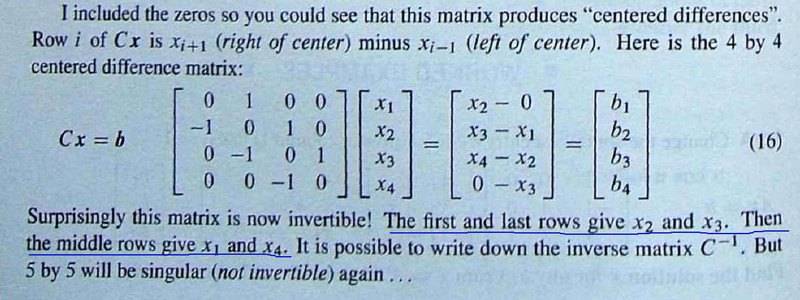
Here's an image of the solution to a worked example (from Intro to Linear Algebra 4th by Strang)
IG6r15H.jpg


here's the imgur link: http://i.imgur.com/IG6r15H.jpg

I cannot figure out what the underlined (underlining added by me) sentences mean:

"The first and last rows give x2 and x3. Then the middle rows give x1 and x4."

How do the middle rows only give x1 and x4? Is this the result of treating this as a system of simultaneous equations rather than linear combinations? That's the only explanation I can find at the moment. Mostly I don't know what the author's intended meaning is.

I could find all the x's by solving simultaneous equations, but would that be how the author has done it, or has Strang found the x's a different way?
 
Physics news on Phys.org
What the author describes IS the solving of the 'simultaneous' equations :
##x_2 = b_1 \\
x_3-x_1 = b_2\\
x_4 - x_2 = b_3\\
-x_3 = b_4 ##​

we humans don't do 'simultaneously: we see that this means that

first and last rows give x2 and x3 and THEN the middle rows give x1 and x4.​

Thereby Cx = b has been solved, and that can only be the case if C is invertible (x = C-1 b).
 
  • Like
Likes   Reactions: kostoglotov
Solving the system of simultaneous equations just means that the same solution should be valid for all equations.
 
  • Like
Likes   Reactions: kostoglotov

Similar threads

  • · Replies 4 ·
Replies
4
Views
3K
  • · Replies 7 ·
Replies
7
Views
3K
  • · Replies 1 ·
Replies
1
Views
4K
Replies
2
Views
2K
  • · Replies 2 ·
Replies
2
Views
2K
  • · Replies 44 ·
2
Replies
44
Views
5K
  • · Replies 2 ·
Replies
2
Views
9K
  • · Replies 7 ·
Replies
7
Views
1K
  • · Replies 34 ·
2
Replies
34
Views
3K
Replies
22
Views
6K