How can I determine the values of α and β for a canonical transformation?

  • Thread starter Thread starter Lambda96
  • Start date Start date
  • Tags Tags
    Transformations
Click For Summary
SUMMARY

This discussion focuses on determining the values of α and β for a canonical transformation in a system with one degree of freedom. The participants analyze the Jacobian transformation matrix J and its relation to the symplectic identity matrix I, emphasizing the requirement that JIJ^T = I. The calculations reveal that the values α = 1/2 and β = 1/2 satisfy the necessary conditions for the transformation to be canonical. The conversation also highlights common pitfalls in matrix notation and the importance of correctly interpreting the Poisson brackets.

PREREQUISITES
  • Understanding of canonical transformations in Hamiltonian mechanics
  • Familiarity with Jacobian matrices and their properties
  • Knowledge of symplectic geometry and symplectic matrices
  • Proficiency in LaTeX for mathematical notation
NEXT STEPS
  • Study the properties of symplectic matrices in Hamiltonian systems
  • Learn about Poisson brackets and their significance in phase space
  • Explore canonical transformations in multi-degree-of-freedom systems
  • Review matrix calculus and its applications in physics
USEFUL FOR

Students and researchers in theoretical physics, particularly those focusing on classical mechanics, Hamiltonian dynamics, and mathematical physics. This discussion is also beneficial for anyone looking to deepen their understanding of canonical transformations and symplectic geometry.

Lambda96
Messages
233
Reaction score
77
Homework Statement
See Screenshot
Relevant Equations
none
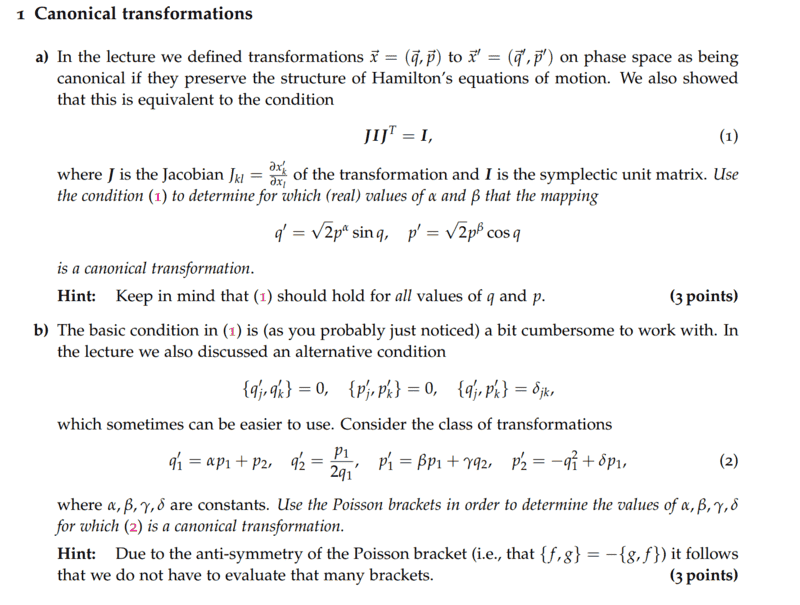
Hi,

unfortunately, I have problems with the following task
Bildschirmfoto 2023-01-21 um 17.53.00.png

I first tried to calculate ##JIJ^T##.

$$\left( \begin{array}{rrr}
\frac{\partial q'_i}{\partial q_j} & \frac{\partial q'_i}{\partial P_j} \\\frac{\partial P'_i}{\partial q_j} & \frac{\partial P'_i}{\partial P_j} \\
\end{array}\right)\left( \begin{array}{rrr}
0 & \textbf{1} \\\ -{\textbf{1}} & 0 \\
\end{array}\right)\left( \begin{array}{rrr}
\frac{\partial q'_i}{\partial q_j} & \frac{\partial P'_i}{\partial P_j} \\\frac{\partial P'_i}{\partial q_j} & \frac{\partial q'_i}{\partial P_j} \\
\end{array}\right)=\left( \begin{array}{rrr}
\frac{\partial q'_i}{\partial q_j} \textbf{1} \frac{\partial q'_i}{\partial P_j} -\frac{\partial q'_i}{\partial P_j} \textbf{1} \frac{\partial q'_i}{\partial q_j} & \frac{\partial q'_i}{\partial q_j} \textbf{1} \frac{\partial P_i}{\partial P_j} -\frac{\partial q'_i}{\partial P_j} \textbf{1} \frac{\partial P_i}{\partial q_j} \\
\frac{\partial P_i}{\partial q_j} \textbf{1} \frac{\partial q'_i}{\partial P_j} -\frac{\partial P_i}{\partial P_j} \textbf{1} \frac{\partial q'_i}{\partial q_j} & \frac{\partial P_i}{\partial q_j} \textbf{1} \frac{\partial P_i}{\partial P_j} -\frac{\partial P_i}{\partial P_j} \textbf{1} \frac{\partial P_i}{\partial q_j} \\
\end{array}\right)$$

##\textbf{1}## is supposed to be the unit matrix, but unfortunately I don't know how to write it with latex, which is why I have represented it in my calculation like this

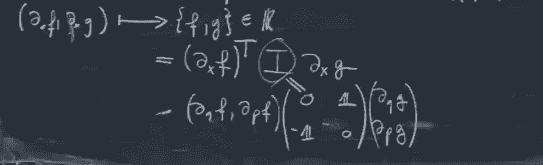
Then I took the following relation from my professor, I hope you can read it well.
Bildschirmfoto 2023-01-21 um 18.38.51.png

and get the following
$$\left( \begin{array}{rrr}
\Bigl\{ q'_i,q'_i \Bigr\} & \Bigl\{ q'_i,P_i \Bigr\} \\
\Bigl\{ P_i,q'_i \Bigr\} & \Bigl\{ P_i,P_i \Bigr\} \\
\end{array}\right)$$

Unfortunately, I am not getting anywhere now, because in order to show which values ##\alpha## and ##\beta## must assume in order for it to be a canonical transformation, I would have to get the symplectic unit matrix again, but with my calculation I would only get numbers as entries in the matrix and not unit matrices, as it should be.

My professor's script contains the following formulation

Bildschirmfoto 2023-01-21 um 18.58.05.png
 
Physics news on Phys.org
Hi @Lambda96. I’m no expert, but (since you haven’t any other replies and I may have seen where you are going wrong) here goes...

What you have written suggests that you are trying to apply a general format to construct equations for systems with 2 or more degrees of freedom. But the problem is simpler than that.

The given transformation equations (for ##p’## and ##q’##) show the system has only one degree of freedom (so the phase space is 2-dimensional).

That means ##\vec x## has only two components, ##x_1 = q## and ##x_2 = p##.

Similarly ##\vec x’## has only two components, ##x_1’= q’## and ##x_2’ = p’##.

The Jacobian tranformation matrix,##J##, is 2x2.

For example ##J_{11} = \frac {∂x_1’}{∂x_1} = \frac {∂q’}{∂q}##

Since ##q’ = \sqrt 2 p^α \sin q ## then ##J_{11} = \frac {∂q’}{∂q}= \sqrt 2 p^ α \cos q##

Similarly, you need to find ##J_{12}, J_{21}## and ##J_{22}##.

The corresponding symplectic identity matrix, ##I##, is also a 2x2 matrix (the elements are simple integers).

You are dealing only with 2x2 matrices (but still probably have some messy working ahead!). Multiply-out ##JIJ^T## and then find what values of ##\alpha## and ##\beta## are needed to make ##JIJ^T=I##.
 
  • Like
Likes PhDeezNutz and Lambda96
The matrix notation is a bit clumsy when it comes to concrete calculations in my opinion. It's nice for formal calculations. It just says that the "canonical Poisson brackets" should hold for the new phase-space coordinates, i.e., you have to find values for ##\alpha## and ##\beta## such that
$$\{x',x' \}=\{p',p'\}=0, \quad \{x',p'\}=1.$$
 
  • Like
Likes PhDeezNutz and Lambda96
Thanks for your help Steve4Physics, I had completely misunderstood the meaning of the matrix and its entries then, also thanks to vanhees71 for your help.

I have now done the calculation again:

$$\left( \begin{array}{rrr}
\frac{\partial q'}{\partial q} & \frac{\partial q'}{\partial p} \\
\frac{\partial p'}{\partial q} & \frac{\partial p'}{\partial p} \\
\end{array}\right)\left( \begin{array}{rrr}
0 & 1 \\
-1 & 0 \\
\end{array}\right)\left( \begin{array}{rrr}
\frac{\partial q'}{\partial q} & \frac{\partial p'}{\partial q} \\
\frac{\partial q'}{\partial p}& \frac{\partial p'}{\partial p} \\
\end{array}\right)$$

Inserting values then gives:

$$\left( \begin{array}{rrr}

\frac{\partial q'}{\partial q} & \frac{\partial q'}{\partial p} \\

\frac{\partial p'}{\partial q} & \frac{\partial p'}{\partial p} \\

\end{array}\right)\left( \begin{array}{rrr}

0 & 1 \\

-1 & 0 \\

\end{array}\right)\left( \begin{array}{rrr}

\frac{\partial q'}{\partial q} & \frac{\partial p'}{\partial q} \\

\frac{\partial q'}{\partial p}& \frac{\partial p'}{\partial p} \\

\end{array}\right)=\left( \begin{array}{rrr}

\sqrt{2}p^{\alpha}\cos(q) & -\sqrt{2}p^{\beta}\sin(q) \\

\sqrt{2} \alpha p^{\alpha-1}\sin(q) & \sqrt{2} \beta p^{\beta-1}\cos(q) \

\end{array}\right)
\left( \begin{array}{rrr}

\sqrt{2} \alpha p^{\alpha-1} \sin(q) & -\sqrt{2}p^{\beta} \sin(q) \\

-\sqrt{2}p^{\alpha} \cos(q) & \sqrt{2} \beta p^{\beta-1} \cos(q) \

\end{array}\right)$$$$=\left( \begin{array}{rrr}

2 \alpha p^{2\alpha-1} \cos(q) \sin(q) -2 \alpha p^{2\alpha -1} \cos(q) \sin(q) \ & 2 \beta p^{\alpha} \cos^2(1)p^{\beta -1} +2 \alpha p^{\beta} \sin^2(q)p^{\alpha -1} \\

2 \alpha p^{\beta} \cos^2(1)p^{\alpha -1} -2 \beta p^{\alpha} \sin^2(q)p^{\beta -1} & -2 \beta p^{2\beta-1} \cos(q) \sin(q) +2 \beta p^{2\beta -1} \cos(q) \sin(q) \

\end{array}\right)$$

Now the following holds:

$$a_{11}: 2 \alpha p^{2\alpha-1} \cos(q) \sin(q) -2 \alpha p^{2\alpha -1} \cos(q) \sin(q) =0$$
$$a_{12}: 2 \beta p^{\alpha} \cos^2(1)p^{\beta -1} +2 \alpha p^{\beta} \sin^2(q)p^{\alpha -1}=1$$
$$a_{21}: 2 \alpha p^{\beta} \cos^2(1)p^{\alpha -1} -2 \beta p^{\alpha} \sin^2(q)p^{\beta -1} =-1$$
$$a_{22}: -2 \beta p^{2\beta-1} \cos(q) \sin(q) +2 \beta p^{2\beta -1} \cos(q) \sin(q)=0$$

So now I just have to solve the 4 equations for ##\alpha## and ##\beta##.
 
  • Like
Likes Steve4Physics
Are all these equations independent from each other? Are all of them give any restrictions on ##\alpha## and ##\beta##? Finally note that the right-hand sides of the equations are independent of ##q## and ##p##. What does this imply for ##\alpha## and ##\beta##?
 
Lambda96 said:
So now I just have to solve the 4 equations for ##\alpha## and ##\beta##.
Well, only 2 equations really. On inspection, the values of ##a_{11}## and ##a_{22}## are necessarily both zero.

I haven't checked you working but you appear to have some typo's: ##a_{12}## and ##a_{21}## contain ##cos^2(1)## which doesn't look right.

More generally, if you think it would be useful, the video below provides a wonderful (IMHO) treatment of material relevant to your Post #1 question.

However, the video is 1h 18m long (excluding the YouTube ad’s). If you watch it, be prepared to regularly hit the ‘Skip ad’ button! And don’t be put-off by the quite-basic first 5 minutes.
 
Thanks Steve4Physics and vanhees71 for your help👍, thanks also for the videos 👍

@Steve4Physics I have now checked my calculation several times regarding ##a_{12}## and ##a_{21}## but I always get ##cos^2## and ##sin^2## or do you mean that the 1 in ##cos^2## and ##sin^2## is wrong? If so, that's right it should actually be ##cos^2(q)## and ##sin^2(q)##, I don't know how the 1 got in their :smile:
 
Lambda96 said:
If so, that's right it should actually be ##cos^2(q)## and ##sin^2(q)##, I don't know how the 1 got in their :smile:
Yes. You are given ##q’ = \sqrt 2 p^α \sin (q) ## and ##p’ = \sqrt 2 p^ β \cos (q) ##.

When you differentiate, you can only get expressions containing ##\cos (q)## and ##\sin (q) ##. Terms containing ##\sin (1) ## and/or ##\cos (1) ## can't arise. Looks like some sort of transcription error that turned ‘##q##’ into ‘##1##’.

If that’s the only mistake, I’d guess that you should have
##a_{12}: 2 \beta p^{\alpha} \cos^2(q)p^{\beta -1} +2 \alpha p^{\beta} \sin^2(q)p^{\alpha -1}=1##
##a_{21}: 2 \alpha p^{\beta} \cos^2(q)p^{\alpha -1} -2 \beta p^{\alpha} \sin^2(q)p^{\beta -1} =-1##

These can be simplified/combined in different ways. But I'll admit I don't see how to find ##\alpha## and ##\beta## from them.
 
Some hints: First of all there's only one non-trivial Poisson bracket here, which is ##a_{12}=-a_{21}## the other are ##0##, because ##\{Q,Q\}=\{P,P\}## for all phase-space functions ##Q(q,p)## and ##P(q,p)##.

Finally you need two equations to solve for ##\alpha## and ##\beta##. After simplifying your equations for ##a_{12}## a bit, you'll see that one equation follows from the demand that the right-hand side must not depend on ##p##. After solving for this, ##a_{12}=1## gives the 2nd equation.
 
  • Like
Likes Lambda96, Steve4Physics and vela
  • #10
Steve4Physics said:
But I'll admit I don't see how to find ##\alpha## and ##\beta## from them.
After eliminating the dependence on ##p##, rather than trying to solve for ##\alpha## or ##\beta## individually, think about what pair of values will work to get rid of the dependence on ##q##.
 
  • Like
Likes Lambda96, vanhees71 and Steve4Physics
  • #11
Lambda96 said:
$$\left( \begin{array}{rrr}
\frac{\partial q'}{\partial q} & \frac{\partial q'}{\partial p} \\
\frac{\partial p'}{\partial q} & \frac{\partial p'}{\partial p} \\
\end{array}\right)\left( \begin{array}{rrr}
0 & 1 \\
-1 & 0 \\
\end{array}\right)\left( \begin{array}{rrr}
\frac{\partial q'}{\partial q} & \frac{\partial p'}{\partial q} \\
\frac{\partial q'}{\partial p}& \frac{\partial p'}{\partial p} \\
\end{array}\right)$$
Instead of substituting the explicit expressions for ##q'## and ##p'## in terms of ##q## and ##p## at this point, I think it's much nicer to carry out the matrix multiplication above and show that it reduces to what your professor indicated:
$$\left( \begin{array}{rrr}
\{q', q'\} &\{q', p'\} \\
\{p', q'\} & \{p', p'\} \\
\end{array}\right)$$ It should be easy to see that two of the entries here are zero and the other two differ only in sign. Since the matrix is required to equal the matrix
$$\left( \begin{array}{rrr}
0 & 1 \\
-1 & 0 \\
\end{array}\right)$$ you end up with only one independent equation to be satisfied. This equation is your ##a_{12}## equation given below

Lambda96 said:
$$a_{12}: 2 \beta p^{\alpha} \cos^2(1)p^{\beta -1} +2 \alpha p^{\beta} \sin^2(q)p^{\alpha -1}=1$$
Your ##a_{21}## equation has a sign error. The ##a_{21}## equation should be equivalent to the ##a_{12}## equation.

So, you just need to find values of ##\alpha## and ##\beta## such that the ##a_{12}## equation is satisfied.
 
  • Like
Likes Lambda96 and vanhees71
  • #12
vela said:
After eliminating the dependence on ##p##, rather than trying to solve for ##\alpha## or ##\beta## individually, think about what pair of values will work to get rid of the dependence on ##q##.
Thanks. I realised how to do it after reading @vanhees71's Post #9.
 
  • #13
Thank you Steve4Physics, vanhees71, vela and TSny for your help👍 👍 👍👍

I have now started to rewrite ##a_{12}## as follows:

$$2p^{\alpha} \cos^2(q) \beta p^{\beta -1}+2 \alpha p^{\alpha -1} \sin^2(q) p^{\beta}$$

$$2 \cos^2(q) \beta p^{\beta +\alpha -1}+ 2 \alpha p^{\alpha +\beta -1} \sin^2(q)$$

After all, I want p to vanish or rather become 1, which is the case when ##\alpha + \beta -1=0## simultaneously, I also want the 2 to vanish and become a 1. I would achieve all this if ##\alpha= \frac{1}{2}## and ##\beta=\frac{1}{2}##.

Regarding task b, I still have a question, if I have now understood correctly, the system has two degrees of freedom, must the Poisson bracket then be calculated as follows?

$$\Bigl\{ q'_j, p'_k \Bigr\}=\sum\limits_{i=1}^{2}\frac{\partial q'_j}{\partial q_i}\frac{\partial p'_k}{\partial p_i}- \frac{\partial q'_j}{\partial p_i}\frac{\partial p'_k}{\partial q_i}=\frac{\partial q'_j}{\partial q_1}\frac{\partial p'_k}{\partial p_1}- \frac{\partial q'_j}{\partial p_1}\frac{\partial p'_k}{\partial q_1}+\frac{\partial q'_j}{\partial q_2}\frac{\partial p'_k}{\partial p_2}-\frac{\partial q'_j}{\partial p_2}\frac{\partial p'_k}{\partial q_2}$$

I have tried to determine ##\alpha, \beta, \delta, \gamma## by calculating the following

$$\Bigl\{ q'_1,p'_1 \Bigr\}=1$$
$$\Bigl\{ q'_2,p'_2 \Bigr\}=1$$
$$\Bigl\{ q'_1,q'_2 \Bigr\}=0$$
$$\Bigl\{ p'_1,p'_2 \Bigr\}=0$$

With this I found out that ##\gamma=1##, ##\alpha=0##, ##\beta=0## and ##\delta=0## but since I got so many zeros I don't know if I defined the Poisson brackets correctly?
 
  • #14
Lambda96 said:
Regarding task b, I still have a question, if I have now understood correctly, the system has two degrees of freedom, must the Poisson bracket then be calculated as follows?

$$\Bigl\{ q'_j, p'_k \Bigr\}=\sum\limits_{i=1}^{2}\frac{\partial q'_j}{\partial q_i}\frac{\partial p'_k}{\partial p_i}- \frac{\partial q'_j}{\partial p_i}\frac{\partial p'_k}{\partial q_i}=\frac{\partial q'_j}{\partial q_1}\frac{\partial p'_k}{\partial p_1}- \frac{\partial q'_j}{\partial p_1}\frac{\partial p'_k}{\partial q_1}+\frac{\partial q'_j}{\partial q_2}\frac{\partial p'_k}{\partial p_2}-\frac{\partial q'_j}{\partial p_2}\frac{\partial p'_k}{\partial q_2}$$
That looks ok to me.

Sorry, but I don't have the time to check your values for ##\alpha, \beta, \gamma## and ##\delta##.
 
  • #15
Lambda96 said:
Thank you Steve4Physics, vanhees71, vela and TSny for your help👍 👍 👍👍

I have now started to rewrite ##a_{12}## as follows:

$$2p^{\alpha} \cos^2(q) \beta p^{\beta -1}+2 \alpha p^{\alpha -1} \sin^2(q) p^{\beta}$$

$$2 \cos^2(q) \beta p^{\beta +\alpha -1}+ 2 \alpha p^{\alpha +\beta -1} \sin^2(q)$$

After all, I want p to vanish or rather become 1, which is the case when ##\alpha + \beta -1=0## simultaneously, I also want the 2 to vanish and become a 1. I would achieve all this if ##\alpha= \frac{1}{2}## and ##\beta=\frac{1}{2}##.
Looks good to me.

Lambda96 said:
Regarding task b, I still have a question, if I have now understood correctly, the system has two degrees of freedom, must the Poisson bracket then be calculated as follows?

$$\Bigl\{ q'_j, p'_k \Bigr\}=\sum\limits_{i=1}^{2}\frac{\partial q'_j}{\partial q_i}\frac{\partial p'_k}{\partial p_i}- \frac{\partial q'_j}{\partial p_i}\frac{\partial p'_k}{\partial q_i}=\frac{\partial q'_j}{\partial q_1}\frac{\partial p'_k}{\partial p_1}- \frac{\partial q'_j}{\partial p_1}\frac{\partial p'_k}{\partial q_1}+\frac{\partial q'_j}{\partial q_2}\frac{\partial p'_k}{\partial p_2}-\frac{\partial q'_j}{\partial p_2}\frac{\partial p'_k}{\partial q_2}$$

I have tried to determine ##\alpha, \beta, \delta, \gamma## by calculating the following

$$\Bigl\{ q'_1,p'_1 \Bigr\}=1$$
$$\Bigl\{ q'_2,p'_2 \Bigr\}=1$$
$$\Bigl\{ q'_1,q'_2 \Bigr\}=0$$
$$\Bigl\{ p'_1,p'_2 \Bigr\}=0$$
There are some more brackets that you need to evaluate, such as ##\Bigl\{ q'_1,p'_2 \Bigr\}##.

Lambda96 said:
With this I found out that ##\gamma=1##, ##\alpha=0##, ##\beta=0## and ##\delta=0## but since I got so many zeros I don't know if I defined the Poisson brackets correctly?
Check your result for ##\gamma##.
 
Last edited:
  • #16
Steve4Physics said:
That looks ok to me.

Sorry, but I don't have the time to check your values for ##\alpha, \beta, \gamma## and ##\delta##.
No problem, you have already helped me a lot with task 1 👍

Thank you TSny for your help 👍👍👍

I have checked my calculation for ##\gamma## again and unfortunately overlooked the minus sign, so the following applies ##\gamma=-1##

unfortunately I did not have so much time yesterday to add my complete calculation, my calculations are as follows

$$\Bigl\{ q'_1,p'_1 \Bigr\}=0 * \beta - \alpha * 0 + 0*0-1* \gamma=-\gamma \rightarrow \gamma=-1$$
$$\Bigl\{ q'_2,p'_2 \Bigr\}=-\frac{p_1}{2q_1^2} \delta + 1 + 0*0-0*0=-\frac{p_1}{2q_1^2} \delta + 1 \rightarrow \delta=0$$
$$\Bigl\{ q'_1,q'_2 \Bigr\}=-0 * \frac{p_1}{2q_1^2} + \alpha \frac{p_1}{2q_1^2} + 0*0-1*0=\alpha \frac{p_1}{2q_1^2} \rightarrow \alpha=0$$
$$\Bigl\{ p'_1,p'_2 \Bigr\}=0 * \delta + 2\beta q_1 + \gamma*0-0*0=2\beta q_1 \rightarrow \beta=0$$
$$\Bigl\{ q'_1,p'_2 \Bigr\}=0 * \delta +2 \alpha q_1 + 0*0-1*0=2 \alpha q_1 \rightarrow \alpha=0$$
 
  • #17
Lambda96 said:
No problem, you have already helped me a lot with task 1 👍

Thank you TSny for your help 👍👍👍

I have checked my calculation for ##\gamma## again and unfortunately overlooked the minus sign, so the following applies ##\gamma=-1##

unfortunately I did not have so much time yesterday to add my complete calculation, my calculations are as follows

$$\Bigl\{ q'_1,p'_1 \Bigr\}=0 * \beta - \alpha * 0 + 0*0-1* \gamma=-\gamma \rightarrow \gamma=-1$$
$$\Bigl\{ q'_2,p'_2 \Bigr\}=-\frac{p_1}{2q_1^2} \delta + 1 + 0*0-0*0=-\frac{p_1}{2q_1^2} \delta + 1 \rightarrow \delta=0$$
$$\Bigl\{ q'_1,q'_2 \Bigr\}=-0 * \frac{p_1}{2q_1^2} + \alpha \frac{p_1}{2q_1^2} + 0*0-1*0=\alpha \frac{p_1}{2q_1^2} \rightarrow \alpha=0$$
$$\Bigl\{ p'_1,p'_2 \Bigr\}=0 * \delta + 2\beta q_1 + \gamma*0-0*0=2\beta q_1 \rightarrow \beta=0$$
$$\Bigl\{ q'_1,p'_2 \Bigr\}=0 * \delta +2 \alpha q_1 + 0*0-1*0=2 \alpha q_1 \rightarrow \alpha=0$$
That all looks good.

What about ##\Bigl\{ q'_2,p'_1 \Bigr\}##?
 
  • #18
Thank you TSny, for your help and for looking over my calculations 👍👍👍

For ##\Bigl\{ q_2' , p_1' \Bigr\}## I have obtained the following:

$$\Bigl\{ q_2' , p_1' \Bigr\}=-\frac{p_1 \beta}{2q_1^2}-\frac{1}{2q_1}*0+0*0-0* \gamma=-\frac{p_1 \beta}{2q_1^2}=0 \rightarrow \beta=0$$
 
  • #19
Lambda96 said:
Thank you TSny, for your help and for looking over my calculations 👍👍👍

For ##\Bigl\{ q_2' , p_1' \Bigr\}## I have obtained the following:

$$\Bigl\{ q_2' , p_1' \Bigr\}=-\frac{p_1 \beta}{2q_1^2}-\frac{1}{2q_1}*0+0*0-0* \gamma=-\frac{p_1 \beta}{2q_1^2}=0 \rightarrow \beta=0$$
Yes. Nice work.
 
  • #20
Thanks for your help TSny and for looking over my calculation 👍👍👍
 

Similar threads

Replies
7
Views
6K
  • · Replies 3 ·
Replies
3
Views
2K
  • · Replies 4 ·
Replies
4
Views
2K
  • · Replies 9 ·
Replies
9
Views
2K
  • · Replies 2 ·
Replies
2
Views
585
  • · Replies 13 ·
Replies
13
Views
5K
  • · Replies 3 ·
Replies
3
Views
2K
  • · Replies 2 ·
Replies
2
Views
4K
  • · Replies 1 ·
Replies
1
Views
3K
  • · Replies 3 ·
Replies
3
Views
2K