How can I find the slope of a curve using the limit definition of a derivative?

  • Thread starter Thread starter grace77
  • Start date Start date
  • Tags Tags
    Curve Slope
Click For Summary

Homework Help Overview

The discussion revolves around finding the slope of the curve defined by the function F(x) = x² - 3x at the point P = (1, f(1)) using the limit definition of a derivative. Participants are exploring the relevant limit equation and the necessary calculations involved in applying it.

Discussion Character

  • Exploratory, Mathematical reasoning, Assumption checking

Approaches and Questions Raised

  • Participants are attempting to apply the limit definition of a derivative but express confusion regarding the calculations, particularly in evaluating f(1 + h) and the proper use of limit notation. Some participants question the accuracy of their expressions and seek clarification on notation.

Discussion Status

There is ongoing dialogue about the correct formulation of the limit and the calculations leading to the slope. Some participants have identified errors in their work and are receiving feedback, while others are seeking guidance on how to properly format mathematical expressions within the forum.

Contextual Notes

Participants have noted issues with consistency in their use of mathematical notation and are discussing how to properly represent limits in their posts. There is an emphasis on ensuring clarity in their calculations and expressions.

grace77
Messages
43
Reaction score
0
Problem statement
F(x)= x^2-3x
P=(1,f(1))

Revelant equation
Lim f(a+h)-f(a)/ (h) As h approaches 0

Attempt at a solution
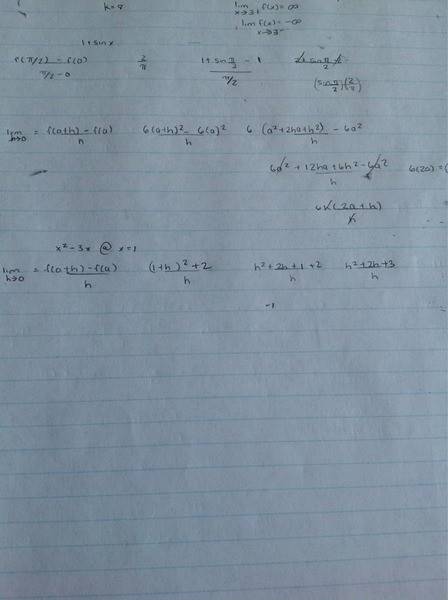
ImageUploadedByPhysics Forums1393450782.190789.jpg


Now this is where I get stuck.. Because usually you have a h that cancels out and then you have something in the form of (h+a) that can be used to determine the slope.. What do I do next??
 
Physics news on Phys.org
grace77 said:
Problem statement
F(x)= x^2-3x
P=(1,f(1))

Revelant equation
Lim f(a+h)-f(a)/ (h) As h approaches 0

Attempt at a solution View attachment 67057

Now this is where I get stuck.. Because usually you have a h that cancels out and then you have something in the form of (h+a) that can be used to determine the slope.. What do I do next??
What you got for f(1 + h) is wrong. f(1 + h) = (1 + h)2 - 3(1 + h).

Also, you don't seem to use "=" consistently in your work. You have
##lim_{h \to 0} = ##, following by the thing you're taking the limit of, which is incorrect. You also don't connect the expressions you're doing algebra on with an equal sign, nor do you include the "lim" notation. "lim" should go away only when you actually take the limit, not before.
 
grace77 said:
Problem statement
F(x)= x^2-3x
P=(1,f(1))

Revelant equation
Lim f(a+h)-f(a)/ (h) As h approaches 0

Attempt at a solution View attachment 67057

Now this is where I get stuck.. Because usually you have a h that cancels out and then you have something in the form of (h+a) that can be used to determine the slope.. What do I do next??

You have made a calculation error:

F(1 + h) - F(1) = (1 + h)^2 - 3(1 + h) + 2
and not (1 + h)^2 + 2 as you have.
 
pasmith said:
You have made a calculation error:
F(1 + h) - F(1) = (1 + h)^2 - 3(1 + h) + 2

and not (1 + h)^2 + 2 as you have.
I see my error now thank you!
 
Mark44 said:
What you got for f(1 + h) is wrong. f(1 + h) = (1 + h)2 - 3(1 + h).

Also, you don't seem to use "=" consistently in your work. You have
##lim_{h \to 0} = ##, following by the thing you're taking the limit of, which is incorrect. You also don't connect the expressions you're doing algebra on with an equal sign, nor do you include the "lim" notation. "lim" should go away only when you actually take the limit, not before.
Thank you for your comments. How do I do the lim notations on physics forum?
 
grace77 said:
Thank you for your comments. How do I do the lim notations on physics forum?

Code:
[tex]\lim_{h \to 0}[/tex]
produces
<br /> \lim_{h \to 0}<br />
 
pasmith said:
Code:
[tex]\lim_{h \to 0}[/tex]

produces

<br /> <br /> \lim_{h \to 0}<br /> <br />
Is there a guide where I can find all of these notations?
 
grace77 said:
Is there a guide where I can find all of these notations?

See here.
 
pasmith said:
See here.
Thank you. You have been a great help!
 

Similar threads

Replies
2
Views
2K
Replies
15
Views
2K
  • · Replies 20 ·
Replies
20
Views
3K
Replies
4
Views
1K
  • · Replies 11 ·
Replies
11
Views
2K
  • · Replies 8 ·
Replies
8
Views
2K
  • · Replies 4 ·
Replies
4
Views
2K
  • · Replies 53 ·
2
Replies
53
Views
7K
  • · Replies 4 ·
Replies
4
Views
2K
  • · Replies 7 ·
Replies
7
Views
2K