SUMMARY
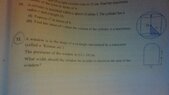
The discussion focuses on maximizing the area of a window using the equations for area \(A\) and perimeter \(P\). The relevant equations are \(A=\dfrac{1}{2}\pi r^2 + 2rh\) and \(P=2h+2r+\pi r=12+3\pi\). The solution involves expressing \(h\) in terms of \(r\) from the perimeter equation, substituting it into the area equation, differentiating the resulting equation with respect to \(r\), and solving for \(r\) to find the optimal dimensions for maximum area.
PREREQUISITES
- Understanding of calculus, specifically differentiation
- Familiarity with geometric concepts of area and perimeter
- Knowledge of algebraic manipulation and substitution
- Basic understanding of the properties of circles and rectangles
NEXT STEPS
- Practice solving optimization problems using calculus
- Learn about the application of derivatives in real-world scenarios
- Explore geometric properties of shapes and their equations
- Study the relationship between area and perimeter in different geometric figures
USEFUL FOR
Students studying calculus, mathematics educators, and anyone interested in optimization problems in geometry.