How can I optimize my DIY humidifier to improve its longevity and efficiency?

Click For Summary

Discussion Overview

The discussion revolves around optimizing a DIY humidifier design to enhance its longevity and efficiency. Participants explore various methods and modifications to improve humidity output while minimizing mineral buildup and operational challenges.

Discussion Character

  • Exploratory
  • Technical explanation
  • Debate/contested
  • Experimental/applied

Main Points Raised

  • One participant describes their DIY humidifier setup using an aquarium air pump, a sealed water container, and an airstone, seeking advice on bubble travel distance to maximize humidity output.
  • Some participants suggest warming the water to increase the mass of water that can dissolve in the air bubbles, which may enhance humidity levels before the air is released into the room.
  • Another participant notes that smaller bubbles can achieve a better equilibrium with surrounding water, potentially increasing humidity, but this may require a more powerful pump.
  • There is a suggestion to measure humidity levels before and after the pump to assess the effectiveness of the modifications made to the humidifier.
  • Concerns are raised about mineral buildup in the water, with ideas proposed for periodic water replacement or continuous water flow to mitigate this issue.
  • One participant mentions the possibility of air bubbles carrying minerals, comparing it to ultrasonic humidifiers, but expresses uncertainty about the implications for this DIY design.

Areas of Agreement / Disagreement

Participants generally agree on the importance of empirical testing to determine the effectiveness of various modifications. However, there are multiple competing views on the best methods to optimize the humidifier, and the discussion remains unresolved regarding the optimal design parameters.

Contextual Notes

Participants acknowledge the complexity of the system and the many variables involved, indicating that specific outcomes may depend on individual testing and adjustments.

Who May Find This Useful

Individuals interested in DIY projects, home humidity control, or those facing issues with commercial humidifiers may find this discussion beneficial.

Cheatcode
Messages
3
Reaction score
1
TL;DR
How far does a bubble need to rise in water to max out its humidity.
I am making my own humidifier, the store bought heat based humidifiers seem to all die very fast from how hard the water is where I live.
1637587585326.png

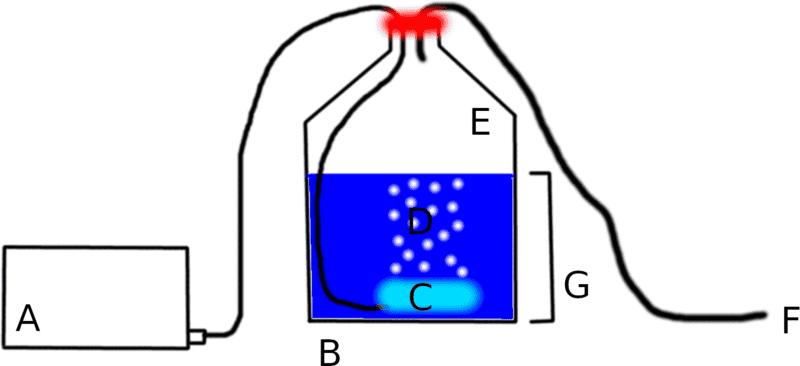
I am pumping air from an aquarium air pump (A) into a sealed gallon of water (B) through an airstone (C) so that bubbles (D) rise through water and hydrated air leaves the hose end (F).

The initial humidity level entering the airpump is approximately 30%, and it appears that the humidity is rising as something that is condensation-like is happening in the air above the water (E).

How much bubble-travel-distance (G) is required to maximize the humidity in the air released at the hose end (F).
What would a maximized humidity level using this method look like?

I can change out the reservoir for a long pipe, or even chain several containers in-line to increase the bubble travel distance (G) I just need to know how much height I really need.

Thanks in advance for any wisdom you share :) I'm open to better ideas for an almost heat-free hydration method.
 
Physics news on Phys.org
Welcome to PF.

Warm the water, so the air will also be warm, then a greater mass of water can dissolve in the air bubble. Keep the generated air warm, (so it does not condense), until after it is released into the room, when it will cool and release some water into the air in the room.
 
  • Like
Likes   Reactions: BillTre and Cheatcode
Baluncore said:
Welcome to PF.

Warm the water, so the air will also be warm, then a greater mass of water can dissolve in the air bubble. Keep the generated air warm, (so it does not condense), until after it is released into the room, when it will cool and release some water into the air in the room.
Okay! I can do that, I have a spare aquarium heater. Thanks for the welcome :)
 
Smaller bubbles will more rapidly approach an equilibrium with the water surrounding them.
This is probably the easiest way to increase humidity in the bubbles. It can be done with a good quality air stone. An air stone making smaller bubbles will have more resistance and require a more powerful pump, but so would a deeper tank to bubble in.
Smaller bubbles will also raise through the water column more slowly, thus haveing longer exposure to the water than a large bubble.

I have not heard of any rules of thumb about when bubbles going up become saturated, but bubble size will be a big variable.
On the other hand (going the other way), a rule of thumb about water splashing down over trickle media (blue stuff in the picture) will be come at equilibrium with dissolved gasses in the atmosphere after 5 feet of traveling. The water in this situation of water trickling would have greater thickness then real small bubbles.
This kind of thing will also humidify the air.

Screen Shot 2021-11-22 at 10.12.55 AM.png

If you can measure the humidity, you can get a better determination for yourself about what's going on. Measure the humidity before your pump (in the room around the pump) and after (under a container over where the bubbles are coming out of the water) to see how effective your actions are. There are too many variables to predict long distance.
 
Last edited:
  • Informative
  • Like
Likes   Reactions: Cheatcode and berkeman
Great information! Thank you so much!
 
  • Like
Likes   Reactions: berkeman
Let us know how this works out for you. I'm assuming you figure you can just swish out some of the water from time to time to get rid of most of the minerals? And/or just replace that container if needed? Though I'd think it could still have a lot of mineral build up, and still function just fine - the bubbles won't 'see' the build up, unlike the filter medium.

All the above advice is good, but it's hard to say where you hit the limits for your design. I think you'll need to do some empirical testing, and try some things to see which parameters it is sensitive to (weakest link in the chain approach). Or, if it gets the job done, just go with it (but what's the fun in that?).

Another way to minimize build up (the furnace whole-house humidifiers do this), is to add a tap on the container at the point you want the water level to be, and run that to a drain. Then add a constant trickle of water to the container. This will replenish the water that is evaporating, and also will keep diluting the mineral build up - it gets flushed away.

One more thing - I don't know if the air bubbles would actually be droplets that could carry minerals with them? If so, that could lead to mineral build at the exhaust (a fine powder). This happens with the ultrasonic type humidifiers - but I would think those droplets are much larger (mechanically broken up, more like a 'spray' of water, not evaporation?), so I think you will be fine there. Just something to watch for (and I think you could build a 'trap' if it were a problem).

You might also look at the systems to supply oxygen for people with limited lung function. These bubble the O2 through distilled water. They supply ~ 2L/minute of O2, and of course the humidity is concentrated, but you might learn something.

Good luck, and keep us informed of your progress.
 
  • Like
Likes   Reactions: BillTre

Similar threads

  • · Replies 42 ·
2
Replies
42
Views
22K
  • · Replies 1 ·
Replies
1
Views
4K
  • · Replies 11 ·
Replies
11
Views
7K
  • · Replies 6 ·
Replies
6
Views
5K
  • · Replies 3 ·
Replies
3
Views
9K