How Can I Solve Part C Using Buckingham Pi Theorem and Newton's Method?

Click For Summary

Discussion Overview

The discussion revolves around solving a specific part of a physics problem using the Buckingham Pi theorem and Newton's method. Participants are exploring dimensional analysis, mathematical modeling, and problem-solving techniques related to the question posed by the original poster.

Discussion Character

  • Homework-related
  • Mathematical reasoning
  • Technical explanation
  • Debate/contested

Main Points Raised

  • The original poster, Jay, is seeking help with part C of a problem, having completed parts A and B using dimensional analysis.
  • One participant suggests that Jay should rotate the images of the textbook to make them easier to read.
  • Another participant proposes finding an expression for ##10 K_Q## in terms of ##J##, suggesting a linear relationship to work with.
  • A participant points out a potential error in Jay's calculations regarding the density of seawater, noting that it should be approximately 1025 kg/m³ instead of 1000 kg/m³.
  • Jay expresses appreciation for the suggestion of using the straight line method, which he initially dismissed as too complex.
  • Jay reports that he has attempted to solve the equation but finds it nearly impossible, indicating that he has a close approximation for the answer.
  • One participant advises that for polynomials of degree 5 or higher, graphical methods or iteration, such as Newton's method, can be used to find solutions.

Areas of Agreement / Disagreement

Participants have not reached a consensus on the best approach to solve part C, and multiple viewpoints and suggestions remain in the discussion. There are also indications of potential errors in the original calculations, but no agreement on the implications of those errors.

Contextual Notes

There are unresolved assumptions regarding the accuracy of the density value used in calculations and the clarity of the images shared by Jay, which may affect the ability of participants to provide effective assistance.

Jaydude
Messages
3
Reaction score
0
Hi, this is my first post, so sorry if this is posted on wrong section etc.

Do not worry about the initial part of dimensional analysis, that was fine - use Buckingham pi therem, but here's the prob...

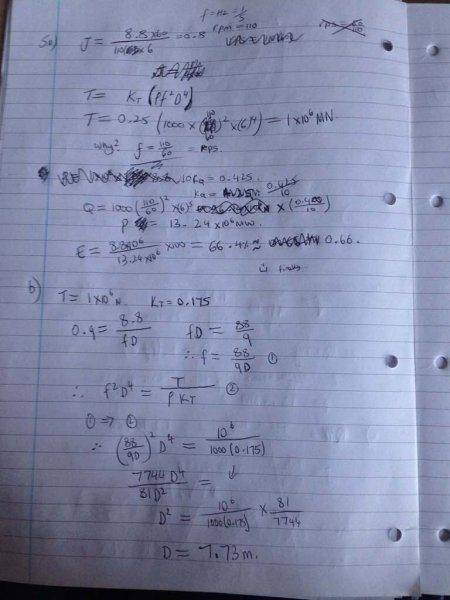
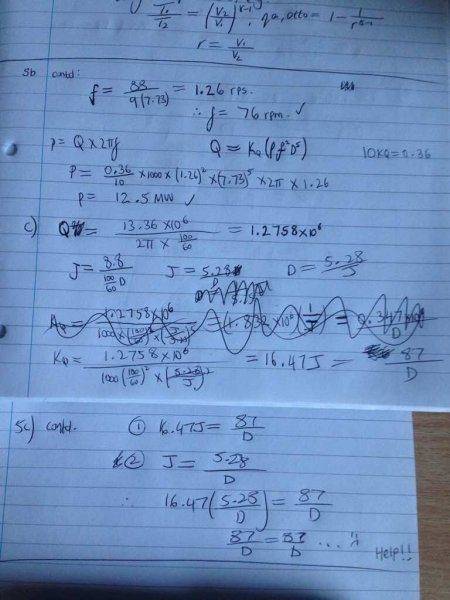
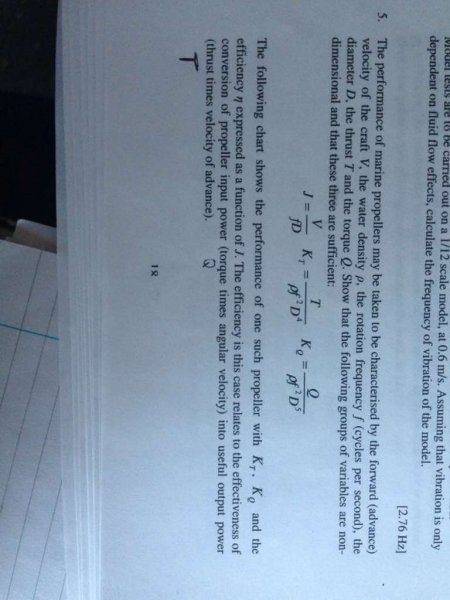
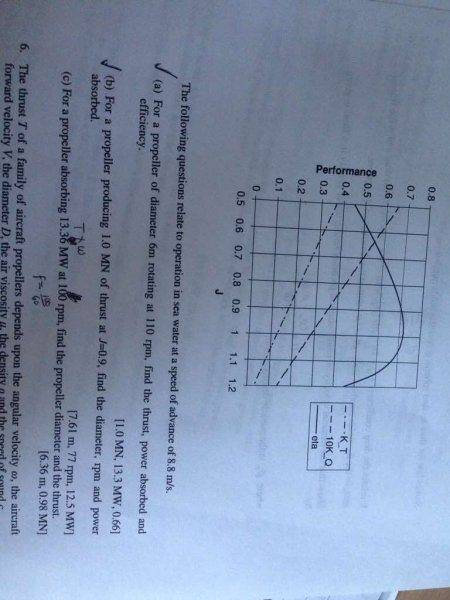
Below is the question, I am stuck on being part C, however to show you guys what needs to be done, I've shown my working for parts a and b, and what I attempted for part C:
ImageUploadedByPhysics Forums1418483739.896810.jpg

ImageUploadedByPhysics Forums1418483780.517634.jpg


My working:
ImageUploadedByPhysics Forums1418483839.231044.jpg

ImageUploadedByPhysics Forums1418483908.584099.jpg


Please help, I've been trying to work out q5 for hours, really need to move on! (Tutors do not provide solutions so you guys are my only hope)

Kind regards, Jay.
 
Physics news on Phys.org
I suggest you rotate the images of the textbook so people don't have to read them sideways - or explain how they can be rotated with tools on the forum.
 
So, my neck is now kind of stiff, but I have a suggestion: It should be fairly easy to find an expression for, for instance, ##10 K_Q## in terms of ##J## (what is the equation of a straight line etc.).

You'd then have something like:
$$
J = \frac{V}{f D}\\
10 K_Q = a J + b = \frac{10 Q}{\rho f^2 D^5}
$$to work with.
 
One problem I see is that you've done all your calculations assuming that ρ of seawater is 1000 kg/m3. It's actually about 1025 kg/m3.
 
I assumed my question got deleted due to a pm I got, only just found I got replies - thanks!

The straight line method seems like a good idea- something I dismissed thinking it was too much for this question, maybe not. I'll post further workings soon if I get stuck/solve it.
 
Jaydude said:
I assumed my question got deleted due to a pm I got, only just found I got replies - thanks!

The straight line method seems like a good idea- something I dismissed thinking it was too much for this question, maybe not. I'll post further workings soon if I get stuck/solve it.
If you post any more images with your work, take more care than you did the first time. As already noted, the images of the problem were posted sideways. Also, your work was pretty messy, with several sections scribbled over. If you want us to help, don't make us have to work too hard to do so.
 
I had another go, but the equation at the end is...near impossible to solve - pics below: (I'm being as neat, clear and concise as possible!)

ImageUploadedByPhysics Forums1419002847.757069.jpg


Answer is 6.36m, if I enter that into the equation I get at the end, it's a close enough value, so the equation I think is right, just how would I solve that?!
Any other methods that can be recommended?

Thanks and kind regards - Jay
 
For polynomials of degree 5 or higher, you either solve them graphically by plotting them, or you use iteration. Since it's a polynomial in one variable (namely D), you can use Newton's method to speed up convergence on a solution.

http://en.wikipedia.org/wiki/Newton's_method
 

Similar threads

  • · Replies 1 ·
Replies
1
Views
1K
  • · Replies 1 ·
Replies
1
Views
2K
  • · Replies 3 ·
Replies
3
Views
3K
  • · Replies 10 ·
Replies
10
Views
3K
Replies
11
Views
4K
Replies
1
Views
4K
Replies
6
Views
19K
  • · Replies 2 ·
Replies
2
Views
3K
  • · Replies 2 ·
Replies
2
Views
2K
Replies
20
Views
2K