How Can I Solve Question Type: "With Magnitude and Unit Vectors"?

Click For Summary
SUMMARY

This discussion focuses on understanding the question type "With Magnitude and Unit Vectors" in the context of physics, specifically regarding vector forces between charged spheres. The key takeaway is the application of Coulomb's Law, expressed as $$\vec{F} = k \frac{q_1 ~q_2 }{r^2}~ \hat{r}$$, which incorporates both magnitude and direction. Participants emphasized the importance of visualizing vectors on a Cartesian coordinate system to solve related problems effectively.

PREREQUISITES
  • Understanding of vectors and their properties, including magnitude and direction.
  • Familiarity with Cartesian coordinate systems.
  • Knowledge of Coulomb's Law and its mathematical expression.
  • Basic principles of electric forces between charged objects.
NEXT STEPS
  • Study the derivation and applications of Coulomb's Law in various scenarios.
  • Learn how to represent vector quantities graphically on Cartesian coordinates.
  • Explore the concept of unit vectors and their role in vector calculations.
  • Practice solving problems involving electric forces and vector addition.
USEFUL FOR

This discussion is beneficial for physics students, educators, and anyone seeking to deepen their understanding of vector forces in electrostatics.

denfaro
Messages
8
Reaction score
2
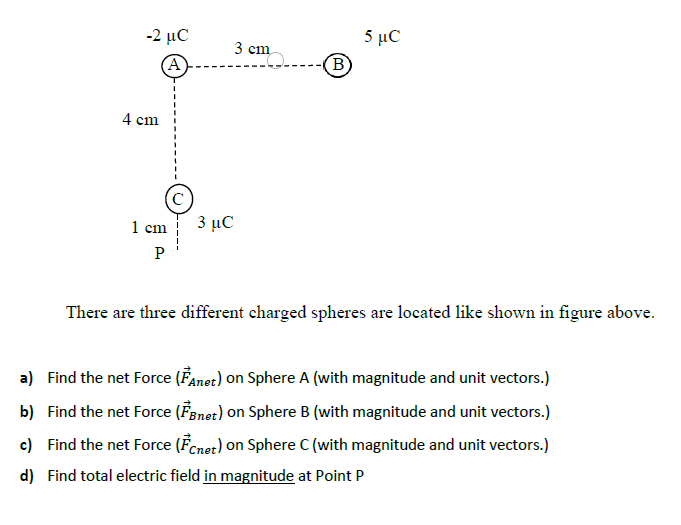
Hi I am a beginner in this topic. I didn't understand this question type clearly.What does it mean" With Magnitude and Unit Vectors" exactly? May you help me for the solution step by step :). Thanks in advance.
question.png
 
Physics news on Phys.org
denfaro said:
Hi I am a beginner in this topic. I didn't understand this question type clearly.What does it mean" With Magnitude and Unit Vectors" exactly? May you help me for the solution step by step :). Thanks in advance.
View attachment 260846
Welcome to the PF. :smile:

Your thread has been moved to the Schoolwork forums.

We cannot do your schoolwork/homework for you, but perhaps we can give you a few tips to help your understanding so that you can start working on the problem.

What have you done with vectors so far? You know that vectors have a magnitude and direction, right? And have you learned about coordinate systems like Caretesian coordinates, where there are x and y directions, etc.?
 
berkeman said:
Welcome to the PF. :smile:

Your thread has been moved to the Schoolwork forums.

We cannot do your schoolwork/homework for you, but perhaps we can give you a few tips to help your understanding so that you can start working on the problem.

What have you done with vectors so far? You know that vectors have a magnitude and direction, right? And have you learned about coordinate systems like Caretesian coordinates, where there are x and y directions, etc.?
Yes I learned the vectors,coordinate system but I don't know how can I use them on this question.
 
denfaro said:
Yes I learned the vectors,coordinate system but I don't know how can I use them on this question.
So start by drawing an x-y set of axes on the diagram. I would probably make the (0,0) point at the A charge, with the x-axis to the right and the y-axis pointing up.

Then write the general vector force equation for the force on one charge due the electric field from another charge (based on the amount of the charges and the separation distance).

Please do those things, and show us what you get. Thank you.
 
  • Like
  • Informative
Likes   Reactions: denfaro and Adesh
denfaro said:
Yes I learned the vectors,coordinate system but I don't know how can I use them on this question.
Do you know charged spheres will apply force on each other?
 
Adesh said:
Do you know charged spheres will apply force on each other?
Yes I know
 
denfaro said:
Yes I know
What’s the expression for that force? I mean is there any law which governs how two charged spheres will apply force on each other ?
 
Adesh said:
What’s the expression for that force? I mean is there any law which governs how two charged spheres will apply force on each other ?
I think you mean Coulmb's Law
 
denfaro said:
I think you mean Coulmb's Law
Yes. Can you please write out the Coulombs Law?
 
  • #10
Adesh said:
Yes. Can you please write out the Coulombs Law?
F=(k*(q1*q2))/r^2.
 
  • #11
denfaro said:
F=(k*(q1*q2))/r^2.
But force is a vector quantity, the expression which you have given doesn’t involve the direction of the force. Can you fix it? Can you do something so that we get a vector quantity in that expression of Coulombs Law?
 
  • #12
Adesh said:
But force is a vector quantity, the expression which you have given doesn’t involve the direction of the force. Can you fix it? Can you do something so that we get a vector quantity in that expression of Coulombs Law?
Sorry I don't. How can I do that?
 
  • #13
denfaro said:
Sorry I don't. How can I do that?
$$\vec{F} = k \frac{q_1 ~q_2 }{r^2}~ \hat{r}$$ the force acts on the line joining the two charges.
 
  • Like
  • Informative
Likes   Reactions: berkeman and denfaro
  • #14
Adesh said:
$$\vec{F} = k \frac{q_1 ~q_2 }{r^2}~ \hat{r}$$ the force acts on the line joining the two charges.
Thanks I have an idea now. :)
 
  • Like
Likes   Reactions: berkeman and Adesh
  • #15
And it's important to remember that the force between like charges is repulsive, and the force between opposite charges is attractive. That's where the direction for the force vector comes from. :smile:
 

Similar threads

Replies
26
Views
2K
Replies
13
Views
2K
  • · Replies 2 ·
Replies
2
Views
3K
  • · Replies 8 ·
Replies
8
Views
3K
  • · Replies 5 ·
Replies
5
Views
4K
  • · Replies 5 ·
Replies
5
Views
879
  • · Replies 3 ·
Replies
3
Views
1K
  • · Replies 3 ·
Replies
3
Views
2K
  • · Replies 3 ·
Replies
3
Views
1K
  • · Replies 2 ·
Replies
2
Views
793