MHB How can substitution make solving integrals easier?

Click For Summary
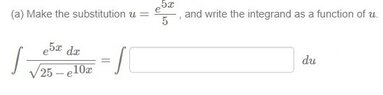
Substitution, particularly u-substitution, simplifies the process of solving integrals by transforming complex expressions into more manageable forms. By letting u equal a function of x, such as u = e^(5x)/5, the integral can be restructured to make integration easier. This method also involves calculating the differential du, which helps in converting dx to du, further simplifying the integral. Understanding how to choose the right substitution is crucial for effective problem-solving in calculus. Mastering u-substitution can significantly enhance one's ability to tackle integral problems.
TheFallen018
Messages
52
Reaction score
0
Hi, I've got this problem that I've been trying to work out. I think most of my problems come from the fact that I am not yet well versed in u substitution when it comes to integrals. I'm also not 100% sure what the problem is asking.

I've tried doing a couple of things, but they don't seem to be correct. I'm now at that point where everything I do confuses me more. If someone could help shed some light on the subject, I would be very grateful. Thanks.

View attachment 7944
 

Attachments

  • Screenshot_9.jpg
    Screenshot_9.jpg
    6.4 KB · Views: 133
Physics news on Phys.org
TheFallen018 said:
Hi, I've got this problem that I've been trying to work out. I think most of my problems come from the fact that I am not yet well versed in u substitution when it comes to integrals. I'm also not 100% sure what the problem is asking.

I've tried doing a couple of things, but they don't seem to be correct. I'm now at that point where everything I do confuses me more. If someone could help shed some light on the subject, I would be very grateful. Thanks.
A couple of things to get you started:

In the suggested substitution, if $u = \dfrac{e^{5x}}5$ then $u^2 = \dfrac{e^{10x}}{25}.$ That should help you with the denominator of the integrand.

If $u = \dfrac{e^{5x}}5$ then $\dfrac{du}{dx} = e^{5x}.$ That should help convert the $dx$ in the integral to something involving $du$.
 
There are probably loads of proofs of this online, but I do not want to cheat. Here is my attempt: Convexity says that $$f(\lambda a + (1-\lambda)b) \leq \lambda f(a) + (1-\lambda) f(b)$$ $$f(b + \lambda(a-b)) \leq f(b) + \lambda (f(a) - f(b))$$ We know from the intermediate value theorem that there exists a ##c \in (b,a)## such that $$\frac{f(a) - f(b)}{a-b} = f'(c).$$ Hence $$f(b + \lambda(a-b)) \leq f(b) + \lambda (a - b) f'(c))$$ $$\frac{f(b + \lambda(a-b)) - f(b)}{\lambda(a-b)}...

Similar threads

  • · Replies 6 ·
Replies
6
Views
2K
  • · Replies 6 ·
Replies
6
Views
3K
  • · Replies 21 ·
Replies
21
Views
4K
Replies
12
Views
3K
  • · Replies 5 ·
Replies
5
Views
2K
  • · Replies 5 ·
Replies
5
Views
2K
  • · Replies 4 ·
Replies
4
Views
2K
Replies
1
Views
2K
  • · Replies 4 ·
Replies
4
Views
1K
Replies
2
Views
2K