How can the Maclaurin series for sin^2(x) be simplified?

Click For Summary

Homework Help Overview

The discussion revolves around simplifying the Maclaurin series for sin²(x). Participants are exploring the implications of squaring the series for sin(x) and the resulting behavior of the series terms.

Discussion Character

  • Conceptual clarification, Mathematical reasoning, Problem interpretation

Approaches and Questions Raised

  • Participants question the assumption that squaring the series for sin(x) leads to a non-alternating series for sin²(x). There is a discussion about the validity of equating the square of a sum to the sum of squares. Some participants suggest exploring the half-angle property as a potential method for simplification, while others mention the Cauchy product as a more complex alternative.

Discussion Status

The discussion is active, with participants raising questions about the algebraic simplification of the series and the nature of the terms after squaring. There is acknowledgment of different methods that could be employed, but no consensus has been reached on a singular approach.

Contextual Notes

Participants are navigating the complexities of series manipulation and the implications of mathematical identities, with some expressing uncertainty about the best path forward for simplification.

John112
Messages
19
Reaction score
0
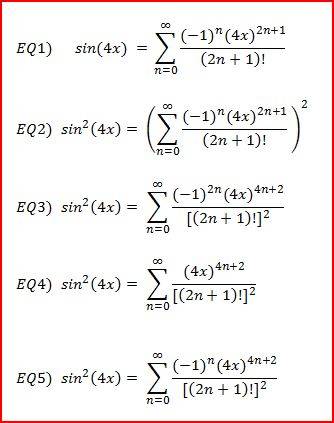
since the maclaurin series for sin x is alternating in sign (EQ1) so when you square it to get sin^{2}(x) (EQ2) the (-1)^{n} should become (-1)^{2n} (EQ3) which can be simplified down to (EQ4), but when i checked that series at wolframalpha the series was still alternating like: Why is that? So when we square it do we ignore squaring the (-1)^{n} and put that after we're done squaring the series?In the above post when I say EQ#, I'm referring to these equations
140jd7c.jpg
 
Last edited by a moderator:
Physics news on Phys.org
You seem to think that ##\left(\sum \alpha_n\right)^2 = \sum \alpha_n^2##. This is of course false. It's the same thing as saying that ##(x + y)^2 = x^2 + y^2##.
 
micromass said:
You seem to think that ##\left(\sum \alpha_n\right)^2 = \sum \alpha_n^2##. This is of course false. It's the same thing as saying that ##(x + y)^2 = x^2 + y^2##.
I can now see why sin^{2}(x) should be alternating, but how would I then simplify this algerbracially? how would I simplify ##\left(\sum \alpha_n\right)^2## ? Is using the half angle property for sin^{2}(x) my only method?
 
Last edited:
John112 said:
I can now see why sin^{2}(x) should be alternating, but how would I then simplify this algerbracially? how would I simplify ##\left(\sum \alpha_n\right)^2## ? Is using the half angle property for sin^{2}(x) my only method?
It's probably the easiest way to go.
 
John112 said:
I can now see why sin^{2}(x) should be alternating, but how would I then simplify this algerbracially? how would I simplify ##\left(\sum \alpha_n\right)^2## ? Is using the half angle property for sin^{2}(x) my only method?

The half-angle property is indeed the easiest way. But there also is a explicit way to multiply two series. This is called the Cauchy product: http://en.wikipedia.org/wiki/Cauchy_product So you can solve it with this too, but this is a lot more complicated.

Another way is to explicitely find the derivatives of ##\sin^2(x)## and see if you can find a pattern. But this is also not a very simple way to go.
 

Similar threads

  • · Replies 6 ·
Replies
6
Views
2K
  • · Replies 3 ·
Replies
3
Views
1K
  • · Replies 4 ·
Replies
4
Views
3K
  • · Replies 2 ·
Replies
2
Views
5K
  • · Replies 16 ·
Replies
16
Views
3K
  • · Replies 1 ·
Replies
1
Views
2K
  • · Replies 2 ·
Replies
2
Views
2K
  • · Replies 1 ·
Replies
1
Views
2K
Replies
3
Views
2K
  • · Replies 12 ·
Replies
12
Views
3K