How Can Two Different Resistances Dissipate the Same Power?

  • Thread starter Thread starter eniluap
  • Start date Start date
  • Tags Tags
    Resistors Thanks
Click For Summary

Homework Help Overview

The discussion revolves around a circuit problem involving resistors and power dissipation. The original poster is attempting to determine two possible values of a resistor given a specific power dissipation and voltage.

Discussion Character

  • Mixed

Approaches and Questions Raised

  • Participants explore different loop equations and question the setup of the circuit, particularly regarding the flow of current through the resistors. There are discussions about the correct formulation of equations and the use of the quadratic equation to find the unknowns.

Discussion Status

Some participants have provided alternative equations and suggestions for solving the problem, while others express confusion over the current flow and the setup of the equations. There is no explicit consensus on the correct approach yet, but the dialogue indicates a productive exploration of the problem.

Contextual Notes

Participants are working within the constraints of a homework assignment, which may limit the information available and the methods they can use. There is an emphasis on understanding the relationships between current, resistance, and power in the context of the circuit.

eniluap
Messages
3
Reaction score
0
Hi, I am having a bit of trouble solving for an unknown current. Can anyone help me out, thanks.


The resistor R in Fig18.56 dissipates 11 W of power. Determine 2 possible values of R (V= 76 V).
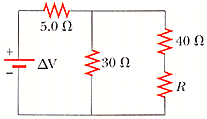
p18-56alt.gif


My attempt so far,

1st loop: 35I-35I1=76

2nd loop: I=[(70/30)+(R/30)]I1

I plugged equation (2) into (1): 81.667I1 +1.1667I1R-35I1
=76...(3)
Given that:
I1R =11W/I1

plug that into (3): 46.667I1 +12.8337/I1 -76=0

I've tried using quadratic equation to solve for I1, then plugging into P=I^2R to solve for R, but I still keep getting the wrong answer. Please help. Thank you.
 
Physics news on Phys.org
1st loop: 35I-35I1=76

Are you sure about that? Why do you think both currents flowing through 35 ohms resistance?
 
Is it 35I-30I1=76? plug (2 )into that then solve with IR. In the end, do I use the quadratic equation to solve for I1? thanks.
 
eniluap said:
Is it 35I-30I1=76?/
That looks better. :approve:

The rest of your first attempt was the right idea.
 
I attempted the problem again with the new 1st loop equation, however I am still getting the incorrect answer for I1 and R. Can someone help me solve the problem? Thanks.
 
yea, it's not 35I-30I1. I is supposed to be the current before the currents splits, right? I am guessing you got 35 by adding 30 and 5 together, but when does the current I ever go across the 30 ohm resistor? by the time it reaches the 30 ohm resistor, the current is different cause it split.

also, I am not sure how you got the equation for the second loop, neither I = I2 +I3... or V-RI-RI2-RI3... would result in that.
 
The OP was using I for the loop current in the first loop and I2 for the loop current in the second loop I think.

Using that notation my loop equations are

5 I + 30(I-I2) = 76
30(I-I2) = (40+R)I2

Eliminating I gives

1550 I2 = 2280 - 35 R I2

Power = R I2^2 = 11

So multiplying the equation by I2,

1550 I2^2 = 2280 I2 - 385

R = 6.76 or 20.36
 

Similar threads

  • · Replies 1 ·
Replies
1
Views
2K
Replies
22
Views
4K
  • · Replies 3 ·
Replies
3
Views
1K
  • · Replies 5 ·
Replies
5
Views
7K
Replies
5
Views
1K
Replies
9
Views
3K
Replies
4
Views
2K
  • · Replies 9 ·
Replies
9
Views
2K
  • · Replies 2 ·
Replies
2
Views
3K
  • · Replies 24 ·
Replies
24
Views
6K