Hello, issoder!
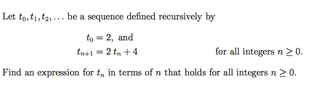
Let [tex]t_o,t_1,t_2,\cdots[/tex] be a sequence defined by:
. . [tex]t_0 \:=\:2[/tex]
. . [tex]t_{n+1} \:=\:2t_n+4[/tex]
Find an expression for [tex]t_n.[/tex]
[tex]\begin{array}{cccccc}\text{We are given:} & t_{n+1} &=& 2t_n + 4 & [1] \\ \text{Next term:} & t_{n+2} &=& 2t_{n+1} + 4 & [2] \end{array}[/tex]
[tex]\text{Subtract [2]-[1]: }\;t_{n+2} - t_{n+1} \;=\;2t_{n+1} - 2t_n[/tex]
. . . . . . . [tex]t_{n+2} - 3t_{n+1} + 2t_n \;=\;0[/tex]
Let [tex]X^n = t_n\!:\;\;X^{n+2} - 3X^{n+1} + 2X^n \;=\;0[/tex]
Divide by [tex]X^n\!:\;\;X^2 - 3X + 2 \;=\;0[/tex]
Then: .[tex](X-1)(X-2) \:=\:0 \quad\Rightarrow\quad X \:=\:1,2[/tex]
The function is: .[tex]f(n) \:=\: (1^n)A + (2^n)B[/tex]
We know the first two terms: [tex]t_0 = 2,\;t_1 = 8[/tex]
[tex]\begin{array}{cccccc}f(0) = 2: & A + B &=& 2 & [3] \\ f(1) = 8: & A + 2B &=& 8 & [4] \end{array}[/tex]
Subtract [4]-[3]: .[tex]B = 6 \quad\Rightarrow\quad A = -4[/tex]
Hence: .[tex]f(n) \;=\;-4(1^n) + 6(2^n)[/tex]
Therefore: .\[tex]t_n \;=\;f(n) \;=\;6\!\cdot\!2^n - 4[/tex]