Find the expression for Power in circuit

Click For Summary
SUMMARY

The discussion focuses on deriving the expression for power in a circuit with resistors in series. The equivalent resistance for two identical resistors is established as Req = 2R. Participants confirm that the power can be calculated using the formula P = I^2 * R, leading to the same results when expressed in terms of voltage and resistance. The equivalence of different power formulas, such as P = IR, is also highlighted, emphasizing that the calculations yield consistent outcomes regardless of the approach used.

PREREQUISITES
  • Understanding of Ohm's Law (V = IR)
  • Knowledge of power formulas in electrical circuits (P = IV, P = I^2R)
  • Familiarity with series circuits and equivalent resistance calculations
  • Basic concepts of voltage and current in electrical engineering
NEXT STEPS
  • Study the derivation of power formulas in electrical circuits
  • Learn about series and parallel resistor configurations
  • Explore the implications of Ohm's Law in circuit analysis
  • Investigate practical applications of power calculations in real-world circuits
USEFUL FOR

Electrical engineering students, circuit designers, and anyone interested in understanding power calculations in series circuits.

VitaminK
Messages
46
Reaction score
4
Homework Statement
Find the expression for Power in a Circuit with two light bulbs ( each with resistance R) in series. The terminal voltage is V.
Relevant Equations
Req= R1+ R2
P=V^2/R
I was wondering if someone could check my answer and see if it is correct.
The resistance in series is Req= R+ R= 2R
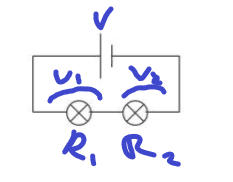
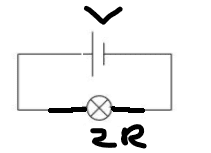
1583839565324.png
1583838844231.png


The voltage across 2R is the terminal voltage V. The expression I get is:
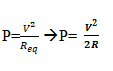
1583839080552.png

Can I also use this formula P=I^2*R?
When using it I get:
Current through the resistors is
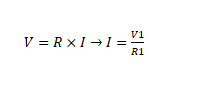
1583839926673.png

The resistance in series is Req= R+ R= 2R
The Power is:

1583840214428.png

However i don't get the same answer :(
 
Physics news on Phys.org
Actually, you do get the same answer. ## \frac{V1^2\times 2}{R} = \frac {V^2}{2R}##

But why do the second calculation for just one lamp?
If you do the same as your first calculation for both lamps, 2R, you get a simpler answer.
But it is exactly the same as the first result!

You could also use P=IR and again get the same result.
It's hardly surprising: all you know is V and R, so you can't do better than P in terms of V and R.
 
  • Like
Likes   Reactions: VitaminK

Similar threads

  • · Replies 10 ·
Replies
10
Views
1K
  • · Replies 1 ·
Replies
1
Views
2K
  • · Replies 2 ·
Replies
2
Views
2K
  • · Replies 1 ·
Replies
1
Views
2K
Replies
4
Views
2K
  • · Replies 24 ·
Replies
24
Views
6K
  • · Replies 9 ·
Replies
9
Views
2K
Replies
5
Views
2K
  • · Replies 3 ·
Replies
3
Views
2K
  • · Replies 3 ·
Replies
3
Views
2K