How Do Black Holes Acquire More Mass Than Other Objects?

Click For Summary

Discussion Overview

The discussion centers around the nature of black holes and their mass compared to other celestial objects, exploring concepts of gravity, light interaction, and the conditions under which black holes might "consume" stars. The scope includes theoretical and conceptual aspects of astrophysics.

Discussion Character

  • Debate/contested
  • Conceptual clarification

Main Points Raised

  • Some participants assert that black holes do not have greater mass than other objects, suggesting that their mass can be equivalent to that of stars.
  • Others propose that while black holes can have the same mass as stars, their gravitational pull is experienced differently due to their size, allowing one to get closer to them.
  • There is a discussion about the gravitational effects of black holes and stars, with some participants stating that at the same distance, their gravitational pull is identical.
  • Participants express confusion about how black holes can "attract" light, with some clarifying that black holes bend light similarly to stars but with a stronger effect due to their intense gravity.
  • One participant mentions the idea of black holes "eating" stars, prompting a response that emphasizes the need for credible sources and understanding before asking questions.

Areas of Agreement / Disagreement

Participants generally disagree on the nature of black holes' mass and their gravitational effects, with multiple competing views remaining unresolved throughout the discussion.

Contextual Notes

Some claims rely on assumptions about the nature of gravity and mass, and there are unresolved questions regarding the interaction of black holes with light and other celestial bodies.

Mohan Nivas
Messages
16
Reaction score
0
How the black hole acquire greater mass than any other objects in the universe...?
 
Physics news on Phys.org
They don't.
 
Are u saying they don't have mass...?
 
Mohan Nivas said:
Are u saying they don't have mass...?
That's ridiculous. He is saying they don't have greater mass than any other objects in the universe, as a direct answer to your question.

I'd be more likely to say that for a given size, they have more mass than anything else, but there are small black holes that have much less mass than some huge stars.

Again, I caution you against just asking random questions on an internet forum. Read some books and then ask questions if you don't undertstand. CLEARLY your level of understanding right now is such that asking random questions on an internet is NOT the best way for you to learn.
 
Mohan, a black hole might be no more massive than our sun (though this is not the natural progression of our sun). The key to a black hole's strong gravity is that, because of its size, you can get much closer to it than a normal object.

The gravitational force experienced near the sun (or any object) is a product of its mass and the square of the distance to its centre.

The sun is 400,000 miles in radius. The closest you can get to it is 400,000 miles from its centre. That is where you will experience the highest gravitational force: 28g's.

But if the sun were to turn into a black hole, it would shrink to being only 2 miles in radius. While its mass would not change at all, you could now get 399,998 miles closer to the centre of that mass. You would now experience a gravitational force that is (399,998/2)2 times larger.

Note that this would have NO effect on the planets of the solar system. They are still the same distance from the same mass. The sun's gravitational influence on the planets has not changed at all.
 
Last edited:
  • Like
Likes   Reactions: Mohan Nivas
DaveC426913 said:
Mohan, a black hole might be no more massive than our sun (though this is not the natural progression of our sun). The key to a black hole's strong gravity is that, because of its size, you can get much closer to it than a normal object.

The gravitational force experienced near the sun (or any object) is a product of its mass and the square of the distance to its centre.

The sun is 400,000 miles in radius. The closest you can get to it is 400,000 miles from its centre. That is where you will experience the highest gravitational force: 28g's.

But if the sun were to turn into a black hole, it would shrink to being only 2 miles in radius. While its mass would not change at all, you could now get 399,998 miles closer to the centre of that mass. You would now experience a gravitational force that is (399,998/2)2 times larger.

Note that this would have NO effect on the planets of the solar system. They are still the same distance from the same mass. The sun's gravitational influence on the planets has not changed at all.
Oh... So their mass is not much but have stronger gravitational pull than stars having same mass isn't it...?
 
Mohan Nivas said:
Oh... So their mass is not much but have stronger gravitational pull than stars having same mass isn't it...?
No, they have exactly the same gravitational pull as a star of the same mass. Re-read the answer you quoted.
 
Mohan Nivas said:
Oh... So their mass is not much but have stronger gravitational pull than stars having same mass isn't it...?
At the same distance, they have exactly the same pull. Mercury will not notice if the Sun suddenly collapses to form a BH.
But you could get closer to it (say, by diving into the sun's vicinity in a spaceship), which means you will experience a stronger force there.
 
wabbit said:
No, they have exactly the same gravitational pull as a star of the same mass. Re-read the answer you quoted.
Then how black hole attracts light while stars don't...?
Stars only can bend the light rays but black hole attracts the light..
I am getting confused can you clear it..?
 
  • #10
Mohan Nivas said:
Then how black hole attracts light while stars don't...?
Stars only can bend the light rays but black hole attracts the light..
I am getting confused can you clear it..?
Black holes do not "attract" light.
They bend light exactly the same way stars do. But because their gravity is so huge, light passing very close is bent directly toward the BH, so that it cannot escape.
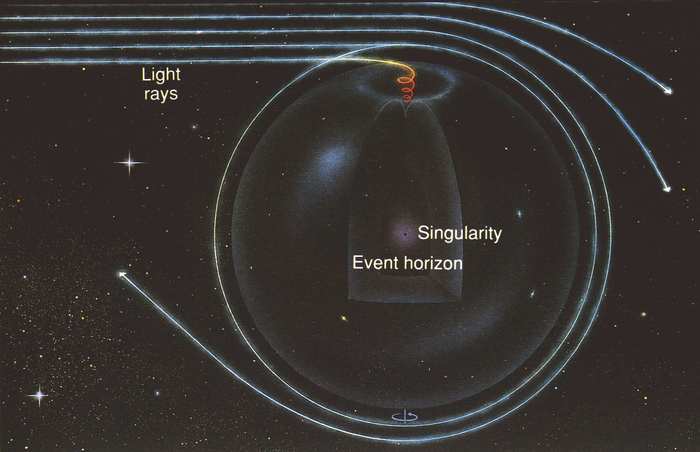
EventHorizon.jpg
 
  • Like
Likes   Reactions: Mohan Nivas
  • #11
DaveC426913 said:
Black holes do not "attract" light.
They bend light exactly the same way stars do. But because their gravity is so huge, light passing very close is bent directly toward the BH, so that it cannot escape.

EventHorizon.jpg
oh...
I had heard that they can eat stars how it happen...?
 
  • #12
Mohan Nivas said:
oh...
I had heard that they can eat stars how it happen...?

You will find the Physics Forums rules here;they include a section on acceptable sources, and "I had heard" is not one of them. Please find and study a decent textbook or other serious source. Then when you have specific questions based on that study come back and ask, and we can help you work through them; but throwing random questions into an internet forum is just a waste of everyone's time.

This thread is closed.
 

Similar threads

  • · Replies 31 ·
2
Replies
31
Views
2K
  • · Replies 8 ·
Replies
8
Views
2K
  • · Replies 8 ·
Replies
8
Views
1K
  • · Replies 14 ·
Replies
14
Views
2K
  • · Replies 40 ·
2
Replies
40
Views
4K
  • · Replies 67 ·
3
Replies
67
Views
6K
  • · Replies 9 ·
Replies
9
Views
1K
  • · Replies 51 ·
2
Replies
51
Views
2K
  • · Replies 5 ·
Replies
5
Views
2K
  • · Replies 4 ·
Replies
4
Views
2K