How do electromagnetic waves combine into a single wave?

  • Level: High School 
  • Thread starter Thread starter sameeralord
  • Start date Start date
  • Tags Tags
    Light Wave
Join the discussion
Registration is free. Start your own thread to ask a follow-up.
5 replies · 5K views · last reply
sameeralord
Messages
659
Reaction score
3
Hello,

Quick question. This is a light wave
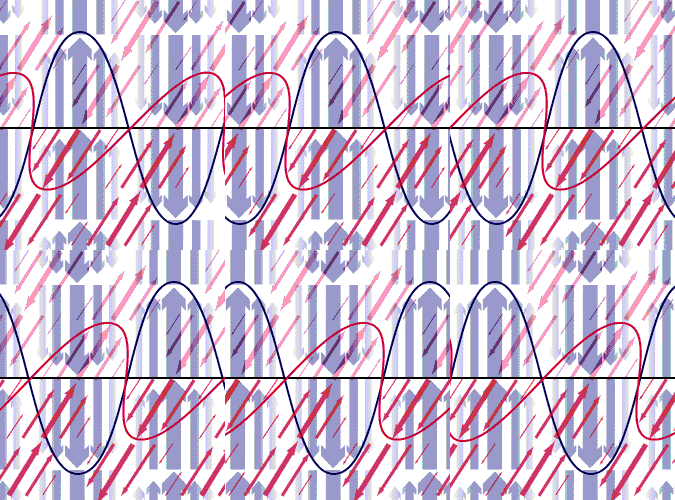
Diagram of an electromagnetic wave with a blue sinusoid and a red sinusoid, both drawn in one plane, with blue and red arrows in the background showing field directions at points along the wave.


This is another light wave

http://www.chem.yale.edu/~chem125/125/xray/DiffractionMasks/sinpositiont1.JPG

Why doesn't this graph have another perpendicular graph. Are they talking about the particles in the magnetic field or electric field here or both.

Simply how do they make one wave out of a light wave that has two waves.
 
Attachments
  • Diagram of an electromagnetic wave: a blue sinusoidal curve for the magnetic field and a red sinusoidal curve for the electric field, drawn perpendicular to each other, with arrows showing field directions across the grid.
    ems.gif
    82.2 KB · Views: 562
  • Diagram of a transverse electromagnetic wave: a navy sine curve and a red sine curve, with blue arrows showing the electric field and red arrows the magnetic field, both oscillating perpendicular to each other and to the direction of travel.
    ems.gif
    82.2 KB · Views: 434
  • Diagram of an electromagnetic wave: a blue sinusoidal curve and a red sinusoidal curve, perpendicular to each other, with arrows along the wave showing the electric and magnetic field directions at points along the wave.
    ems.gif
    82.2 KB · Views: 470
  • Diagram of a transverse electromagnetic wave: a blue sinusoidal curve and a red sinusoidal curve drawn at right angles, with blue arrows showing the magnetic field and red arrows showing the electric field along the propagation direction.
    ems.gif
    82.2 KB · Views: 411
Last edited by a moderator:
Physics news on Phys.org
sameeralord said:
Why doesn't this graph have another perpendicular graph. Are they talking about the particles in the magnetic field or electric field here or both.
While your first diagram seems like the usual depiction of an EM wave (which is what light is, classically), it's not clear what that second diagram is supposed to show. (It looks like it's meant to depict the force on some charged particle.)
Simply how do they make one wave out of a light wave that has two waves.
A light wave has both electric and magnetic fields, which are at right angles to each other. But that doesn't mean you always have to show both in a diagram.
 
Doc Al said:
While your first diagram seems like the usual depiction of an EM wave (which is what light is, classically), it's not clear what that second diagram is supposed to show.

A light wave has both electric and magnetic fields, which are at right angles to each other. But that doesn't mean you always have to show both in a diagram.

Thanks Doc Al! :smile: So most of the time I think they show the electric field. When light has a particular freuqency would both electric and magnetic waves travel at that frequency. I think they do because one is created from the other.
 
sameeralord said:
When light has a particular freuqency would both electric and magnetic waves travel at that frequency.
Yes.
 
Doc Al said:
Yes.

Thanks Doc Al :smile: Topic closed unless someone wants to start the topic if light is a wave or particle :smile:
 
sameeralord said:
Thanks Doc Al! :smile: So most of the time I think they show the electric field. When light has a particular freuqency would both electric and magnetic waves travel at that frequency. I think they do because one is created from the other.

Wrong. Electric and Magnetic fields in EM waves DO NOT "create each other". Sorry Wikipedia is wrong on that. (and they won't correct it, because they are determined to keep it wrong) Electric and Magnetic fields of waves are both created by the source of the waves (moving charges) not each other.